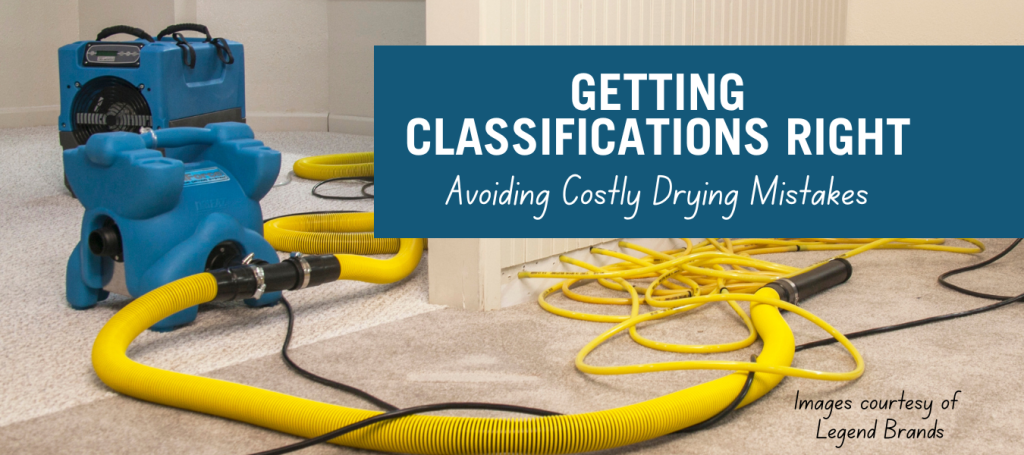
Effective restoration relies not only on the right equipment but also correctly classifying the job. Consider a large-scale water intrusion from a pipe burst. The restoration contractor classifies it as a Class 2 loss and begins work. Days later, progress is slow, and both the client and contractor are frustrated. Upon reassessment, it turns out the project was actually a Class 4 job. The conclusion: Drying progress lagged because it was misclassified, and thus the project was “shorted” 20% of the LGR dehumidification required.
This kind of misclassification happens often, and it can significantly impact drying efficiency and client satisfaction. From numerous restoration class surveys, it’s clear that restorers most often classify jobs as Class 2 – yet conditions on most projects support classifying them as Class 4, according to the classification system that is and has been in the S500 Standard for water damage restoration, by the Institute of Inspection Cleaning and Restoration Certification (IICRC).
Understanding Current IICRC Classifications
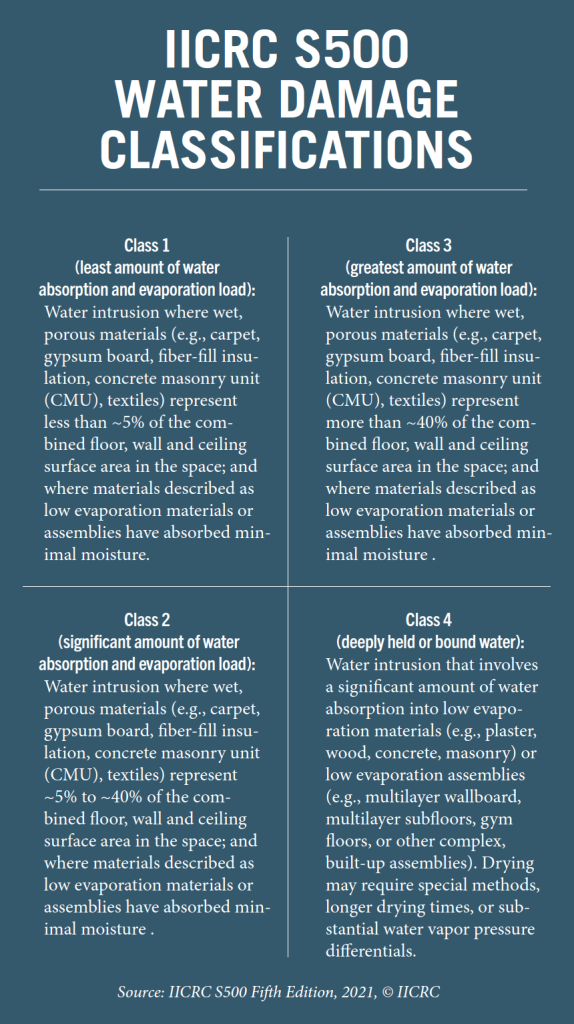
The ANSI/IICRC S500 (5th Edition, 2021) Standard for Professional Water Damage Restoration classifies water losses by expected “evaporation load” and depth of building materials’ absorption into four classes of water intrusion (“Class of Loss”):
- Class 1 involves minimal water absorption and evaporation, with less than 5% of porous materials affected.
- Class 2 refers to significant water absorption, with 5 – 40% of porous materials affected.
- Class 3 represents the highest level of water absorption in porous materials, with more than 40% of the area affected.
In the definitions of each of the first three classes, the IICRC S500 also includes this phrase:
“…where materials described as low evaporation materials or assemblies have absorbed minimal moisture”
The above classes are appropriate when restoration has begun immediately after flooding, and as a result, low evaporation materials have not had the exposure time to deeply absorb moisture. Such projects (however rare) should be dropped into Class 1, 2, or 3 according to the percentage of wet porous materials in the drying chamber.
To highlight the S500 Class 4 definition, here it is verbatim:
Class 4 — (deeply held or bound water): water intrusion that involves a significant amount of water absorption into low evaporation materials (e.g., plaster, wood, concrete, masonry) or low evaporation assemblies (e.g., multilayer wallboard, multilayer subfloors, gym floors, or other complex, built-up assemblies). Drying may require special methods, longer drying times, or substantial water vapor pressure differentials.
Historically, the IICRC S500 definition of Class 4 always included specialty drying, such as wood floor drying, injection drying, etc. However, when the 2015 edition of the S500 was released, Classes 1,2, and 3 were to be determined by very different criteria, compared to previous editions. And the 2015 edition explicitly expanded Class 4 to include many or most everyday restoration projects.
In addition to Class criteria changes, the 2015 S500 Class 4 “factors” (numbers used in dehumidification formulas) were increased to equal the factors for Class 3, so from then on, Class 4 jobs would also be prescribed the greatest amount of starting dehumidification.
Many contractors have not yet adopted these changes and thus continue misclassifying most of their jobs as Class 2 or even Class 1, leading to inadequate amounts of dehumidification.
Class 4 includes low evaporation materials with a “significant amount of water absorption,” which means deep absorption, in contrast to the minimal absorption described in Classes 1,2, and 3. That implies more days and hours of the most aggressive drying are needed to dry not only the abnormal moisture at or near the surface, but also to correct abnormal moisture deep within dense materials.
 Classifying and Restoring to the Current Class 4 Guidelines
To properly classify drying projects as Class 4, restoration professionals should look for any these indicators:
- Ordinary Low Evaporation Materials: Plaster, lumber, engineered wood products, concrete, masonry bricks, foundation materials, wet exposed soil or other dense materials that have deeply absorbed water.
- Multiple Layers: Assemblies being dried such as multilayer wallboard, double-layer subfloors, wood flooring assemblies, wood gymnasium floors, etc.
- Specialty Drying in Use: Deeply held or trapped moisture in cavities or multiple layer assemblies requiring specialized equipment or special methods (see below) to place warm dry air directly in touch with materials beneath, behind, or above the visible finishing layers.
Class 4 Specialty Drying Equipment and Techniques
For multiple layer assembly drying, the warm dry air of the general drying system must be forced past the outer layer to directly contact the inner layer of material and even structural materials beyond the inner layer. Therefore, specialty equipment is utilized, specifically:
1. Injection Drying of Multi-Layer Assemblies
Forcing pressurized warm, dry air past multiple finishing layers (i.e., of gypsum wallboard or plaster and lath) through ceiling, walls, and other voids, using specialized equipment is called “injection.” There are 2 major types:
- High pressure air injection system (“inter-air drying system”) with slender tubes and ¼” diameter injectors, such as the Dri-Eaz® DriForce Air Drying System.
- Low pressure, high volume air injection system which typically consists of an airmover with a snout attachment and larger diameter tubes or hoses, with or without larger diameter injectors.
2. Wood Floor Drying
Use of a mat-type negatively pressurized wood floor drying system, such as the Dri-Eaz DriForce® Rescue Mat System.
Special Drying Methods
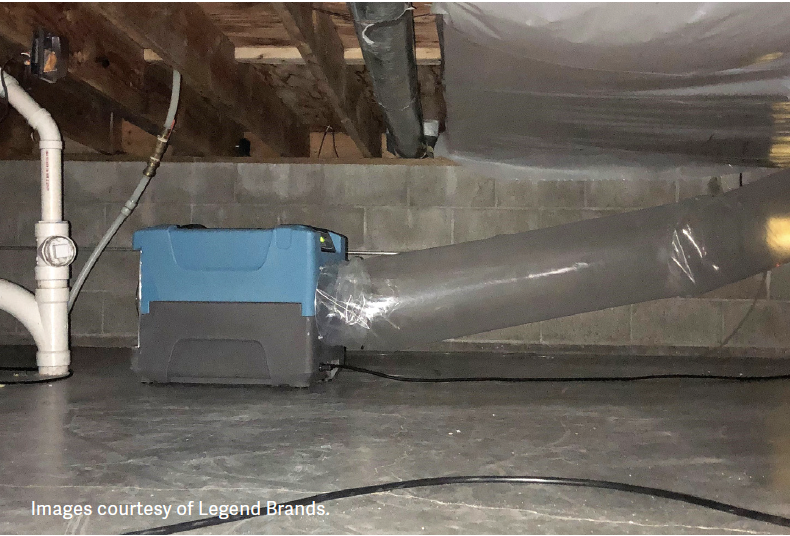 A dedicated low grain refrigerant (LGR) or desiccant dehumidifier or specialized heater delivers warm dry air into a contained part of building materials/assemblies through ducting to create very aggressive drying conditions. This method, typically constructed with sheet plastic, specifically targets deeply absorbed moisture in low evaporation materials and assemblies, often described as: Tenting, Mini Containment, Making a containment close to the surface, Concentrated drying system, Plenum drying system, and Chambering.
All projects using specialized equipment and methods are Class 4, since these operations are done to counteract deeply held moisture in dense, semi-porous materials and assemblies. Using these methods on targeted areas is the most efficient way to make “substantial water vapor pressure differentials” between the wet materials/assemblies and the air that contacts them – which requires using the recommended Class 4 levels of dehumidification.

Case Study in Classification
A 1,000 square foot area drying down double-layer wallboard, plaster surfaces, and deeply wet wood subfloors, using LGR dehumidification
Why Proper Classification Matters
1. Optimized Equipment Usage
The IICRC S500 offers calculations for how much dehumidification capacity is recommended for the job. For example, an 8,000 cubic foot drying chamber classified as Class 2 would require 160 pints per day (ppd) of dehumidification. However, proper Class 4 increases this to 200 ppd, ensuring the most aggressive drying. (See table.)
Class 4 also requires the highest performing dehumidification technologies, which are low grain refrigerant (LGR) and desiccant models. Conventional/standard dehumidifiers are not adequately aggressive, which is why the Conventional Refrigerant row in the S500 “Factor Chart” shows “N/A” for Class 4. All Class 4 projects should be dried with either LGR or desiccant dehumidification to establish and maintain a very low vapor pressure drying environment.
2. Improved Drying Efficiency
Accurate classification will yield efficiency in all scenarios. The problem comes when jobs are misclassified – i.e., when the conditions of the project fit the definition of Class 4, and a restorer classifies it as a Class 2 or Class 1. That results in substantially less dehumidification than is actually needed, and drying progress lags, resulting in more days to dry and making the contractor seem less efficient than competitors.
According to IICRC definitions, a majority of everyday water restoration projects are Class 4, including a project that does not call for any specialty drying or special drying methods but has deeply absorbed plywood . Class 4 is the only class of loss appropriate for deeply absorbed, low evaporation materials (e.g., plaster, wood, concrete, masonry) and low evaporation assemblies.
3. Enhanced Revenue
When a project is determined to be Class 4 for any reason (deeply wet ordinary structural materials, specialized equipment or methods used, etc.), the starting dehumidification calculation will require the highest level of dehumidification, using the most effective drying technologies (LGR and desiccant). On certain jobs this can increase invoice totals and, ultimately, revenue for restoration contractors. When done accurately and professionally, clients will benefit from better outcomes while businesses achieve higher profitability.
The Path Forward
The IICRC S500 provides a loss classification framework that benefits both contractors and clients when used correctly. Given the common misclassification of Class 4 losses, restoration professionals can benefit by refining their practices to align with the current S500 Standard’s plainly stated definitions. If a party connected to the project disagrees with the classification of Class 4, and argues that it should be a Class 1 or Class 2, make sure to focus the debate on the clear language in the IICRC S500’s definitions of classes.
Proper classification is not just about compliance but about delivering the best results, most effectively restoring property owners’ investments, and positioning your business as a trusted expert and efficient drying contractor. Equip your team with the knowledge and tools needed to correctly identify Class 4 losses and ensure better outcomes for every project.
Source: ANSI/IICRC S500 (5th Edition, 2021) Standard for Professional Water Damage Restoration, © 2021 of Inspection Cleaning and Restoration Certification
Brendan Kimmel
 Brendan Kimmel managed a full-service cleaning and disaster restoration firm for over six years in the greater Seattle area before becoming a Restoration Sciences Academy instructor with Legend Brands in 2008. He is an IICRC Certified “Triple Master,” an IICRC approved Water Restoration and Cleaning Instructor, and a Water Loss Specialist with the RIA.
Related Posts