The relative quiet in catastrophic weather losses during the first half of 2025 is deceptive. While year-to-date claims are down, global climate patterns and ocean conditions are aligning for what could be a volatile second half of the year. This is not just a meteorological story – it’s a business risk story for insurers, reinsurers, and coastal communities alike.
Two interconnected drivers – the likely transition of the El Niño–Southern Oscillation (ENSO) toward La Niña and record-warm Atlantic sea surface temperatures – are creating a high-confidence forecast for an above-average Atlantic hurricane season. When paired with shrinking insurance availability, rising rebuilding costs, and shifting policyholder behavior, the risks go far beyond storm counts.
ENSO: From Neutral Toward La Niña
As of July 2025, ENSO remains in a neutral state, with Pacific sea surface temperatures near long-term averages. Forecasts from NOAA’s Climate Prediction Center and other global agencies point toward La Niña developing in late fall or winter. La Niña reduces vertical wind shear over the Atlantic-a critical change because strong shear can tear storms apart before they intensify. In La Niña years, that atmospheric brake is released, creating conditions far more favorable for tropical cyclones to form and strengthen. While the timing of this transition will influence its impact, even the possibility of La Niña during peak season raises risk levels.
Record-Warm Atlantic Waters
The Atlantic’s Main Development Region (MDR)-the zone where most major hurricanes are born-has been running persistently hot. Sea surface temperatures remain among the top five warmest on record for late July, more like a typical mid-August. Waters at or above 26.5°C (80°F) are the primary energy source for hurricanes, and this year’s deep heat content increases the likelihood of rapid intensification, when a storm’s winds jump by at least 35 mph in 24 hours, leaving little time for preparation.
Hurricane Season Outlook: Above Average Threat
Major forecasting agencies are aligned on an average to above-average 2025 season:
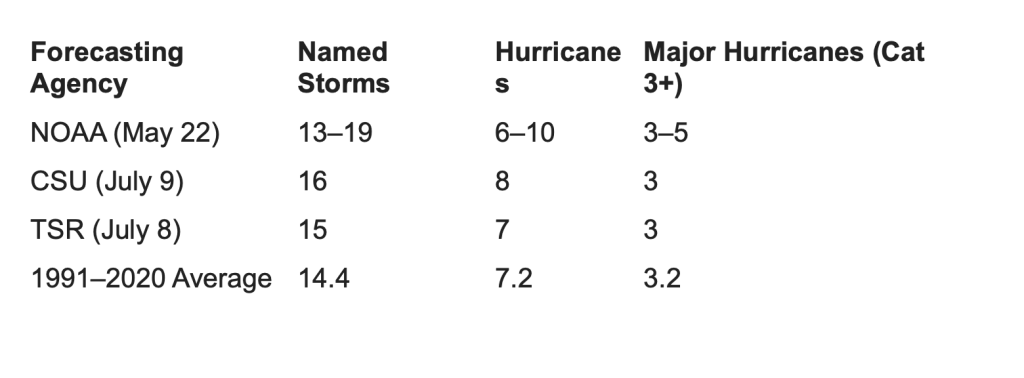
An above-normal forecast directly translates to a higher probability of one or more damaging U.S. landfalls-though location and timing remain unpredictable.
Claims Volume Dynamics: January–July 2024 vs. 2025
While the meteorological setup is concerning for the months ahead, the first seven months of 2025 have been shaped by a different reality: fewer large-scale, high-cost events compared to the hyperactive 2024 season.
A direct comparison of internal claims data reveals a 9.1% overall decrease in claim filings year-over-year. But the monthly data shows a more complex story:
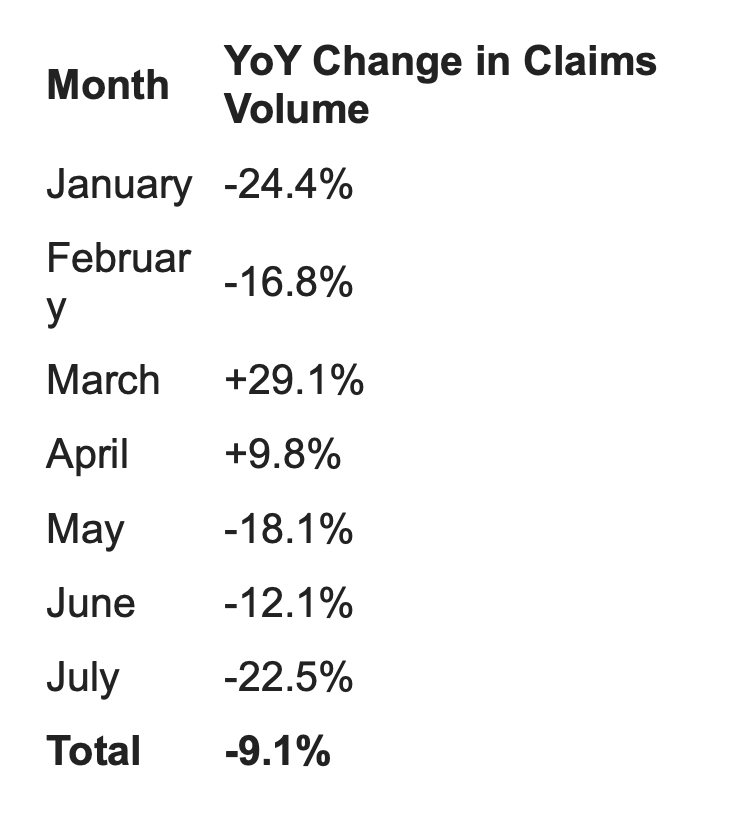
Most months in 2025 have seen double-digit drops in claims volume versus 2024, largely due to the absence of multi-state disasters like landfalling hurricanes. But March and April bucked the trend-posting year-over-year increases of 29.1% and 9.8%, driven by a highly active severe convective storm (SCS) season. This included a rare “high risk” tornado outlook from the Storm Prediction Center on March 15, 2025.
These spikes demonstrate that even in a year with fewer hurricanes, the portfolio remains highly sensitive to localized but intense perils like tornadoes and hail. The “quiet” of early 2025 is peril-specific, not systemic.
Why This Matters for Insurers
The current lull in overall claims should not be mistaken for reduced portfolio risk. In fact, the market is now contending with three compounding pressures:
- 1.Shrinking Insured Base – Rising premiums and carrier withdrawals are pushing more homeowners into state-run FAIR Plans-or out of the insurance market altogether. In some states, more than 20% of homeowners are now uninsured.
- 2.Claim Aversion – High deductibles and fear of non-renewal have created “pseudodeductibles” where homeowners absorb significant losses out-of-pocket before filing a claim.
- 3.High-Cost Environment – Inflation in materials and labor, coupled with “social inflation” from litigation trends, is driving up severity even as frequency appears lower.
The Compounding Risk Scenario
If a major hurricane makes U.S. landfall in 2025, it will strike a market already stressed by:
- Fragile coverage availability in high-risk states
- Inflated rebuilding costs from economic and social inflation
- Policyholder mistrust and delayed reporting
- Operational strain on claims handling capacity
In such an environment, the economic and operational impact of a storm could far exceed that of a similar event just a few years ago.
Looking Ahead
The combination of a potential La Niña shift, record-warm Atlantic waters, and an already strained insurance market creates a high-latent-risk environment for the remainder of 2025. The current drop in claims frequency is less a sign of relief and more a pause before a possible surge.
For insurers, the imperative is clear: readiness plans must integrate both the physical hazard forecasts and the economic/behavioral realities that will shape the second half of the year’s risk profile.
David Obert
 David Obert serves as the Chief Product Officer at Verisk Property Estimating Solutions. In this role, he leads the charge in developing the innovative Xactware suite of products, including Xactimate and XactAnalysis. David’s leadership style is characterized by a deep passion for product innovation and a commitment to excellence, traits that have been instrumental in introducing several new products to Verisk's market offerings. Aside from his professional achievements, David is deeply involved in community service. He contributes his time and effort to Meals on Wheels America, helping to ensure seniors have access to necessary meals and services. Additionally, David collaborates with the Brigham Young University’s Association of Computing Machinery, showcasing his dedication to supporting the next generation of computer science professionals. David holds a bachelor’s degree in Information Technology and a master’s of business from Colorado State University. His journey reflects a blend of technical acumen and strategic leadership, driving product innovation and fostering community growth.
Related Posts