

For many of us who were involved in the early development of mold remediation as a separate subsection of restoration, it is sometimes difficult to realize that 20+ years of development means that the industry is not “new” anymore. Along with the recognition that mold remediation is a respected part of the cleaning and restoration world, comes the tendency to be complacent about the status and the standards that surround legitimate mold remediation efforts.
However, such complacency would be a mistake. With an expected release date of early 2022, the heated discussions about every proposed adjustment in the fourth edition of the S520 Standard for Professional Mold Remediation make it clear that the industry is still changing. Such adjustments are welcomed as all industries need to grow to meet the needs of their clients. One area of remediation that regularly needs to be addressed is the incorporation of technological advances, in both chemicals and equipment, that proliferate on an almost daily basis.
What Is a HEPA Sandwich Anyway?
Specifically, a concept that probably is a good potential candidate for a “refreshing” or “reimagining” as compared to complacent acceptance is the three-step mold cleaning process known throughout the industry as the “HEPA Sandwich”. The HEPA sandwich was introduced as a concept to assist in the cleaning for mold remediation over two decades ago. From my recollection, the term is generally attributed to Rachel Adams, an early pioneer in developing and presenting mold remediation classes.
The HEPA sandwich is an effective mental image of what a detailed cleaning process to remove small particulates from surfaces should include. Like a sandwich, with the messy stuff contained between two pieces of bread, a HEPA sandwich places a wet cleaning between two rounds of dry vacuuming. This means that the process involves three steps, with vacuuming being the first and last activity. In between, some form of wet cleaning is utilized, such as damp-wiping, washing, or hot water extraction.
While this HEPA sandwich approach has been used extensively for cleaning non-porous or semi-porous building surfaces, it has also been employed successfully for a number of porous materials. For example, carpet that is impacted by deposition of mold spores but is not supporting visible colonies of fungal growth has been efficiently cleaned by HEPA vacuuming before and after a professional hot water extraction of the floor covering. Thousands of pieces of upholstered furniture have also been successfully saved using this method.
A New Take for a Classic Sandwich
Despite the fact that the HEPA sandwich cleaning technique has proven effective in most mold cases, there is a particular type of project where the standard “sandwich” is not very “filling” in regard to the environment being clean enough. Years of experience in developing work plans for mold-contaminated environments, and then checking the effectiveness of the work that followed those directions, has led us to understand that the HEPA sandwich cleaning technique is not as reliable with occupants who have become mold sensitized as compared to individuals who can tolerate a “normal fungal ecology”. What is now clear is that cleaning for sensitized individuals, or other types of work that require a higher degree of removal of microscopic contaminants, oftentimes needs more than a HEPA sandwich.
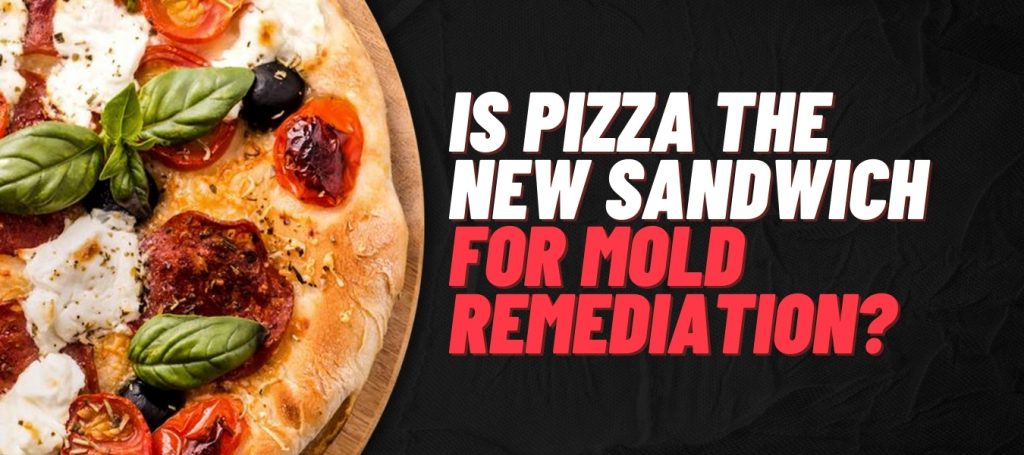
With the long, established history of successful mold cleaning using a HEPA sandwich procedure, moving to adjust that venerable technique required quite a change in thinking. Despite some initial hesitancy, the combination of science, new technology, customer requirements driven by an increased awareness and prevalence of environmental sensitivity, and practical necessity justified an updated approach. In some cases, a HEPA “pizza” approach to cleaning instead of a HEPA sandwich can deliver cleaner results. Just like with a HEPA sandwich, the individual steps of the HEPA pizza work in concert as a final cleaning regimen. That means that a remediation or cleaning crew does not start making their “pizza” until after source removal and cleaning of the visible debris/gross filth have been completed.
Once a crew is at the stage of final cleaning, the HEPA pizza is a simple but critical adjustment of the sandwich approach. Instead of using the HEPA vacuum at both the start and finish of the three steps (the slices of bread in the sandwich), HEPA vacuuming is the foundation of the “pizza” process, similar to how a pizza starts with a solid crust to support the other ingredients. The HEPA vacuum is the first step of the process because it is effective at removing loose particles, including both the visible particulate and those that are too small to see.
The “sauce” of the HEPA pizza is the wet cleaning. Any of the same variations of wet cleaning used for a HEPA sandwich can be used in the HEPA pizza. Regardless of the chemicals used during this step of the cleaning, a key ingredient is mechanical agitation while wet wiping. Spraying and wiping, or using saturated cloths, break the bond of small particles that keep them stuck to the surface and is critical for breaking up bio-films to loosen pathogenic contamination. This is especially important for removing the liquid form of mycotoxins, the poisonous substances excreted by some molds. Since many mycotoxins are sticky, the combination of physical agitation from wiping and chemical action loosens and breaks down mycotoxins, enabling more effective cleaning.
The primary difference between a HEPA sandwich cleaning approach and a HEPA pizza process is the fact that the second HEPA vacuuming at the end of the sandwich technique is replaced with surface cleaning using disposable microfiber wipes.
Why Change to a Pizza?
In the HEPA sandwich approach, HEPA vacuuming a second time theoretically picks up any tiny particles that were freed from the surface but not collected by the wet wiping. Some interesting science suggests that while repeated HEPA vacuuming may sound good in a work plan, it may not be the most effective last cleaning step in reality because of some fundamental principles of chemistry and physics.
One important aspect of that science is the attraction of small particles to one another and to surfaces that was first described by Dutch physicist Johannes Diderik Van der Waals. In simple terms, Van der Waals forces explain attraction and repulsions between atoms, molecules, and surfaces. For very small particles, the chemical/electrical attraction between the particles and the surface they are on may be greater than the removal force generated by the suction of a vacuum. Hard to imagine, but the extremely lightweight nature of many small spores and fragments actually allows them to stay on the surface because of the Van der Waals attraction, even in the suction stream of a HEPA vacuum.
Removal of very small particles is also affected by chemistry and biology. The biology of many molds associated with long-term water damage, like Stachybotrys, Fusarium, and Chaetomium shows that the spores and fragments are often held together in a sticky clump, probably to facilitate dispersion through the movement of insects, animals, and people. The chemistry of some of the liquid compounds produced by such molds, including the mycotoxins discussed previously, gives added support to the sticky nature of these microscopic-sized particles. Therefore, if the first step of HEPA vacuuming and the next step of wet wiping have not removed all of the small, sticky mold residue, then biology, chemistry, and physics all conspire to keep a second round of vacuuming from delivering a clean surface.
By shifting from the HEPA sandwich cleaning approach to the HEPA pizza process, restoration professionals can focus more of their effort into utilizing a cleaning process to obtain the results they want without investing time and labor in a final HEPA vacuuming step that delivers minimal value. Just as new baking techniques and combinations of ingredients can yield a fresh and delightful experience with pizza, technological advances in cleaning tools and updated techniques can make cleaning both easier and faster for restoration professionals. Since time is money, and the industry is currently experiencing a labor shortage, using innovative microfiber cleaning tools can deliver more than just a cleaner surface.
What is so Special About Single-Use Microfiber Cloths for Restoration Professionals?
When microfiber cleaning products first entered the market, people quickly recognized how well they cleaned, but most people washed them because they were expensive. From this experience, several things were learned related to using microfiber for restoration jobs:
- The impressive ability of microfiber cloths to capture and hold small particles works against laundering. Multiple studies have shown that microfiber does not release all of the dirt or contamination when washed. The residual contaminants in laundered microfiber promotes cross-contamination and neutralizes disinfectants. The potential spreading of contamination from one area to another, or even one project to a different location, through the use of laundering microfiber cloths does not match with the detailed cleaning associated with either the HEPA sandwich or HEPA pizza technique.
- Used microfiber loses its ability to clean efficiently and effectively. Since the heat from dryers and chemicals from laundering cause microfibers to melt and clump together, the advantage of cleaning with microfiber goes away with only a few wash cycles. While the cloths may look or feel the same after laundering, their performance is compromised. As a result, previously used microfiber cloths are not as effective as new material. While the drop-off in performance may be acceptable for detailing an automobile, it does not make sense to utilize laundered microfibers for the last step in a process designed to remove dangerous microscopic contamination.
Single-use microfiber avoids these issues altogether because every pad used on the jobsite is brand new. When paired with wall cleaning hardware, restoration companies have experienced more than a 50% reduction in time needed to clean walls and ceilings, leading to quicker completion of the job with less effort and greater profitability.
The impressive results from single-use microfiber cloths have even led a number of companies to use them during the wet cleaning phase of the HEPA pizza. The good news in that regard is that currently, every known commercial cleaner and disinfectant commonly used in the restoration industry is compatible with single-use microfiber.
It Is Time for the Mold Remediation Industry to Have Pizza Parties (HEPA Pizzas That Is)
It is fascinating that many sensitized individuals already are using microfibers for daily cleaning. Since ill individuals measure success in symptom reduction, they know that microfiber cleaning products work to remove contaminants from even visibly clean surfaces. Consultants and contractors that specialize in cleaning structures for mold sensitized individuals have also begun to make the move to HEPA pizza cleaning with a dry microfiber wipe as the last step. Many have learned the hard way that it is the best approach to help them pass stringent post-remediation clearance criteria.
If any additional rationale was necessary, the experience of pharmaceutical plants, medical facilities, and even everyday businesses opening from COVID restrictions, have confirmed that using a HEPA pizza approach is a win-win-win situation for the contractor, the consultant, and the customer.
- Many people have heard the account of the birth of the sandwich in 1762. John Monague, the 4th Earl of Sandwich, was a problem gambler. His addiction to cards led him to spend hours at the table, to the point that he did not want to get up from it to eat. During one particularly long session playing cards, the Earl asked the cook for something he could eat without getting up. Putting slices of meat between thick slices of bread let the nobleman eat with one hand and keep playing. The concoction became the Earl’s trademark as he gambled in houses and salons around London. As such, people nicknamed the edible a “sandwich”.
- “Normal fungal ecology” (also known as “Condition 1”) is a concept developed as part of the S520 standard discussed earlier. The term describes an indoor situation reflective of a non-water damaged building. The definition recognizes that some fungal residue (settled spores, hyphal fragments, small amounts of visible mold growth) is typical in most buildings.
- Although the concept of eating flatbread with oil and spices has been common in the Mediterranean world for over 1000 years, the development of what we today call a pizza with tomato sauce, cheese, and toppings is much more recent. That specific arrangement of ingredients is credited to Raffaele Esposito, a baker in Naples. The best understanding of the legend that has now grown up around the invention of the pizza, is that it was created in 1889. Italian King Umberto I and Queen Margherita took a trip to Naples, so the baker used the red tomato sauce, white mozzarella cheese, and green basil leaves to represent the red, white, and green colors on the Italian flag in honor of their visit. A pizza with those particular toppings is still known today as Pizza Margherita.
Related Posts


 Stephen Leung is a business manager with Contec, Inc. and has served as product steward of US EPA registered disinfectants. As a Certified Forensic Operator, an AHE T-CHEST (Association for the Health Care Environment Trainer– Certified Heath Care Environmental Services Technician) and Six Sigma trained Black Belt, Mr. Leung has authored articles which have been published in a number of industry publications and volunteered time and expertise for the development of the RIA Forensic Restoration Guidelines. During the COVID-19 pandemic, Stephen authored decontamination protocols and contributed to cleaning guidelines for ISSA’s GBAC (Global Biorisk Advisory Council) and other organizations. With more than 20 years of professional cleaning experience with wipes, mops, and chemicals, and a willingness to share and to learn, Stephen can be reached at 864-640-3513 or sleung@contecinc.com
 Michael A. Pinto is chief executive officer of Wonder Makers Environmental, Inc. He has earned six professional designations including Certified Safety Professional (CSP), and Certified Mold Professional (CMP). Mr. Pinto is the author of over 230 published articles and several books including, Fungal Contamination: A Comprehensive Guide for Remediation. He has volunteered extensive time and expertise for the development of the RIA Forensic Restoration Guidelines, IICRC S520 Standard for Professional Mold Remediation, and the RIA/IICRC/AIHA white papers explaining proper procedures for addressing the SARS CoV-2 through cleaning and application of disinfectants. Michael can be reached at 269-382-4154 or map@wondermakers.com.