The home technically passed remediation.
There was no visible mold growth remaining. Damaged materials had been removed. The structure had been dried, repaired, and restored. By conventional standards, the project appeared to be completed.
Yet, inside the home, the real problems have not ended.
For nearly two years, the primary occupant had become progressively less functional inside the environment. Fatigue, cognitive dysfunction, environmental intolerance, and persistent physiologic reactivity gradually narrowed ordinary life into something unrecognizable. Eventually, even taking her daughter to school became nearly impossible.
The contradiction was difficult to ignore.
How could the building appear structurally corrected, while the occupant continued deteriorating inside it?
Then something unusual happened.
The environment underwent aggressive environmental stabilization procedures designed not merely to address visible contamination, but to systematically reduce biologically active particulate burden throughout the occupied space itself. Surface biofilm reservoirs were addressed. Fine particulate reservoirs were reduced. Airborne biologic loading was aggressively suppressed through high-level engineering controls designed to rapidly reduce respirable particulate throughout the breathing environment. Within less than one-hour, airborne biologic particulate concentrations collapsed across the most respirable particle ranges inside the home.
Within 48 hours, the homeowner reported that the primary affected occupant had been out of bed and active for two consecutive days for the first time in years. Then came the statement that reframed the entire project: “My wife took our daughter to school this morning for the first time in months.”
That outcome does not establish medical causation nor is it representative of a cure. But it does reinforce a reality that many environmentally reactive occupants, healthcare practitioners, and environmental professionals have quietly encountered for years: structural remediation and environmental health are not the same operational objectives.
For decades, remediation standards were appropriately developed around moisture control, damaged material removal, structural correction, and the restoration of compromised building assemblies. And those functions remain critically important to date. But they were never designed to function as environmental health stabilization frameworks for biologically reactive occupants.
The difference matters. A lot.
Why?
Because occupants do not experience buildings as isolated contamination sites. They experience them as lived-in environments. A person sleeping in biologically impacted bed linens may spend eight continuous hours breathing directly within a concentrated personal exposure zone created by pillowcases, sheets, blankets, settled particulate, and continual disturbance surrounding the breathing space.
A couch cushion may repeatedly release particulate every time someone sits down. HVAC systems may continuously redistribute fine particulate throughout the occupied space. Dust reservoirs become airborne, settle, redistribute through airflow and ordinary activity, and eventually become airborne again. The smallest particles are especially important because they remain suspended longer, travel more efficiently throughout the occupied space, and penetrate more deeply into the respiratory system.
The cycle never fully stops until a comprehensive environmental intervention is performed. For environmentally reactive occupants, these exposure dynamics may ultimately matter the most.
In the summer of 2025, the National Institute of Environmental Health Sciences updated public-facing language acknowledging associations between mold exposure and cognitive dysfunction, changes to the immune system, elevated levels of stress and anxiety in both children and adults and alluded to inhalation as the primary cause of exposure. In April 2026, the Environmental Protection Agency similarly acknowledged that settled dust inside the built environment can function as a biologic reservoir capable of impacting human health.
Those acknowledgments reinforce something a small number of environmental professionals have quietly understood for years: the building itself — and everything inside it — is the exposure.
Once that reality is acknowledged, the conversation changes.
Environmental health stabilization emerges not as criticism of remediation, but as a second discipline remediation was never originally designed to be. The significance of that distinction becomes more understandable when viewed against the environmental measurements collected during stabilization projects. One of the most important observations emerging from years of field work is that meaningful burden reduction tends to become measurable across multiple environmental domains simultaneously when the indoor environment is approached comprehensively rather than in isolated parts. One of the first places this becomes visible is at the surface level.
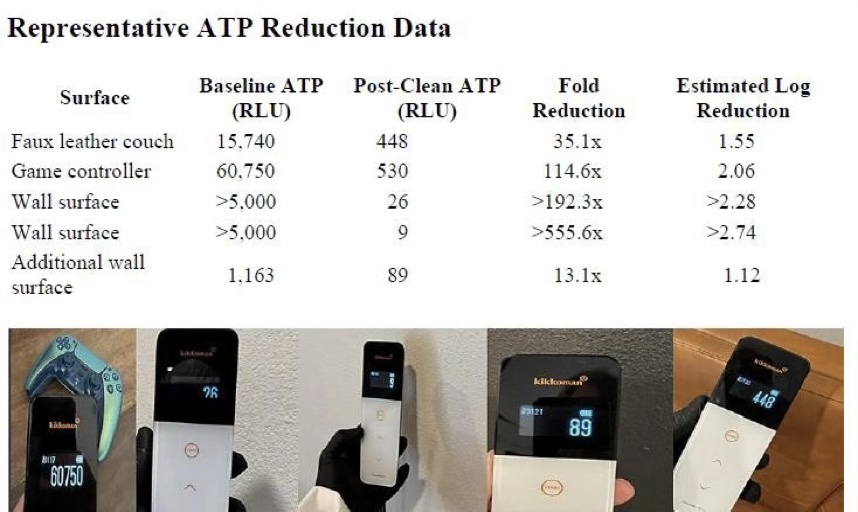
Visually clean does not necessarily mean biologically low burden. A surface may appear acceptable while still functioning as an active environmental reservoir. Because of this, our environmental stabilization efforts routinely rely upon objective verification rather than by appearance alone.
One commonly utilized tool is ATP bioluminescence testing using luminometer technology. ATP testing does not speciate mold or identify organisms. Instead, it helps determine whether meaningful biologic residue reduction has actually occurred on environmental surfaces.
The difference can be substantial.
ATP Verification:
If surface reservoirs matter, airborne particulate may matter even more.
Indoor biologic particulate does not remain confined to surfaces. Reservoirs continuously aerosolize through airflow, occupant movement, HVAC circulation, bedding disturbance, walking, vacuuming, and ordinary daily activity. Once it’s airborne, particulate redistributes itself throughout the occupied space before eventually resettling back onto environmental surfaces where the cycle repeats again.
This continuous exchange between surface reservoirs and the breathing environment is one of the defining realities of indoor exposure dynamics. In practical terms, less biologic loading on surfaces generally means less material available for aerosolization into the air. Likewise, reducing airborne particulate decreases the amount of biologic material resettling back onto environmental surfaces over time. Surface burden and airborne burden therefore function as interconnected components of the same exposure ecosystem. This is particularly important in highly reactive indoor environments where ultrafine particulate can remain suspended within the breathing zone for prolonged periods of time.
Objective measurements demonstrate how rapidly airborne loading can shift following deployment of aggressive engineering controls combined with coordinated reservoir reduction strategies. The significance of that environmental shift becomes more understandable when viewed against the corresponding particle reductions.
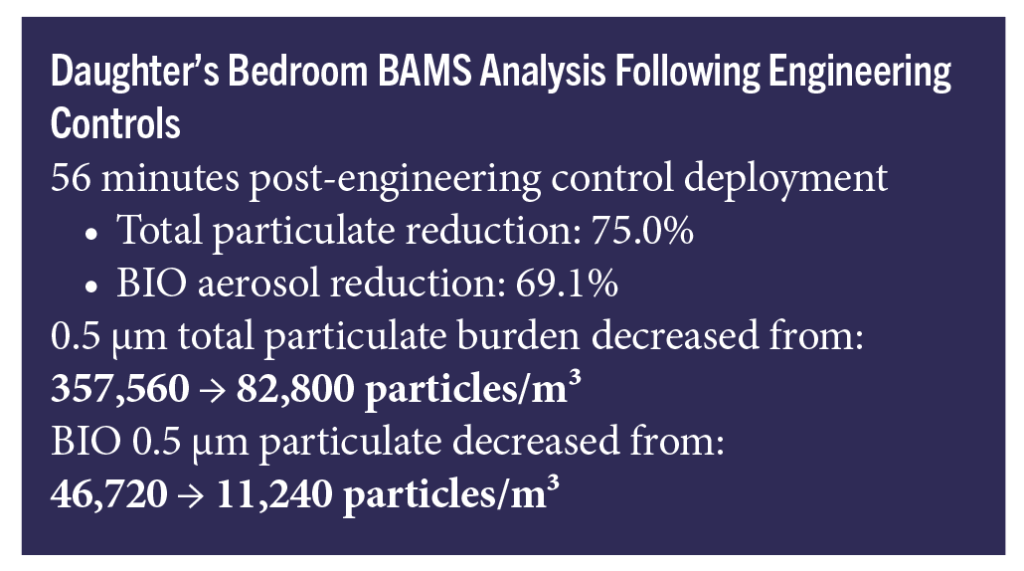
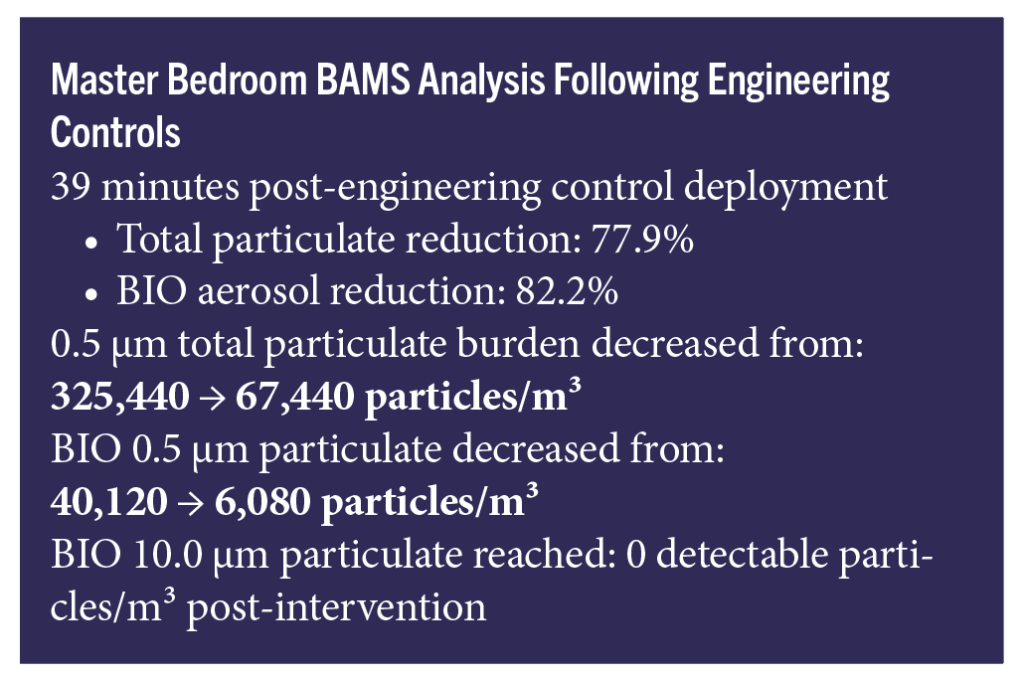
The importance of these findings lies in the fact that the largest reductions occurred within the smallest and most respirable particle ranges. In practical terms, the inhalation environment changed dramatically within less than one hour. As was referenced in this article’s opening, the homeowner reported substantial functional improvement in the primary affected occupant, including activity levels not observed in nearly two years.
A growing body of peer-reviewed literature has demonstrated the biologic significance of fine and ultrafine particulate exposure. While these environmental findings do not establish medical causation or imply clinical treatment, applying exposure science to reduce inhalation burden and improve occupant tolerance may be one of the most important emerging objectives within indoor environmental health. From a practical standpoint, reducing airborne loading may function much like turning down the volume on an alarm system or reducing water flow from a spigot. The environment itself becomes less inflammatory, less reactive, and physiologically less demanding on the occupant.
This distinction may help explain why some environmentally reactive occupants self-report meaningful symptomatic improvement following aggressive particulate reduction and environmental stabilization procedures.
The measured results may also help clarify the emerging distinction between structural remediation and environmental health stabilization. Environmental health stabilization focuses more broadly on the occupant’s ongoing interaction with inhaled particulate, biologic reservoirs, HVAC redistribution, and the whole-environment exposure dynamics occurring throughout the occupied space. Both perspectives are important. But they are not identical disciplines.
Environmental Profiling and qPCR-Based Assessment
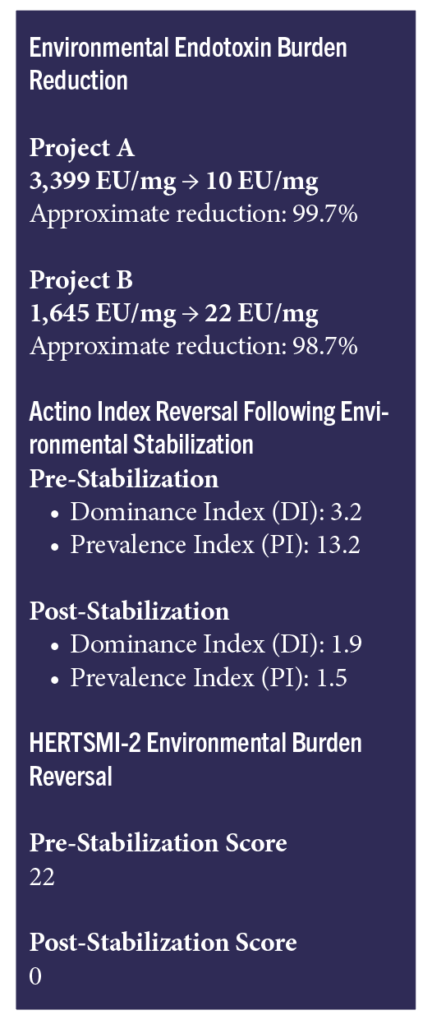 Many environmental burden metrics currently utilized within indoor environmental assessment— including HERTSMI-2, fungal ecology analysis, and actinobacterial profiling — rely partly on qPCR (quantitative polymerase chain reaction) methodologies designed to identify and quantify biologic DNA signatures within environmental dust samples.
Like all environmental testing methodologies, qPCR-based analysis has limitations and should not be interpreted as a perfect representation of total occupant exposure or precise toxicologic dose. Indoor environments are highly dynamic systems, and no single sampling methodology fully characterizes the complexity of biologic loading within an occupied space.
However, qPCR-based environmental analysis remains one of the most widely available tools for identifying measurable shifts in microbial ecology, biologic loading patterns, and environmental burden profiles following intervention.
For environmental stabilization purposes, the significance is not absolute perfection of measurement methodology, but whether multiple environmental indicators demonstrate substantial directional change following intervention. In practical terms, one important question remains: how much biologic material was present before intervention, and how much remained afterward? Within that context, directional reduction itself becomes environmentally meaningful.
The Industry Is Evolving
Discussion surrounding environmentally compromised buildings is no longer confined to environmentally sensitive occupants or niche environmental circles. It has increasingly entered federal and congressional discussion.
Military housing investigations and Senate subcommittee hearings have increasingly reinforced a critical distinction: structural remediation and environmental health stabilization represent different operational objectives. Congressional discussions surrounding military housing conditions have specifically emphasized the need for both structural correction and environmental health solutions. Environmental health stabilization addresses biologic burden, inhalation exposure dynamics, particulate redistribution, and environmental tolerance within the occupied space itself. These are not interchangeable disciplines because they were never designed around the same endpoint.
That unresolved gap ultimately helped shape PEPN™ — not as a replacement for remediation professionals, physicians, or environmental consultants, but from the recognition that many environmentally reactive occupants were left navigating two disconnected worlds.
The remediation industry addressed the structure. Medicine addressed the patient. Yet, few systems existed to help bridge the environmental realities existing between them.
PEPN™ emerged from the belief that a more meaningful pathway needed to exist between the indoor environment and the exam room, and between the exam room and the environment patients ultimately returned to each day.
Because for many occupants, recovery is rarely purely clinical or purely environmental. It is both.
Conclusion
The home at the beginning of this article had technically passed remediation.
The damaged materials were removed. The structure was repaired. By conventional standards, the project was complete. Yet, the occupant remained physiologically reactive inside the environment until the broader exposure dynamics occurring throughout the occupied space were aggressively addressed.
Existing remediation standards were appropriately developed around moisture control, contamination management, damaged material removal, and restoration of compromised building assemblies within defined work areas. Those objectives remain critically important.
However, biologic exposure dynamics do not necessarily remain confined to the original area of damage. Long before remediation may begin, aerosolized particulate, HVAC redistribution, settled dust reservoirs, textiles, contents, and ordinary occupant activities can redistribute biologic burden throughout the broader indoor environment itself. So, a remediated assembly and a stabilized exposure environment are not the same operational endpoint.
Across multiple independent projects, environmental stabilization demonstrated substantial reductions in biologic aerosol loading, ultrafine particulate burden, endotoxin burden, actinobacterial burden, fungal burden profiles, and residual biologic surface loading. And more importantly, those environmental changes repeatedly aligned with occupants reporting improved environmental tolerance.
Increasingly, environmental measurements, occupant outcomes, federal health language, and real-world field observations are all pointing toward the same conclusion: the building itself — and everything inside it — is the exposure.
The science surrounding exposure dynamics is advancing rapidly. However, many of the operational frameworks, verification methodologies, and professional disciplines required to fully address those realities are evolving far more slowly than the environmental health challenges now emerging within the built environment.
As environmental science and healthcare continue converging, environmental health stabilization is increasingly establishing itself as a distinct discipline centered on inhalation exposure dynamics, biologic burden reduction, and environmental tolerability within occupied space.
For environmentally reactive occupants, the objective is not simply structural correction, because structural correction alone may remain incomplete when broader inhalation exposure dynamics throughout the occupied environment are left insufficiently addressed.
For a growing number of environmentally reactive occupants, healthcare practitioners, and environmental professionals alike, the question is no longer whether these exposure dynamics matter. The question is who is willing to learn how to address them correctly — and whether the methodologies being taught are demonstrably capable of producing meaningful, measurable, and reproducible environmental improvement within real-world occupied environments when properly implemented
Skip Jankoski

Skip Jankoski is an environmental health innovator, author, and educator serving as President of Purified Environments, a Santa Barbara, California-based company specializing in advanced indoor environmental assessment, biotoxin burden reduction, indoor air quality management, and exposure-focused environmental intervention within water-damaged and environmentally compromised buildings.
He is the author of the PEPN-HEART™ Protocol (Health & Environmental Assessment for Recovery & Tolerance), a medically informed framework that applies principles of healthcare diagnostics, exposure science, contamination control, and environmental measurement to the built environment. The protocol views buildings as integrated exposure ecosystems in which air, dust, surfaces, contents, HVAC systems, moisture dynamics, and occupant interaction collectively influence environmental tolerability and human health.
As Co-Founder of PEPN™, an independent national governance alliance, Skip works to advance clinically aligned standards for environmental assessment, intervention, verification, and data integrity. Through PEPN™, environmental professionals, remediation providers, and healthcare practitioners collaborate within a framework designed to better understand and reduce biologically relevant environmental exposures.
With more than two decades of experience spanning medical therapeutics, implantable medical devices, laboratory diagnostics, biotechnology, and environmental health sciences, Skip brings a uniquely interdisciplinary perspective to the relationship between buildings and human health. Few professionals have worked across both healthcare and environmental disciplines at this depth, providing a perspective that connects environmental measurements with real-world exposure dynamics and occupant health considerations. His work focuses on microbial ecology, bioaerosol dynamics, particulate transport, and the role biologically active environmental agents—including microbial fragments, endotoxins,
actinobacteria, β-glucans, and fine particulate matter—play in occupant exposure.
Today, Skip is recognized for helping bridge the historical divide between environmental remediation and healthcare by translating exposure science, contamination-control principles, and aerosol physics into practical environmental health interventions. His work is helping define the emerging discipline of environmental health stabilization, where success is measured not simply by structural correction, but by the meaningful reduction of environmental exposure burden within occupied environments.
Related Posts