
Restoration contractors are always looking for the right resources to set their teams up to achieve successful project outcomes. Project management is won or lost in the details. Scope, budget, materials procurement, scheduling, and a variety of factors all align to either result in a job well done or a one-star fiasco. Too often organizations bemoan the final outcome, lamenting why they can’t hit their timeline, make the customer happy, or achieve profitability. This article will outline how restoration contractors can utilize tools already at their fingertips to move the needle toward better outcomes starting with a few simple profitability resources.
Sync Estimation Details with Production Outcomes
A positive project outcome is the result of bringing harmony to the process starting with a thoroughly documented and clearly understood estimate (See our prior article The Art and Science of Insurance Claims Estimating). Estimators should be trained and held accountable to produce scopes and costs of work that can be executed by the corresponding production teams. Similar to a demolition team thinking about the drywall team that will follow them by cutting straight lines and pulling nails or screws, the estimator must consider the project staff that will follow them to produce the work.
- Project inspectors should set the estimators up for success.
- Estimators should set the project managers up for success.
- Project managers should set up the production staff for success.
Scope creep is a common affliction for construction businesses. One of the most effective ways to combat losses associated with this ailment is to instill the proper mindset and habits into each member of the team so that everyone is helping each other achieve clarity on what is and what is not included in the contracted scope of work. This means everyone upstream is intentionally setting everyone downstream up for success so that those producing the work can and will inform everyone upstream of the additional items to bill for (or at least document and discuss with the paying parties).
Simple Costing Resources from Estimating Software
In traditional construction, a project manager would perform a materials takeoff prior to the estimation sequence. For the majority of property restoration projects, this function is performed after the estimate has been transferred into a signed contract. In the popular estimating software Xactimate, there is a Components List that contractors can utilize to generate the estimated:
- Labor, equipment, and materials for the entire project.
- Labor, equipment, and materials by specific categories of work.
- Labor, equipment, and materials by specific functions.
The Recap by Category Report from Xactimate provides the master categories for a budgeting outline. In my book How To Suck Less At Estimating I share several examples of how an estimator can create simple pick-ups for shortfalls that would otherwise set the project off on the wrong footing.
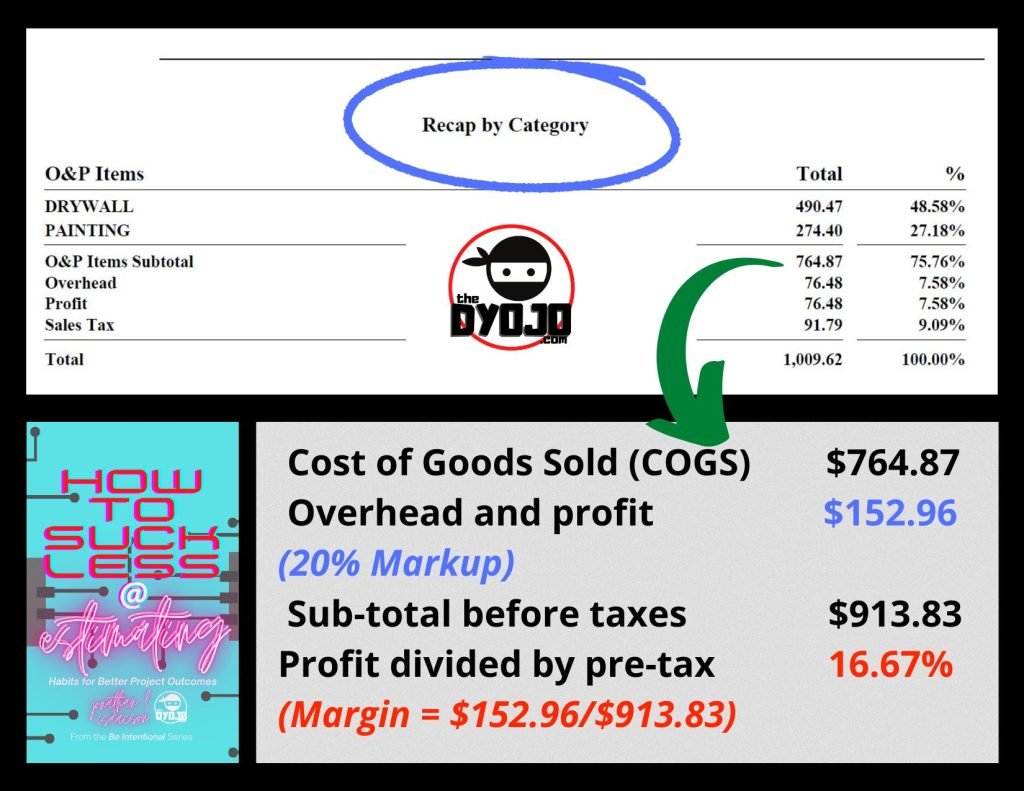
Exhibit A: Budget Overview from Xactimate’s Recap by Category
In the example above there is roughly $760.00 before overhead, profit, and taxes. In the world of insurance, there has been a continued practice of adding “ten and ten” or a 20% markup to the costs. The overhead and profit at 20% in the example above are $152.96. If the contractor spends all the budget of $764.87 on labor, materials, and equipment for this project, their profit would actually be 16.67%.
Cost of Goods Sold (COGS) $764.87
Overhead and profit $152.96 (20% Markup)
Sub-total before taxes $913.83
Profit divided by pre-tax 16.67% (Margin = $152.96/$913.83)
If the contractor wanted to make more than a 16.67% profit margin on their work, they would need to:
- Increase the sales price to reflect their needs (i.e. better capture of details, estimating, supplements, etc.)
- Decrease their costs (i.e. efficiency, negotiation, contractor discounts, etc.)
- Increase the overhead and profit margin to reflect their needs/goals
- Some variation of all of the above
The Restoration Industry Association (RIA) has created two helpful calculators that are free resources to all members. First, a labor calculator developed by Enlightened Restoration Solutions helps contractors determine their true costs. Second, a markup calculator, developed in collaboration with the Advocacy and Government Affairs (AGA) Pricing Committee and Ask AIMe, help contractors determine the appropriate percentage to achieve their margin goals.
Simple Budgeting and Production Resources
Using a simple spreadsheet an estimator or project manager can budget out their project. In many circles within the skilled trades, this is called “buying out” a project, whereby all costs are charted before the project even starts so that there is a roadmap to achieving profitability goals. While many property restoration contractors complain about the common estimating software platforms within the industry, many of them who reach out to The DYOJO for coaching aren’t using even some of its most basic functions.
Simple Production Resources within Xactimate
- Simplified quantity calculations based on the data input
- Components List = Materials, Equipment, and Labor Takeoff
- Recap by Category = Budget breakouts by categories of work
- Scope = Room-by-room production plan
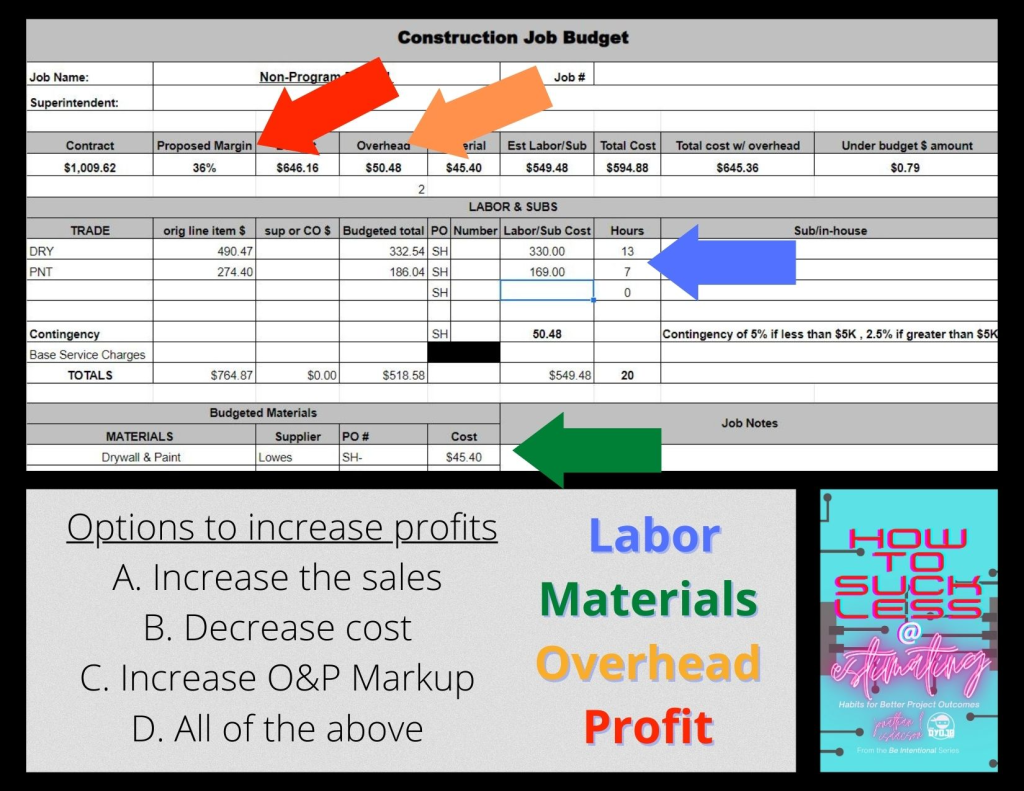
Exhibit B: A Simple Budgeting Spreadsheet (Adapted from Recap by Category)
In the sample budgeting spreadsheet, all of the figures are adapted from the Recap by Category and Components List reports from Xactimate. This does not represent a recommendation but an example of how a contractor might budget a similar project. The sales price is entered into the top left, this should be budgeted based off the pre-tax sales total or the numbers and margin will be skewed. With a profit margin goal of 36% the cost components are factored at .68 of the Recap by Category totals.
If the person budgeting separates out the materials for drywall and painting, they would be budgeting the drywall labor from this row of data. For example, if drywall labor was budgeted at $490.47 x .68, there would be roughly $330 to work with. This may be paid to a subcontractor or broken down further into estimated hours for in-house carpenters. If the labor was paid around $25 per hour, then there would be roughly 13 hours budgeted to this scope of work. Note, these are all extremely rough figures, so they do not include fully burdened labor, true overhead, or other cost factors.
Achieving Better Project Outcomes
Positive project outcomes require clear, consistent, and accountable habits from each person on the team who directly or indirectly touches the project. A good estimate does not guarantee a positive project outcome, but a poorly written or understood estimate will always kick a project off on the wrong footing. The building blocks of an estimate are also the foundational elements of positive project outcomes. There are at least seven factors that go into a solid production plan, which are also key considerations at the estimating phase:
- Job Costs
- Labor
- Materials
- Equipment
- Subcontractors
- Overhead
- Profit
If you are struggling to achieve consistent project outcomes, start by asking how intentionally each person in the production sequence is thinking through and about the work that must be done. Team members can get tunnel vision in their roles which can deter them from thinking about the responsibilities of others. Team members can get set in their ways without observing the small adjustments that need to happen each year to stay sharp. Business owners and managers must create feedback channels for team members to observe issues, discuss frustrations, and collaborate on creative solutions. One of the most immediate fixes could already be at your fingertips, ensure your team is utilizing the simple profitability resources we discussed in this article.
Jon Isaacson
 Jon Isaacson, The Intentional Restorer, is a general contractor based in Tacoma, Washington. He is the author of several moderately selling books and the host of the info-taining DYOJO Podcast. Content from The DYOJO aims to help contractors shorten their DANG learning curve.
Related Posts