- A restorer with a properly-executed Assignment of Insurance Rights can enforce the policyholder’s rights to fair claims handling.
- Allstate pivots and back-peddles, unsuccessfully attempting to find a basis to challenge contractors’ Assignment of Insurance Rights.
- California contractor uses Assignment of Insurance Rights to sue the carrier directly for overhead, profit, and attorneys’ fees and recovers 10x the invoice.
SANTA ANA, CA – As reported in the March/April 2023 edition of C&R, Allstate Insurance Company paid an Orange County restoration contractor $335,000 to settle a dispute that began when Allstate refused to pay $33,221.80 of a $149,574.21 contents restoration invoice.
Reality check. Restorers have no inherent legal rights against carriers. Here, the contractor’s leverage arose exclusively from an Assignment of Insurance Rights (AOR) that included an assignment of benefits. The AOR enabled the contractor to achieve an extremely favorable settlement of its claims for the balance due for the contents work, attorneys’ fees, and interest.
But how?
We gave Allstate multiple attempts to simply pay the $33,221.80, but it refused. Most insurance companies now understand that assignments are enforceable in most states, so lawyers and lawsuits are almost never needed. For some reason, Allstate played hardball on this claim. It dishonestly stated that it does not cover overhead a profit, six months after it published a Code of Conduct stating that it expects its suppliers “to act in an honest and ethical manner.”
Seeking to avoid litigation, I sent a letter to the adjuster explaining that the contractor held rights under the AOR, that the contractor stepped into the shoes of the insured, that Allstate’s denial of O&P was not made in good faith, and that the contractor had the right to prosecute a claim directly against Allstate, and recover its attorneys’ fees (extracontractual damages). I tried to be very clear about the contractor’s intentions:
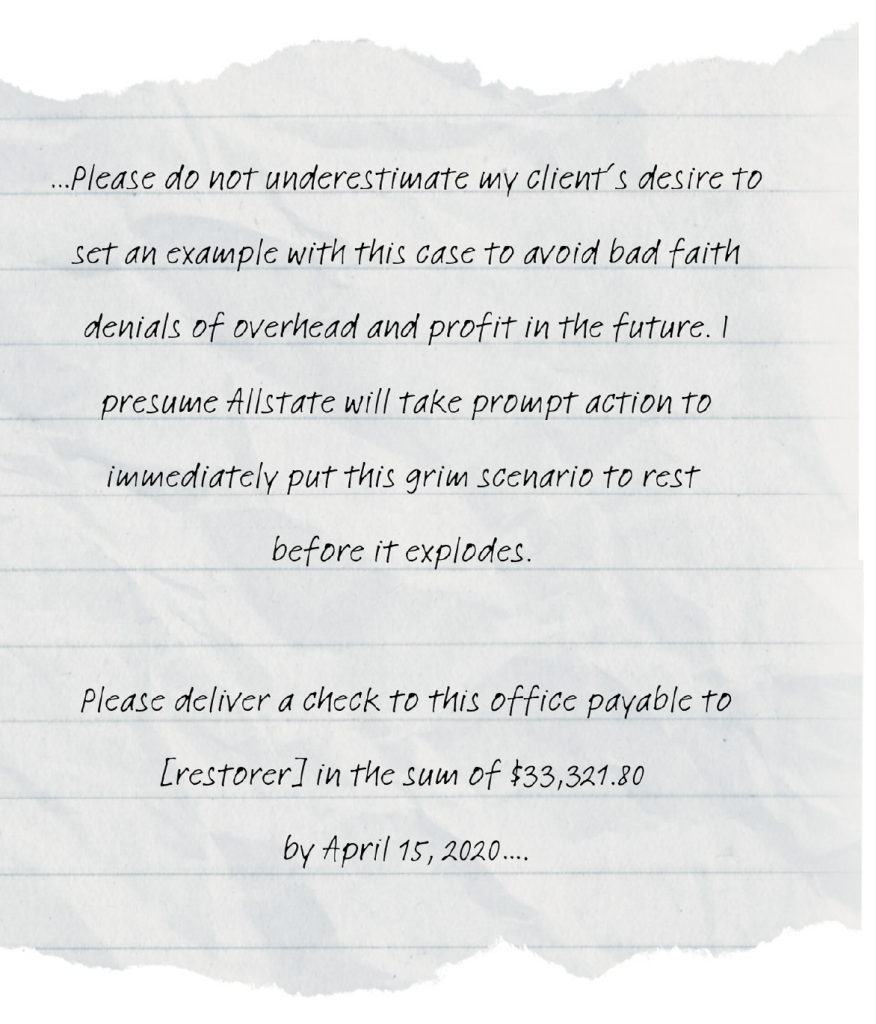
Failed Attempt #1: The Restorer is Not a Party to the Contract
Allstate’s first lawyer was impressed with himself, but not with my letter. He wrote:
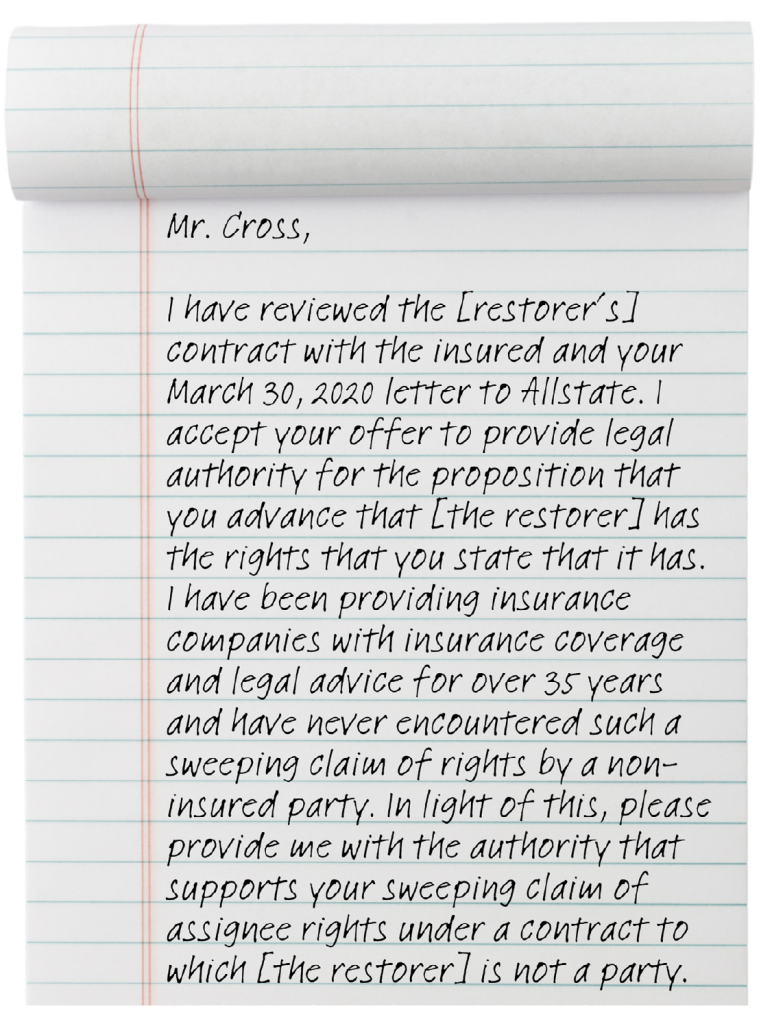
I sent a reply, quoting laws explaining how the restorer does not need to be a party to the contract of insurance, that rights to legal claims are assignable after a loss has occurred, and that the consent of a carrier is not required for a post-loss assignment of insurance rights.
Failed Attempt #2: You Cannot Recover Attorneys’ Fees
Allstate retracted its first position, and admitted that the contractor was entitled to policy benefits. It argued that the restorer was not entitled to recover attorneys’ fees (extracontractual damages) if it were to sue. The lawyer wrote:

He cited no law in support of that position. Instead, he changed the subject to O&P. He admitted that Allstate had paid my client O&P for contents multiple times in the past. Nonetheless, he reiterated Allstate’s final decision that O&P would not be paid for this claim, quoting an irrelevant opinion piece written by an out-of-state insurance defense lawyer which suggested that the duty pay O&P is at the discretion of the adjuster. Wrong.
At that point, there was nowhere to turn for recovery, except the courthouse. We filed suit, carefully quoting Essex v. Five Star Dye House, in which the Supreme Court of California held bad faith claims are assignable and that the assignee can recover attorneys’ fees. This was important because it precluded Allstate from filing any objection or motion to dispose of the case based on alleged defects on the face of the Complaint with respect to the assignment. The Complaint was served concurrently with a settlement demand for $53,895.07, which Allstate refused to pay.
Failed Attempt #3: Future Claims Cannot Be Assigned
Allstate then took the position that the right to sue Allstate was not assigned to the restorer because the alleged bad faith had not occurred at the time the assignment was executed. In other words, Allstate’s argument was that future rights cannot be assigned. Wrong again.
Notably, Allstate did not file a motion for summary judgment to have the case decided in its favor, probably because it did not want to create “bad law.” Of course, assignments of future rights are enforced all the time. When an apartment building is sold, the buyer can receive an enforceable assignment of the tenants’ future rent payments. When I borrowed money for law school tuition, the lender assigned my future loan payments to a second financial institution. Do you think I could have refused to pay on grounds that my payments were current at the time the assignment was made?
Have no fear of anti-assignment provisions. Rookie adjusters sometimes allege that assignments are prohibited by insurance policies. The courts of most states enforce assignments of rights if the assignment is made after a loss occurs. This is because “post-loss” assignments do not change the insurer’s risk. The loss has already occurred, and it doesn’t cost the insurance company any more to write the check to Party A or Party B. They can write the check to the restorer just as easily as they can write the check to the named policyholder.
Carriers are required to be cooperative. Any adjuster who claims that assignments complicate things is being disingenuous. The “complications” are smokescreens manufactured by insurance companies in a bad faith attempt to disempower the restoration industry. They know that most policyholders lack the motivation and the incentive to enforce the terms of the contract of insurance, especially after their properties have been restored. They have what they want. Policyholders expect restorers to collect from insurance companies. Restorers, on the other hand, have a vested interest in the rights conferred by the policy. With an AOR, some stamina, and some motivation, they can get justice.
How did the AOR lead to the recovery of more than 10x the invoice? A properly-drafted assignment of insurance rights transfers certain rights of the policyholder to the contractor. The contractor steps into the shoes of the policyholder and assumes a first party position. In most states, this empowers the contractor to bill the insurance company directly, to negotiate a settlement without violating public adjusting laws, and in extreme cases, to sue the insurer for breach of contract and/or insurance bad faith, and attorneys’ fees, if allowed by state law.
A direction to pay is not an assignment. Some restorers mistakenly believe their contracts contain an assignment when they merely contain a direction to pay. “Owner instructs insurance company to name contractor on the check” is not an assignment. It is an unenforceable direction to pay.
AOB vs. AOR. An Assignment of Insurance Rights (AOR) is more than an Assignment of Benefits (AOB). An AOR transfers legal claims (“causes of action”) to the restorer, whereas an AOB merely transfers the right to a check if the insurance decides to write one. If it decides not to, or it underpays, an AOB is usually useless.
A straight AOB only allows the restorer to sue the policyholder for conversion (the civil version of theft). A straight AOB allows the restorer to force the insurer to pay a second time if the insurer fails to name the restorer on the check after the insurer has been placed on written notice of the assignment. It does not give the restorer the right to sue the carrier for bad faith––only an AOR can do that, because it transfers legal claims, in addition to “benefits.” That’s what the restorer had in the Aliso Viejo case. Without it, Allstate would have prevailed in its refusal to pay the $33,221.80 invoice, because the policyholder was perfectly happy to allow the restorer to get swindled. Ne
ver mind the fact that the restorer helped the policyholder recover from a personal and financial crisis.
Litigation is a last resort. I am strongly opposed to unnecessary acts of aggression by anyone on any side in an insurance claim. But Departments of Insurance rarely help restorers, and if the restoration industry never fights back, the problems will only get worse. A properly-drafted assignment gives a restorer leverage that nothing else can.
Form an alliance with the policyholder. The fastest outcomes occur when policyholders advocate for restorers, if the restorer can persuade the policyholder to do so. The problem is that policyholders usually get pretty uncooperative when the restorer’s invoice is past due. The problem is exacerbated when the adjuster bad-mouths the restorer to use the policyholder as cover to do his dirty work. These adjusters often engage in tortious interference with contract, something they will sorely regret, because the tables are turning. They will be prosecuted. I promise.
Assignments are not for everyone, and they are prohibited for use on program work. Each restoration company should design an assignment strategy that fits its business model. Members of the Restoration Industry Association have free access to the RIA’s 50-State Reference Guide to the Assignment of Benefits and Insurance Bad Faith Law. It is a robust compendium with more than 1,000 hours of legal research. It is not intended as legal advice, but it will reduce your attorneys’ fees because a lot of the research has been done by lawyers volunteering for the RIA. Bring it to your lawyer to jump start the discussion about whether you should employ assignments.
Never surrender.
Yours in the struggle,
Uncle Ed
Related Posts