If My Plastic is Sucking In, That is Proof Enough That My Containment is Under Negative Air!
The primary liability for a mold remediation contractor is cross-contamination from a failure in containment. Failure can result from poor construction, not using an exit/decon chamber, improper doffing of PPE, poor cleaning techniques, and not maintaining adequate pressure differentials. When I ask most restorers how they determine if they have created negative pressure inside containment, the most common answer I get is, “Well, of course! If my plastic pulls in, we have plenty of negative air!” But the reality is, even though it may appear that there is a dramatic pull on the plastic, it is not even close to the minimum pressure needed.
The Correct Way to Check Negative Air Pressure
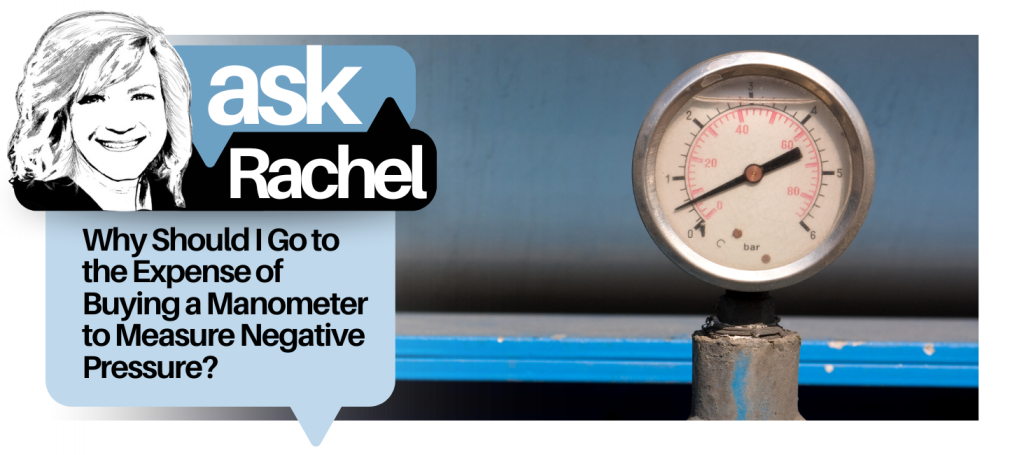
The only way to know the true amount of negative pressure that is being created and maintained is to use a manometer. The ANSI/IICRC S520 states the minimum negative pressure that should be maintained to prevent contaminants from leaving a contained area is -5 Pascals (Pa) or -0.02 inches of water column. For those of you who have never used a manometer to visually see what -5 Pascals looks like compared to being measured on a manometer, it is A LOT of negative air! The constructed containment must be built to withstand that amount of negative pressure and the amount of worker activity for the project’s duration. Containments are not constructed to be airtight. It is not practical or possible with the common materials we use to construct containment. Plus, make-up air must be able to enter the containment to allow for the necessary number of air changes.
There will be some loss in pressure upon entry and exit, so realistically, it is better to maintain a negative pressure between -8 to -10 Pa to allow for some flexibility in pressure changes yet prevent it from dropping below the minimum desired pressure of -5 Pa. Once containment is built, it is a good idea to test the pressure by entering it while monitoring the pressure using a manometer. I use the goal that my containment should not lose more than 0.5 Pa upon entry and exit. If there is a loss of pressure of up to 1 Pa, it is still acceptable, but any more than that, and I would be looking for breaches in the construction and make the necessary repairs to prevent excessive pressure loss.
Remote Monitoring with Manometers
Some manometers can provide data logging options for documentation that can reduce liability for the contractor. Certain units may also provide options for alerting the restorer after hours via wireless cellular plans to notify the restorer in the event of a loss in pressure. These manometers are typically expensive but can also be billed to the project as remote monitoring.
Great examples of high-caliber manometers are the Omniguard 5 and Abatement Technology RPM-RT Series. There are other less expensive handheld manometers that can be used to measure and document containment pressures that may not have all of the bells and whistles but provide the restorer with the needed confirmation of the pressures that have been established and can be manually recorded for documentation purposes. Extech and Dwyer offer handheld options with digital displays and the ability to store the data and connect to a computer to allow the data to be downloaded into a hard copy format. There are even less expensive options, but the quality and accuracy go down significantly.
What Happens When There’s Too Much Negative Air Pressure
It is also possible to create too much negative pressure, which can result in the collapse of the containment, backdrafting, flame rollout, and drawing unwanted moisture or contaminants from unwanted areas. Backdrafting occurs when the negative air is strong enough that carbon monoxide is pulled into the containment from a furnace’s exhaust flu, resulting in oxygen-deficient atmospheric conditions. Flame rollout can occur when negative air pressure is strong enough to pull natural gas from gas appliances, resulting in explosive atmospheres.
Measuring and monitoring negative pressure allows the restorer to ensure that the engineering controls they have put in place adequately prevent cross-contamination, which will also reduce liability and allow for a successful outcome for the overall project!
Have a question for Rachel? Send it to [email protected], and you might see it answered in the next edition of Ask Rachel!
Rachel Adams
 Rachel Adams, I.H., M.T. (ASCP), RPIH, MWR has been involved in the water damage and environmental health industries for more than 30 years. She holds a dual Bachelor of Science degree in Environmental Health Sciences and Medical Technology (Toxicology) from Purdue University and is certified by the American Society of Clinical Pathologists. Rachel also holds a Master Water Restorer designation from the IICRC through her training, dedication, and field experience. Rachel is the Director of Education for Clean Care Restoration Academy located in Panama City, Florida. She served on the Board of Directors for the Institute of Inspection, Cleaning, and Restoration Certification (IICRC) and was appointed to serve as the Technical Advisory Committee Chair for the development of the IICRC Applied Microbial Remediation Technician (AMRT) which she still serves today. She is an Associate member of the American Conference of Governmental Industrial Hygienists (ACGIH) and the American Industrial Hygiene Association (AIHA).
Related Posts