For decades, the debate has raged on: do restorers benefit more from joining a franchise, or is staying independent the better route? Franchising offers a built-in brand name and access to a wide network of resources, but it also comes with franchise fees and operational restrictions that can leave some restorers feeling limited. On the flip side, independent owners have the freedom to run their business as they choose and avoid fees, but building a brand from the ground up can take years to break through the noise and reach the forefront of the industry.
To explore this topic further, we’ve gathered insights from both sides, as well as a “middle ground” option which includes companies that are backed by private equity but operate under their own brand name. Continue reading to discover the ins and outs of these three models and the unique benefits each offers.
Independent Perspective
1. Can you briefly describe your company’s structure and your role within it?
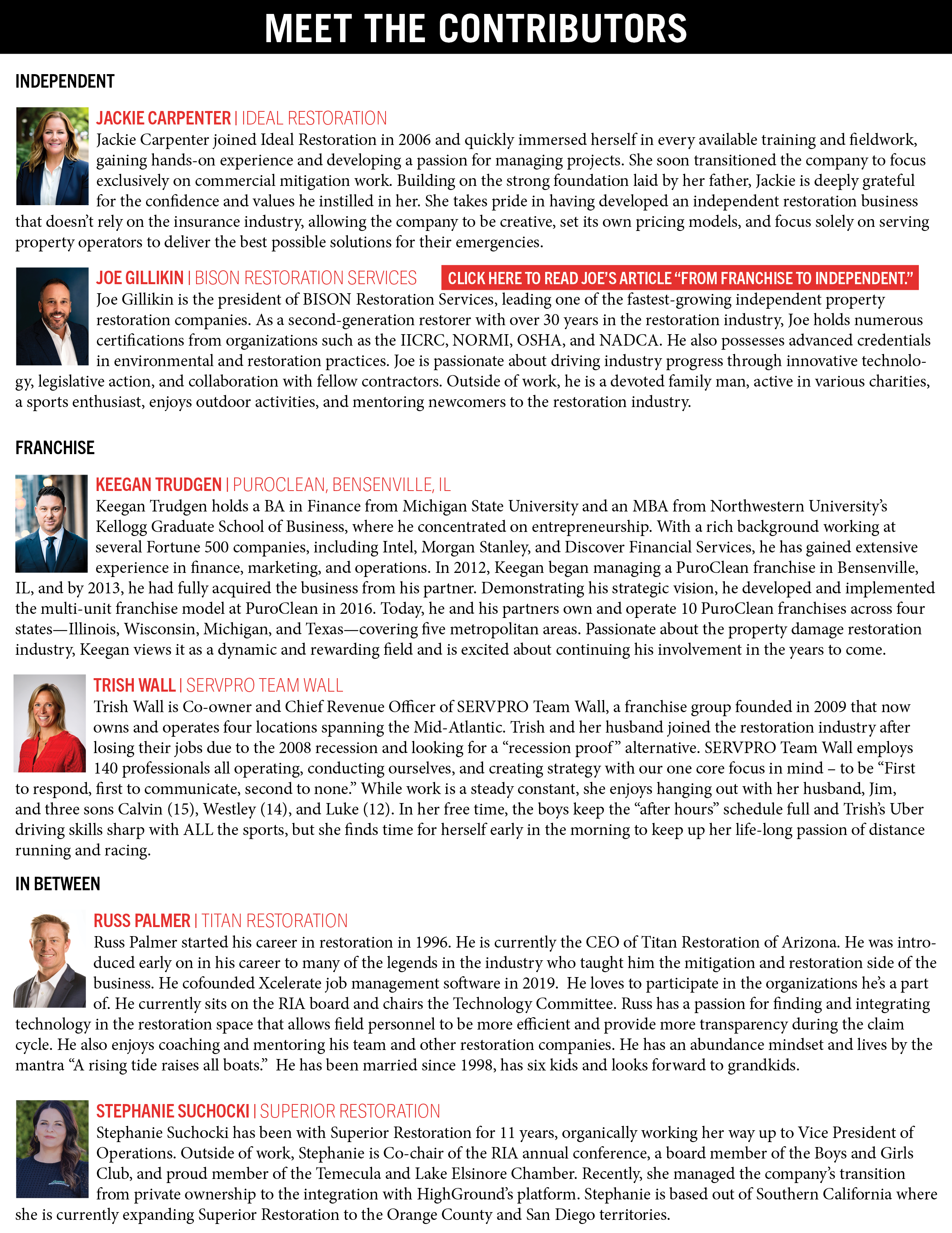
Jackie: Ideal Restoration is a 50-year-old independent restoration firm (Happy Birthday to us!). I purchased the company from my parents 18 years ago, and today I serve as the CEO. Our primary focus is on commercial mitigation services in San Francisco and Silicon Valley.
2. What do you see as the biggest advantage of operating under your current business model (independent, franchise, or in the “middle”)?
Jackie: Operating as an independent contractor presents its challenges, but the rewards are well worth the risks. Over the past 50 years, we’ve navigated shifts in our market, enduring both booms and downturns. The biggest advantage of being independent is the control we maintain—over our territory, pricing strategies, client base, and service offerings. This autonomy allows us to be agile and responsive to changing market conditions, enabling us to make critical adjustments quickly.
3. What challenges or downsides do you face due to your company’s structure?
Jackie: One of the primary challenges for independent contractors is the risk of isolation. While this can keep us from following the herd, it also means we may miss out on new trends, innovations, and operational efficiencies. I strongly believe in staying open to fresh ideas, even if they don’t immediately result in changes. To mitigate this isolation, it’s essential to build a network of trusted, non-competitive peers who can provide insights and support. Otherwise, you run the risk of being too insular.
4. How does the level of autonomy you have as an independent company impact your business decisions and operations?
Jackie: Autonomy is everything to us. It allows us to pivot quickly, whether that means changing our target client base, expanding or contracting our service areas, or opening and closing offices as needed. Every decision is made internally, usually quickly, and based on the expertise and experience of our leadership team. We don’t have to contend with external constraints or corporate red tape, which is a core benefit of entrepreneurship.
5. Do you find that being independent strengthens your relationships within the local community? How does this impact your business?
Jackie: Absolutely. To deepen our connection with the community, we moved our business into San Francisco because I believe San Franciscans prefer working with local businesses. We own property here, pay taxes, and navigate the same complexities as our clients. Being a part of the community enhances our response time and gives us a competitive edge.
That said, in the commercial sector, the majority of our competitors are national corporations, including franchises. Our clients tend to be larger corporations that prioritize service quality over whether we’re independent or part of a franchise. They simply expect the best.
6. How scalable do you find your current business model? Are there limitations or advantages that others might not face?
Jackie: Scaling any business, whether independent or franchise-based, presents its own set of challenges. Franchise models offer the advantage of a “turnkey” solution, which can be especially appealing to those new to the industry. However, the restoration sector is inherently complex, with a constantly evolving landscape. Without the support of a franchise framework, success hinges on actively engaging in industry events, fostering strategic relationships, and continuously building specialized expertise to stay competitive and adaptable.
More importantly, scaling a business involves navigating critical growth thresholds—whether it’s $1M, $5M, $10M, $20M, or $50M. Each phase requires internal restructuring, which can lead to temporary stalls, inefficiencies, or even periods of contraction. However, these growing pains are a natural part of business evolution, no matter the model. Successfully overcoming these challenges is crucial for sustained growth and long-term stability. Not to mention, as an independent business, avoiding franchise fees allows you to keep more profit in your pocket—funds that can be reinvested to navigate challenging times like these.
Franchise Perspective
1. Can you briefly describe your company’s structure and your role within it?
Keegan: My partners and I own and operate 10 PuroClean franchises across four states—Illinois, Wisconsin, Michigan, and Texas. Collectively, we provide property damage restoration services to approximately 2,500 residential and commercial customers annually. In my capacity as President, Owner, and CEO, I oversee the strategic direction of our franchises, ensuring we deliver consistent, high-quality service across all locations. My responsibilities include guiding our long-term growth strategy, managing key partnerships, and leading our executive team to ensure operational excellence and customer satisfaction.
Trish: SERVPRO Team Wall is a multi-market franchise operator with 16 licenses and 4 physical locations in Baltimore, MD; Harrisburg, PA; Pittsburgh, PA; and Chantilly, VA. We run a shared services business model with each local office focused on operations and a centralized team to support the local teams in both administrative and executive leadership capacities. My role in the company is not only co-owner, but Chief Revenue Officer. I directly support the sales, marketing, and intake teams.
2. What do you see as the biggest advantage of operating under your current business model (independent, franchise, or in the “middle”)
Keegan: The most significant advantage of operating within the PuroClean network is the strength and collaboration among the franchisees. This network fosters a true sense of community, where franchisees actively share best practices, collaborate on large-scale projects, and refer business to one another, embodying the spirit of #OneTeam. Additionally, the support from PuroSystems, our franchisor, is invaluable. They provide us with the resources and guidance necessary to scale into new markets effectively. This enables us to leverage our proven operating systems and swiftly establish new franchises in territories that PuroClean does not yet service, delivering vital restoration services to clients impacted by disasters.
Trish: Simply stated? The brand. It’s rare and unusual to build a nationally recognized name in commerce without decades of hard work and sacrifice preceding it. There is no shortage of hard work and sacrifice in the entrepreneurial journey of a franchisee. But the fact you can be an accountant one day and opening the doors to your own business the next with a slew of customers that already understand who you are, what you do, and where to find you is an incredible advantage to the franchise model.
3. What challenges or downsides do you face due to your company’s structure?
Keegan: While our company structure within the PuroClean franchise model offers numerous advantages, there are some challenges compared to operating as an independent restoration contractor. The primary challenge is the financial commitment associated with franchise fees and ongoing royalties. These costs are crucial for accessing the support and resources provided by PuroSystems, but they require careful financial management to ensure they don’t impact our profitability, particularly in highly competitive markets.
Trish: Although “Independently Owned and Operated” is a common tagline following our franchise names, you can certainly be restricted in several regards to operating your company in a truly autonomous fashion. There is freedom. But it is freedom within a framework. At the heart of it, these restrictions are designed to protect the brand and the health of the franchise community. I’d be lying if we didn’t feel frustrations from some of the operational restrictions on a regular cadence. Especially in the last five years as our number of franchises and markets has quadrupled and our need for more sophisticated business operations has compounded. On a positive note? Our minds are kept quite nimble and our knack for finding solutions sharp. There are so many resources, tools, and education we would not have gained if not pushed to find a way to “make it happen” within our framework.
4. How valuable are the support and resources provided by the franchisor? Can you give an example of how it has benefited your business?
Keegan: The support and resources provided by PuroSystems are a major asset to our business. PuroSystems’ ability to establish agreements and become a preferred vendor for national insurance carriers—a feat that would be challenging for us to achieve as an individual business—has been a crucial factor in our success and has significantly contributed to our ability to expand and grow our business. Another example of the support provided is that PuroSystems provides centralized marketing across all channels, including digital, while ensuring we consistently uphold the company’s brand standards.
Each franchise owner benefits from the guidance of a dedicated regional director, who acts as a business coach. This individual helps us stay focused on our goals, offers strategic advice, and provides a trusted perspective when dealing with complex projects or challenging customer situations.
Finally, PuroSystems facilitates owner groups, where franchise owners of similar business sizes and growth goals come together. These groups provide a forum to discuss challenges, share best practices, encourage each other, and hold one another accountable. This collaborative environment has greatly contributed to our ongoing business development and success.
5. How do you feel about the ongoing costs associated with being part of a franchise? Do the benefits outweigh these costs?
Keegan: The ongoing costs associated with being part of the PuroClean franchise are, in my view, a worthwhile investment. The benefits we receive—such as strong brand recognition, comprehensive marketing support, access to national insurance carrier agreements, and the collective expertise of the PuroClean network—far outweigh these costs and have been instrumental in our success. These advantages have significantly contributed to our ability to expand our business and consistently deliver high-quality services to our clients.
The support and infrastructure provided by PuroSystems allow us to focus on growth and customer service, making the ongoing costs a reasonable trade-off for the value we gain. Admittedly, for our business, the incremental benefits of these resources are less impactful for us now than when we first started or compared to a newer franchise. As with anything, it’s challenging to extract incrementally more value from something you’ve already maximized, but the foundational benefits remain critical to our continued success.
Trish: Oh, there are a lot of costs. That’s for sure. Sometimes I feel like I’m unburying new ones that I never even knew existed! It’s easy to start down the rabbit hole of how much more profitable we could be without the costs associated with being a franchisee. That ‘below’ the line number whittles down tremendously, but so would the top line numbers and you can’t take that for granted. You cannot discount the lead generation power of a national brand name that started a decade before you were born. Or more importantly, the tremendous networking and support group that comes with a group of 900 franchise owners all experiencing the same thing day in and day out. Although the costs are material, the revenue generated is certainly bolstered in part by the franchise model.
7. How do you think your company structure impacts the way clients perceive your business? Do you believe it gives you an edge in winning contracts?
Keegan: Our company structure, as part of a well-established and rapidly growing franchise network like PuroClean, positively influences how clients perceive our business. Being associated with a well-known, North American brand instills confidence in our clients, as they appreciate working with a company that has a proven track record, standardized processes, and a commitment to quality.
Clients also value the personal touch of a locally-owned business, where they can directly engage with the owner—unlike companies owned by private equity or those with a more corporate structure. Combining the strength and resources of a national brand with the personalized service of a local contractor gives us an edge in winning and retaining contracts.
Our multi-location presence across states demonstrates our capability to handle large-scale projects and respond quickly to client needs. This broad reach and operational consistency gives us a competitive advantage, especially with larger clients who value reliability and uniform service delivery.
Trish: About six years ago, I surveyed our clients and prospects to gauge their understanding of SERVPRO Team Wall. It was both a fun marketing initiative and a way to gather feedback. One question asked:
“Please finish the following sentence. “SERVPRO is a _______ business”
1. Franchised
2. Corporate
3. Other
Over 50% chose “Corporate.” How eye opening! Despite years of marketing and messaging, we were still seen as a corporate/national business. I thought, “Why not embrace it?”. SERVPRO’s brand recognition opens doors, and we can work on our “last name” later.
On another front, a few years ago, we battled the “SERVPRO can’t handle commercial or construction work,” or even the good old “You never know what you will get with SERVPRO” lines. These are all equally frustrating to hear, but in light of adversity comes the most amazing innovation. Our team has developed great resources to showcase our capabilities, project experience, and satisfied clients to dispel these urban legends. But what I see as even more helpful is how quickly these statements are dissipating year after year as many franchisees are breaking boundaries never imagined with the work they produce and clients they serve. The myths are being debunked daily by the many exceptional operators we have in the franchise system.
8. Which business model do you think offers the most flexibility in adapting to market changes or economic challenges?
Trish: The biggest market and economic challenge we have faced started 3/13/2020. We were five months past closing on a major acquisition that doubled our license count and tripled our markets, we had just experienced the warmest winter on record (i.e. those WIP boards had some dust bunnies), and now the world had stopped. It was an extremely scary time and ”‘layoff” became the word du jour on the leadership team. What happened next was incredible and I believe what really saved our business through some tough years.
On 3/11/20, a SERVPRO Team in Kirkland, Washington was featured on DailyMail.com for providing deep cleaning services at a Nursing Home. The article and pictures went viral and SERVPRO was instantly legitimized as a trusted resource to prevent the spread of COVID-19. All because of this well-prepared and forward-thinking franchise ownership group. Of course, it was not as simple as a just a news article feature. Servpro HQ went into high gear to get the franchise community the training; education; documentation; marketing materials, campaign, and collateral; and perhaps most important of all… they were able to source the cleaning supplies, specialty equipment, and PPE needed to properly stock and protect our teams. Because of this fast-acting team that spanned the nation, we were able to continue to serve our current customers, create new ones, and keep our entire team employed. I wholeheartedly believe we could not have achieved this feat without the strength of a franchisor and franchisee network.
In-Between Perspective
1. Can you briefly describe your company’s structure and your role within it?
Russ: I am the CEO of Titan Restoration of Arizona, which started out as a completely independent restoration contractor. 4-5 years ago we joined CORE and technically became part of the CORE Franchise Network. Being a part of CORE allows us to operate as an independent restoration contractor while also having access to various resources. I would consider it a “hybrid” model. Our headquarters are located in Mesa, AZ, where we started our journey 28 years ago. In 2021, we opened a Tucson, AZ office and earlier this year we opened our Northern Arizona office.
Stephanie: As the Vice President of Superior Restoration, I oversee all functions of the company and I have an incredible management team that reports to me. They each oversee their designated departments within our company.
We are owned by HighGround and I work hand-in-hand with their executive and brand support teams to continue the great work that Superior does throughout southern California and take the company to the next level.
2. What do you see as the biggest advantage of operating under your current business model (independent, franchise, or in the “middle”)
Russ: We are technically in the “middle” or a “hybrid” which allows us to take advantages of being an independent contractor where we have the autonomy to operate in our market as we best see fit. We also have the horsepower behind us with the CORE network where we can call in resources or other members to help us tackle any problem. We have the autonomy to be nimble and operate kind of like a startup. Decisions can be made quickly. We can empower our employees with the autonomy they need to make decisions in the field that are in the interest of Titan and the customer.
Stephanie: I believe the biggest opportunity is the ability to grow our market presence, particularly using HighGround’s support and marketing efforts. Being part of the HighGround family of brands also allows for personal and professional growth for our entire team. The structure we have in place has allowed us to grow our market space, our brand, and our industry knowledge, while allowing us to keep what uniquely makes us Superior Restoration. Our team, culture, and core values remain intact and we are part of a larger team full of industry and functional experts
3. What challenges or downsides do you face due to your company’s structure?
Russ: Being a “hybrid” company, we manage our day-to-day operations but rely on our network peers’ availability during surge events. Core doesn’t have unlimited frontline resources at the corporate level, but they can connect us with national resources and other members who might help. We must be strategic in deploying capital and resources and often struggle to compete with national companies that have large sales teams and nationwide contracts.
Stephanie: We honestly are not experiencing any challenges. The structure we have in place works well as it operates as a collective resource and is fully committed to helping us grow and overcome challenges. We are fortunate to have the opportunity to leverage HighGround’s national scale to continually improve our local execution and do more to take care of property owners.
4. Does being semi-independent provide you with unique growth opportunities compared to fully independent or franchise companies?
Jackie: Being part of the HighGround platform has afforded us unique opportunities at every level of the business. First, the transparent sharing of best practices with our other brands and learning from all the collective playbooks and lessons learned have truly helped us elevate to the next level. Our perspective is just so much broader than if we were still independent.
Second, the platform has been fantastic for our people. Between medical benefits, retirement matching, the HighGround Leadership Academy, and career advancement opportunities, our employees now have a host of professional benefits that we simply weren’t able to provide previously.
Finally, being part of the family of brands has been great for my leadership team and me personally. We have the opportunity to network and share ideas and best practices with a tremendous peer group across the HighGround family of brands and get support from dedicated resources whose main purpose is to help us grow and improve.
5. How do you think your company structure impacts the way clients perceive your business? Do you believe it gives you an edge in winning contracts?
Jackie: Our clients like the fact that we are a local company serving the community. They appreciate our personalization of restoration and the core values we strive towards every day. We’re able to leverage HighGround’s national scale to ensure we have the right people and equipment to provide quality restoration, fast response times, and service excellence to minimize disruption of a loss to property owners across southern California.
6. Which business model do you think offers the most flexibility in adapting to market changes or economic challenges?
Russ: Each business model—independent, “hybrid,” or franchise—can work well, as many sizable companies demonstrate. There are some things that each of these companies have in common: a strong leader who grows personally and professionally, knows how to inspire teams with a clear vision, hires and develops people, clearly defines roles, and delegates responsibilities. They invest in their team’s growth, identify strategic opportunities, and create a plan to complete them. Most use a business operating system like Scaling Up, EOS, or Great Game of Business. They also know how to leverage technology to scale.
Stephanie: I believe our platform allows us to navigate the market, pivot when needed, overcome challenges quicker, and make smart business decisions that are backed by real-time access to data. The fact that we have a brand in every major region of the country allows us to be incredibly flexible and gives us early insights to any emerging trends or changes in the industry. Our transparent, collaborative culture enables the rising tide to lift all the boats as the entire team works together toward our shared purpose.
7. How scalable do you find your current business model? Are there limitations or advantages that others might not face?
Russ: It depends on how fast you want to scale. William S. Burroughs once said, “When you stop growing, you start dying,” and this applies to business. Organically growing “Enterprise Value” or EBITDA is difficult and takes time. Growing a company by 15% annually means doubling your business every five years, but you’re limited by the population in your service area. For example, it’s impossible to grow to a $50M/year company if you only operate in a location with 100k people.
If you prefer controlled growth, organically growing EBITDA is a strategic approach. It creates opportunities for employees and makes your company attractive to Private Equity (PE) firms. For faster EBITDA growth, a PE or Venture Capital (VC) firm can provide capital to acquire companies in multiple markets. However, this model introduces challenges, like integrating accounting, job management, training, and overhead, to ensure the newly combined company grows organically and adds more acquisitions.
Related Posts