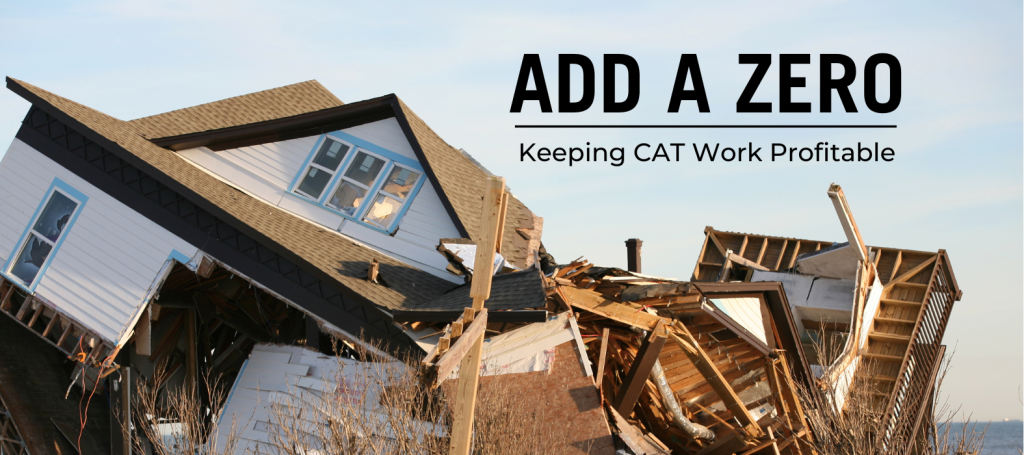
Since the 1990s, ATI has been on the front lines of every major CAT (catastrophe) event throughout the United States. From 9/11 to Hurricane Katrina, and now Hurricanes Helene and Milton, we’ve continued to learn from each response and fine-tune our processes and procedures. When responding to these high-stakes events, every second saved and resource maximized can make a significant difference–not just for operations but for profitability.
In part one of our CAT response series, claims expert and adjuster Andy McCabe addressed a critical question: Should you respond to a CAT event? He gave restorers three key considerations to help them assess and prepare effectively. But readiness alone doesn’t guarantee profitability. To make CAT work worth your while, you need to take a hard look at your entire operation—sales, employee management, billing, and beyond.
In this final installment of our series, Jeff Moore and Derek Middleton from ATI, along with Andrew McCabe, explore strategies that ensure your CAT response efforts aren’t just effective—they’re profitable.
How to Stay Profitable
1. Know What You Can (and Can’t) Bill For
Billing during CAT events requires a clear understanding of what expenses carriers will cover. Derek recalls when Venturi, an ATI company, responded to a Gulf hurricane two years ago, and the nearest hotel was over an hour and a half away. For large-scale CAT projects, carriers often allow for mobilization costs to cover travel and team setup. However, for smaller jobs, logistical hurdles like long commutes can eat into your profits, as insurers may be less willing to reimburse additional expenses like lodging for your crew.
“Always confirm with the carrier what additional costs they’ll cover,” Derek advises. This ensures you’re not blindsided by unexpected out-of-pocket expenses
2. To TPA or Not to TPA
When a CAT event strikes, demand skyrockets, and not just for restoration services but for essentials like equipment, fuel, and lodging. Along with this increase in demand comes–you guessed it–increased costs for these goods. While most insurance companies expect elevated prices, you might run into problems when trying to bill a TPA for these extra costs.
Jeff highlights the trade-offs: “While TPA work can lead to steady payment and a consistent workflow, the operational costs can diminish profits. TPA work is often hard, demanding, and challenging, especially during catastrophic events. It typically does not allow for additional charges or fees, and restorers are often expected to stick to strict billing practices.”
These challenges mean restorers must weigh the benefits of TPA work against the potential hit to profitability, especially during large-scale CAT events.
3. Don’t Let Your Documentation Slip
In part one, Andy discussed the significant challenges restorers face when getting paid, especially after a CAT event. For this reason, Derek suggests focusing your efforts on ensuring your team knows what a good scope of work or estimate looks like, which shows the work is billable and explainable so that you can justify what you did. Jeff agrees: “Documenting every aspect of a job is very important. Keep detailed drying logs, record the equipment used and labor hours, and always get photo evidence of the work you’ve completed.”
Luckily for restorers, this doesn’t need to be done on pen and paper–or even done by the people in the field. There are ways to make CAT job operations a lot smoother and more efficient to eliminate headaches and maximize profitability:
- Lean on Your Home Base: Employees at your home office can assist with communication and help streamline operations, allowing on-site crews to focus on the task at hand while having support available for administrative tasks.
- Utilize Technology: Technology like Docusketch and Matterport can free up people in the field by allowing estimating to be done remotely by someone at the home office. However, Derek points out the importance of being prepared for situations where you don’t have internet or cell service. “Starlink is great because you can set up satellite internet,” he explains, ensuring you can still send data to your team even if cell towers are down.
4. Your Crews Are on a Timeline
From his time responding to CAT work, Andy can tell you that when the adrenaline is pumping and the profits are promising, it’s easy for everyone to overestimate a crew’s stamina, including the crew themselves. “I responded to Hurricane Florence in South Carolina, and the company I was working for tried to keep the entire crew in South Carolina for the duration of the response. About two weeks in, people started dropping. I’ve found that on day 12 or 13, people need a break.” Plan on rotating your crew in and out, or risk losing them. With 2-3 years of work on the horizon following these big hurricanes, there isn’t a rush. The only timeline you are on is the one you put yourself on by making promises to owners.
5. Don’t Get Too Greedy
With the sheer magnitude of work that is created after a large CAT event, it may be tempting to delay lining up jobs after you have boots on the ground. However, Derek and Andy would suggest otherwise. “Start by contacting insurers and TPAs you’ve worked with before to let them know you’re mobilizing,” Derek advises. “They often need help finding reliable teams for the work.”
Andy recommends sending someone ahead of time to canvass neighborhoods and secure jobs before your main crew arrives. “This will ensure that your pipeline stays full, and you can feed the machine you’ve mobilized,” Andy says. “Set up a base in a commercial park or neighborhood, park your trucks, and put up lawn signs. Calls will start coming in,” he says.
It’s equally important to not overcommit. Andy warns against spreading yourself too thin: “Everyone will want you that same day. Some contractors will capitalize on this and take on too many jobs, set up a dehumidifier at each, and then ghost the owner until they finish their current job. By the time they return, a new company is on site, and they’ll be lucky to get their equipment back, let alone get paid.”
6. Protect Your Home Base
After Hurricane Helene, Andy remembers seeing a social media post of a restorer’s truck with a caption that read, “Here I am servicing other people’s customers while they respond to CAT.” If you don’t have anyone taking care of your clients at home, your competitors will capitalize on that. Ask yourself, what work am I potentially walking away from if I respond to this storm, and is my team at home able to take care of our current clients?
ATI prioritizes ensuring our local markets are fully supported before extending resources to CAT events. This approach keeps our reputation intact and ensures a steady stream of work once the CAT response concludes.
The Demand for Restoration
The rising frequency and intensity of natural disasters, aging infrastructure, and urbanization continue to drive an increased global demand for restoration services. As this demand grows, restorers will need to assess which jobs align with their current capacity and long-term goals.
We hope that the insights of Andy, Jeff, and Derek have helped you navigate some of the crucial questions surrounding this type of work: Should I go? How should I prepare? And most importantly, how can I stay profitable?
ATI with contributions from Jeff Moore, Derek Middleton, & Andrew McCabe
 After earning his degree from Southern Methodist University, Jeff Moore began his career at ATI in 1994 as a restoration technician, working his way through the ranks of every division of the company, both in the field and at the corporate level. He served as Executive Vice President from 2012-2019 and has served as Co-President with his brother since 2019, Ryan Moore. At the helm of the company, Jeff is responsible for the day-to-day operations, focusing on the future of the organization and revenue generation, including Sales, Marketing, and Mergers and Acquisitions. He is driven and has a passion for differentiation through technology and innovation.
Jeff serves on the Board of Directors for RIA, continually advocating for the restoration industry. He holds several advanced designations with RIA, CR, WLS, and CMP. He also has his Master Designations with IICRC for Fire & Smoke, Water Restorer, and Textile Cleaner.
 Derek Middleton has been in the restoration industry for 32 years. Starting his career as a mitigation technician in 1993, he gained extensive expertise during his 23 years at BELFOR, where he held a variety of roles. For the past nine years, Derek has been with Venturi, an ATI company, and currently serves as Vice President of Operations at ATI.
 Andrew McCabe is a licensed claims adjuster and founder of Claims Delegates, specializing in property damage restoration and insurance claims. With over 20 years of experience, Andy has responded to numerous catastrophic events, gaining deep insight into the challenges restorers face. He’s also the leader of the Restoration Rebels, a community dedicated to empowering contractors through education and fair practices. Known for his expertise in Xactimate estimating and public speaking, Andy advocates for better business strategies and transparency in the restoration industry.
Related Posts