A happy customer at the end of the job is always the goal. A happy customer several years down the road is even better. Installing the right product for their situation will help maintain a happy customer.
How Do You Know What to Choose?
While the decision for the final product at times becomes the dreaded “like, kind, and quality” scenario, those products might not be available anymore, and decisions have to be made. Oftentimes, decisions must fit within certain parameters, such as price range. And what if the customer wants to change the flooring in the room to something totally different? It all comes down to the customer, and knowing about different products can help you be more informed about how to price installations, how to schedule other work, and for you to have a better idea of what the final project will look like. Some products can be limited by the kind of damage that was done and the remediation to fix it.
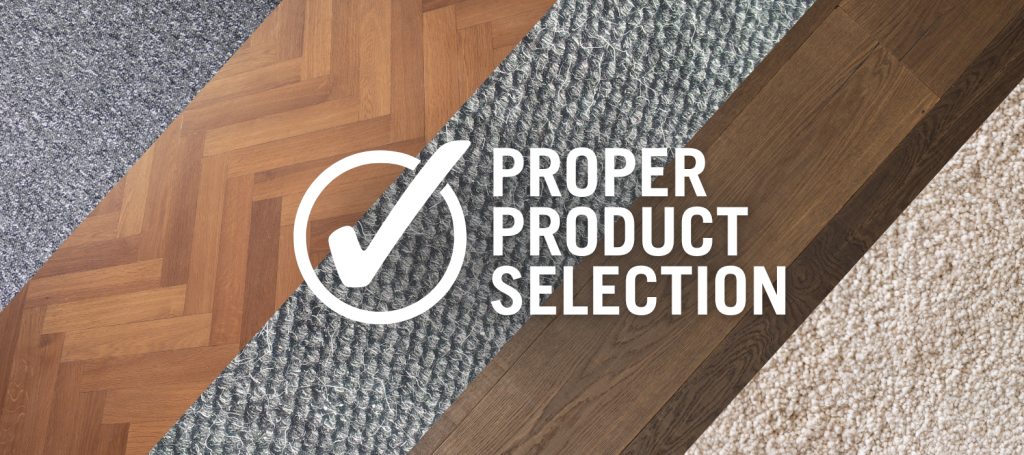
Carpet
Soft, comfy carpet has been falling in market share for hard surfaces, but it is still used in bedrooms and area rugs. Carpet is an inexpensive option for replacement, and with new patterns and designs, it can give your customers the look and feel they’re going for. New patterns and designs in the carpet can make it a statement piece that the room was missing.
Carpet works well in almost every room, including bedrooms, living rooms, and basements. While a customer may be concerned about high-traffic areas, lower pile, cut/uncut patterns, and color fleck (more than one color) can help hide traffic lanes. While a customer may think a hard surface is better to go with after a basement flood, remind them that any hard surface may have to be taken up anyway. Carpet gives the most warmth and helps the most with acoustics.
In commercial applications, consider carpet tiles. While the price point can be a bit more, the ease of installation, the ability to take up a tile if it needs to be replaced, and the designs can make it a more attractive option.
Hard Surface
Hard surface flooring has increased in volume exponentially as luxury vinyl continues to expand. The price points fit most budgets, and the looks are continually improving. While everyone likes hearing a “waterproof” story, it’s important to know what those waterproof warranties cover. Most will only cover top-down water. If the basement floods, the dishwasher leaks, the tub overflows, those floors are not warranted. I have heard of customers being able to remove and replace the floor without damage but know your water categories and know whether it can be removed and reinstalled or if it needs to be thrown away.
While vinyl is the hot product, laminate has come a long way from its first generation. Many now have the same top-down water warranties as the vinyl planks. New technologies in core material, locking mechanisms, and edge sealing make them much more improved than they used to be. Personally, I feel laminate still has a more wood-like appearance. The embossing, print layers, and edging replicate wood better than some vinyl planks. Price points on laminate have not moved much, and many are made in the USA making availability concerns negligible.
Wood floors have seen a resurgence with more middle to high-end clients. Wood can be a great choice as long as its limitations are taken into account. If you’re trying to match something existing, even if it’s the same manufacturer, same stain, same finish, it will not match coming out of the box. Wood will change color with light exposure whether incident or coming through a window. Exotic woods can show this more dramatically and usually take less time to change colors. As you know, wood will scratch and dent (any of the hard surface floors can) more easily than other hard surfaces.
For commercial applications glue-down vinyl plank is always my recommendation over any locking plank. While locking is easier and involves less floor prep and less labor time, the limitations of the product will always come back to haunt you. Locking plank has limitations on the maximum span it can be installed, how it reacts under rolling traffic and subfloor requirements. I have seen one too many locking vinyl plank jobs curl in commercial applications to recommend them confidently. Glue-down vinyl plank is more forgiving, is approved for rolling traffic (read the installation instructions), and is much easier to replace if a plank or planks get damaged.
Proper product selection will ensure your customer is happier with the job once it is completed. Having a good understanding and knowledge of various flooring products, their limitations, and the best choice for each customer and each space can help guide you and your customers to a better-completed project. Reach out to your favorite flooring professional (I would encourage you to reach out to a local non-box store) to help you help your customers.
Jessica Violand Bruno
 Jessica Violand Bruno grew up in the flooring industry as the daughter of a carpet cleaner and inspector. She earned her flooring inspection credentials in 2006 and is also a top sales associate at a local flooring retailer. She specializes in using her unique experience to help customers choose the right products for their projects. You can reach her at [email protected] or 330-807-6702.
Related Posts