Lately, I’ve been out in the field on several water loss projects—ranging from small residential jobs to large commercial claims—and I’ve also reviewed more than my fair share of job files and documentation. What’s become clear, and frankly a little troubling, is the widespread misunderstanding—or in some cases, total absence—of adherence to the ANSI/IICRC S500 Standard for Professional Water Damage Restoration. Despite being one of the most established and accessible tools in our profession, the S500 seems to be underutilized or misapplied on a regular basis, especially when it comes to the technical processes involved in structural drying.
This isn’t meant to point fingers or shame anyone. Restoration work is demanding, fast-paced, and ever-changing. But as professionals, we have a responsibility to not only do the work, but to understand the “why” behind how we do it. The S500 is more than a set of recommendations—it is a consensus-based standard developed by industry experts to guide us toward safe, effective, and justifiable water damage restoration practices.
The following article is a deep dive into Chapter 12 of the S500. It’s intended to serve as both an educational reference and a practical field guide, especially for those in the thick of daily drying jobs. Whether you’re new to the industry or have been doing this work for decades, understanding the guidance in Chapter 12 will sharpen your decisions, strengthen your documentation, and most importantly—help ensure that your work stands up to scrutiny, both technically and ethically.
For professional water damage restorers, Chapter 12 of the ANSI/IICRC S500 Standard isn’t just a technical section—it’s the operational backbone of structural drying. With the latest 5th edition released in 2021, this chapter offers a science-backed, step-by-step roadmap to restoring affected structures to a pre-loss dry standard. In a high-stakes field where the margin for error can lead to microbial amplification, compromised materials, and litigation, the guidance language of Chapter 12 is both a shield and a sword. It empowers restorers to work with precision while holding them accountable to a recognized national benchmark.
One of the most important takeaways from this chapter is the structure of procedural guidance built around five restoration principles: protect health and safety, conduct inspections and documentation, mitigate damage, dry and clean the affected area, and complete final repairs. These principles serve as the foundation from which every drying action should emerge. On the jobsite, understanding how to link these ideals to actual steps can improve project outcomes, protect worker and occupant health, and reduce liability.
The emphasis on rapid response in the initial inspection and planning phase is not theoretical—it’s practical and measurable. Building materials absorb moisture differently based on their porosity and surface tension. The longer these materials remain wet, the more water they absorb. Extended exposure not only increases the drying time but significantly raises the chances of irreversible damage or microbial amplification. Therefore, as soon as it’s safe, extraction and containment must begin. This response window is vital, especially when evaluating the restorability of items like drywall, laminate flooring, and insulation. Waiting just a few extra hours can shift these materials from recoverable to unsalvageable.
Equally critical is the determination of both the Category and Class of water. Category refers to the level of contamination, from clean (Category 1) to grossly unsanitary (Category 3). Class refers to the volume of water and the extent of absorption into building materials. This classification is essential, not only for drying strategy but also for safety, documentation, and potential third-party verification. Misclassifying a Category 2 loss as Category 1, for example, could result in failure to implement containment or personal protective equipment, potentially putting technicians and occupants at risk.
The standard also makes it clear that with Category 2 or 3 water intrusions, remediation must occur before restorative drying. This may include source elimination, gross removal of contaminants, controlled demolition, and the installation of engineering controls. HEPA-filtered air filtration devices, negative pressure zones, and proper containment barriers are not optional—they are required to prevent aerosolized pathogens from cross-contaminating unaffected areas. Technicians should be trained to identify signs of contamination and make clear recommendations for involving an Indoor Environmental Professional (IEP) when high-risk factors such as healthcare settings, infants, or immune-compromised occupants are present.
An often underappreciated component of Chapter 12 is the drying plan. This plan is more than just a checklist; it is a living document that outlines the strategy for humidity control, equipment deployment, environmental control, and drying verification. It takes into account variables such as construction assemblies, building envelope integrity, weather conditions, and the role of HVAC systems. When executed correctly, it allows technicians to adapt and optimize their equipment setup as drying conditions evolve. Key components of a drying plan include the type of drying system (open, closed, or combination), vapor pressure differential goals, air mover and dehumidifier calculations, and monitoring strategies.
Understanding the difference between open, closed, and combination drying systems allows restorers to choose the best approach for each loss scenario. Open systems utilize outdoor air to facilitate drying and are only appropriate when outside humidity ratios are lower than those inside the structure. Closed systems rely entirely on mechanical dehumidification and offer the most control, especially in unpredictable weather or sensitive environments. Combination systems may start with open drying and transition to closed conditions. The decision between systems must be informed by psychrometric readings and jobsite constraints like security, power availability, and building occupancy.
Dehumidification, as outlined in the standard, is a calculated process. It begins with an estimation of the evaporation load based on affected materials and surface area. Technicians must understand how to size dehumidifiers to match this load and monitor whether conditions are moving toward the target vapor pressure differential. The S500 encourages documentation of the rationale behind equipment sizing, including material types, equipment specs, and ambient conditions. Modifications to the equipment setup—such as adding a second LGR unit or repositioning air movers—should be based on psychrometric trends and data and not on intuition alone.
photos courtesy of Lorne McIntyre
The role of airflow in drying cannot be overstated. During the constant rate drying stage, surface evaporation dominates, and airflow velocity of around 600 feet per minute (FPM) is optimal. As drying enters the falling rate phase, surface moisture diminishes, and moisture migration from deeper layers becomes rate-limiting. At this stage, reducing airflow to 150 FPM and increasing vapor pressure differential through added heat or dehumidification, can be more effective. Restoration professionals must be prepared to shift strategies accordingly and understand that excessive airflow can actually impede progress in dense, low-permeance materials.
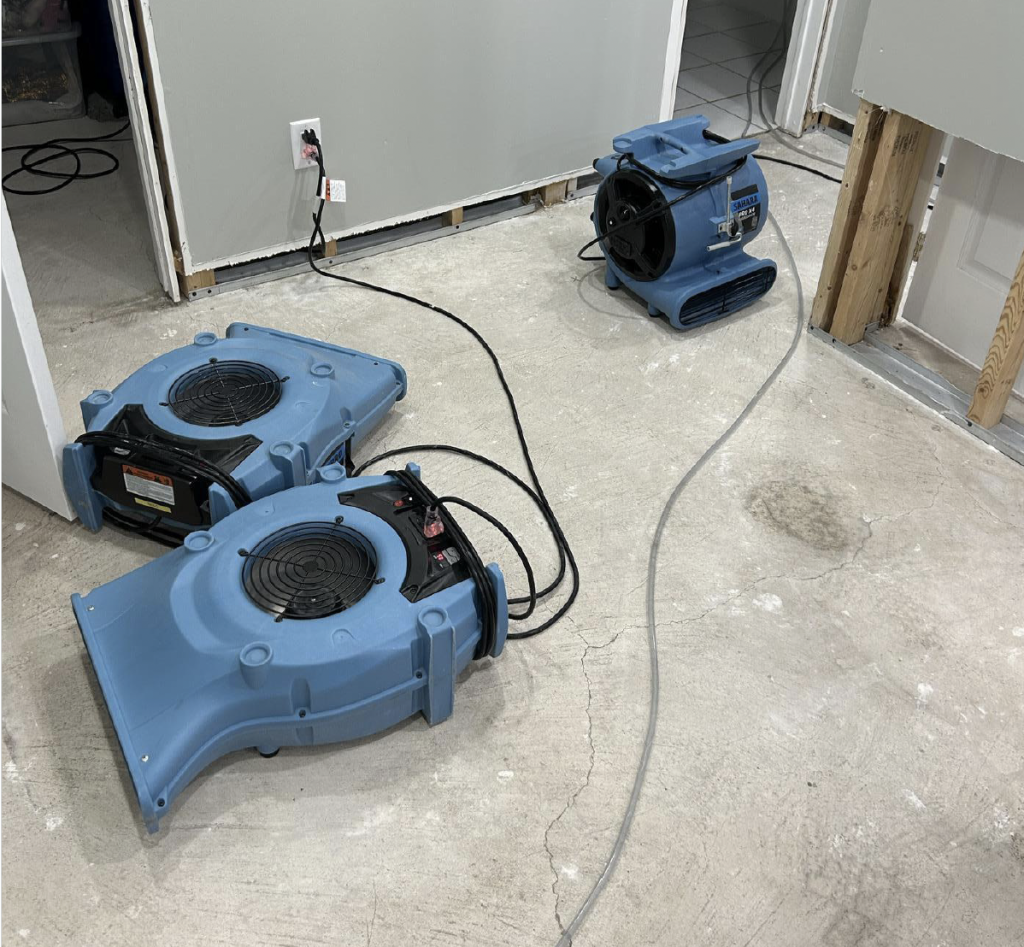
Air mover placement is both science and art. The standard recommends one air mover for every 50–70 square feet of wet floor and one for 100–150 square feet of wet wall/ceiling above 2 feet. Obstacles and insets within rooms should be taken into consideration. Technicians should remember that airflow should be continuous across all wet surfaces, and stagnation zones—like behind furniture or within wall cavities—should be addressed using specialized drying systems or cavity injection methods.
Another crucial component of structural drying is temperature control. Raising the temperature of wet materials accelerates evaporation by increasing the vapor pressure differential. Heat can be introduced through dehumidifiers, HVAC systems, or external heating units, but it must be managed to avoid damaging contents or creating combustion hazards. Technicians must also understand the drying limitations of HVAC systems, which are designed for occupant comfort, not moisture removal. The S500 permits use of these systems, but not as a replacement for professional-grade drying equipment.
photos courtesy of Lorne McIntyre
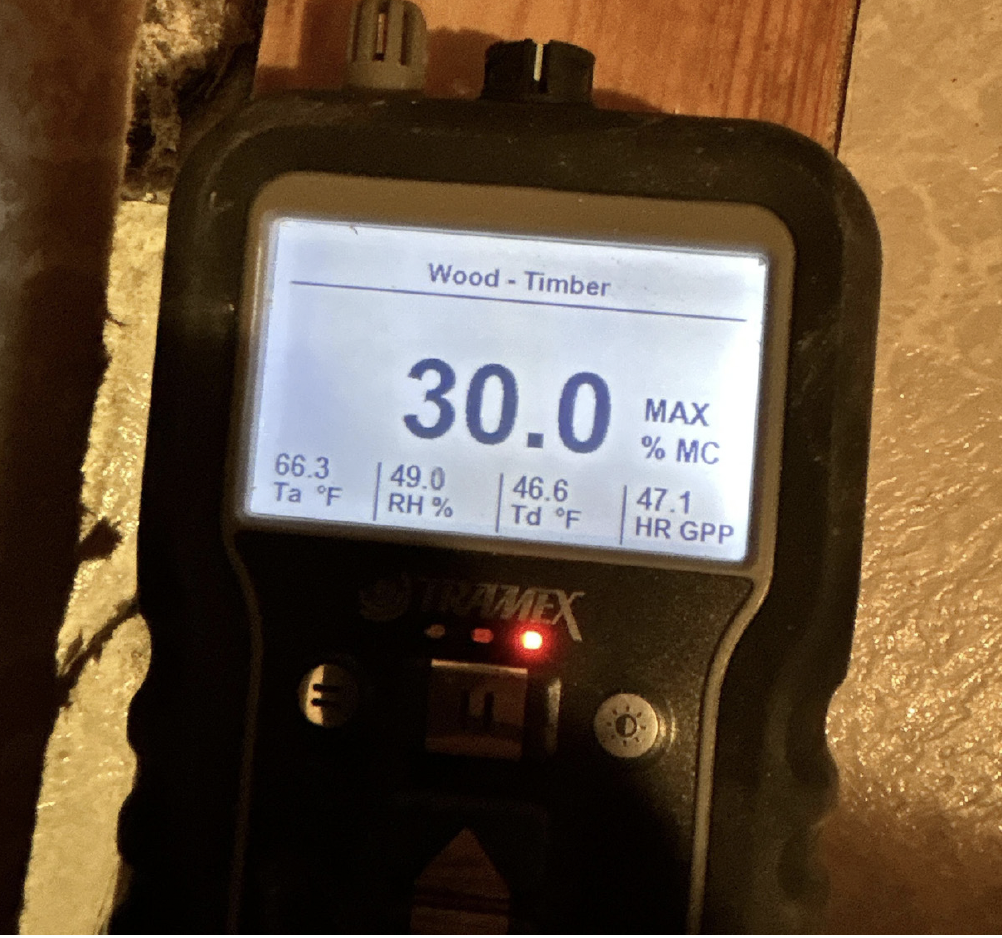
Monitoring is what distinguishes a professional drying operation from amateur work. The standard requires daily documentation of temperature, relative humidity, grains per pound (GPP), and material moisture content. This data is essential to confirm progress, justify equipment use, and identify plateaus or setbacks. Moisture meters should be calibrated and used consistently at marked locations. Adjustments should be made whenever goals are not being met, and any deviation from the original drying plan, should be documented with rationale and communicated to materially interested parties.
Ultimately, structural drying concludes not when the clock runs out or the power is unplugged, but when drying goals are objectively verified. The S500 defines this as the point when materials have returned to normal moisture content or levels consistent with unaffected reference materials. Technicians must use appropriate meters and verification methods and retain those records. If contents, assemblies, or materials remain unrestorable, the standard encourages accurate evaluation, documentation, and recommendation for reconstruction or replacement.
Technicians and restorers working in the field should treat the S500 as more than a regulatory guideline—it’s an operating manual, a liability safeguard, and a blueprint for professional excellence. Chapter 12, with its detailed breakdown of drying phases, equipment deployment, monitoring, and decision-making protocols, is especially relevant for those on the front lines of water loss response. It demands that workers know their terminology, understand the science behind the tools, and follow procedural guidance based not on convenience, but on proven effectiveness.
In the competitive and high-stakes world of restoration, knowledge isn’t just power—it’s professionalism. And with Chapter 12 of the S500 in hand, the industry now has a shared technical language and standard of care to ensure every drying project is safe, successful, and justifiable.
Lorne McIntyre CR WLS FLS CLS ERS CSDS
 Lorne McIntyre is a recognized expert in the cleaning and restoration industry, known for solving complex problems and raising the bar across the field. As Principal Technical Advisor at Verify Appraisal & Consulting, he’s a trusted resource for clarity, credibility, and results.
A Technical Trainer for the Restoration Industry Association (RIA) and an IICRC Approved Instructor with the Restoration Science Academy, Lorne holds all three IICRC Master Certifications and every RIA pillar designation—including the prestigious Certified Restorer (CR).
He also contributes to industry advancement through active roles on several RIA and IICRC committees.
To connect with Lorne, reach out at [email protected]
Related Posts