This article was written by a human.
My hot take is that ALL future searches will be done through AI, whether it be Google (Gemini) and/or others. It’s just that much more effective and efficient. The goal of this article is to let you know where we are with AI Search, what you can do, and how to be at the frontier of it – today.
For the first time in a long time, organic search is changing. How people are searching is changing, where they are searching, the SERP (Search Engine Results Page) itself, how results are being compiled, and even how we respond to the search results.
So what does this mean for us restorers and local service businesses? After two years of careful analysis, research, attending tech conferences, and speaking with head of product at Microsoft – I’m going to lay out what I know about how LLMs are working.
How they’re impacting organic search and what our options are as restorers. I’m going to break this article down into three sections;
- How LLMs are pulling in results.
- What should we be doing to be cited by AI LLMs?
- Where’s this all going, and why should we care?
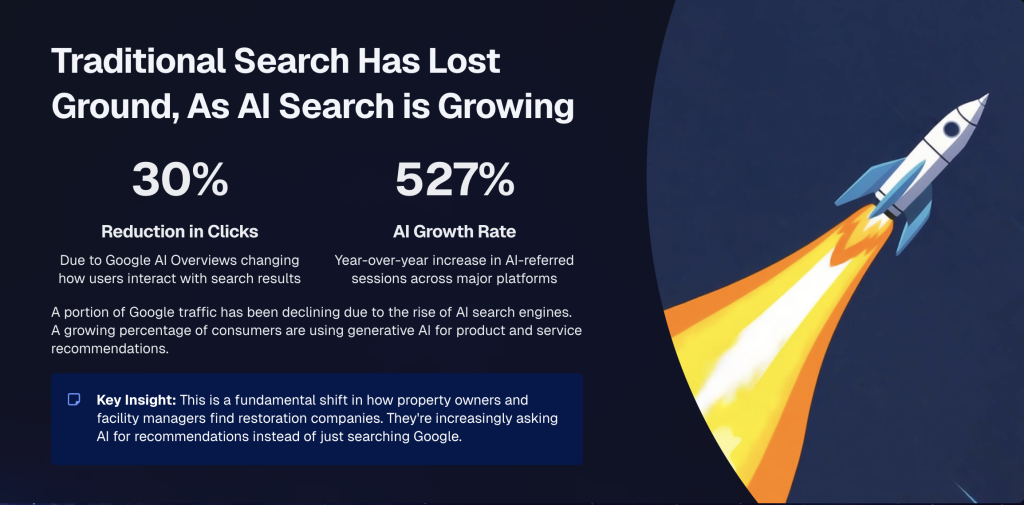
First, here are some key statistics on what’s happening with AI (and this changes fast, of course).
- AI Search increased 527% in 2025.
- Visitors from AI convert 5x-20x better than traditional search.
- Restoration companies that optimize NOW will have compound advantages as AI search grows.
- AI search visitors are predicted to surpass traditional search by late 2027.
- AI Overviews appear in 18% of global Google searches (and growing rapidly)
- Often above Paid Search Results!
How are LLMs working
Let’s tackle one of the more controversial statements in search today – Ranking
in AI (GEO/AEO) is the same as good SEO. As much as I wanted this to be true, primarily because I believe in the strong SEO efforts we provide – the reality is AI is paying attention to things Google didn’t care much about.
The first thing to know about AI is that it cares more about what others are saying about you than what you’re saying about yourself. Google relied on some on-page technicals to fully understand what your page was about, and used those signals to rank
you for the specific terms you wanted. Google also relied on high-authority links to pass trust and authority to your website, and ultimately allow you to rank.
The thing is those links that most people were acquiring and purchasing are invisible to the AI. LLMs aren’t crawling the entire web like Google (still relies on Google’s top ten), and are not following links from one site to another, the way Google did. So while Google gave you credit for those links, the links are relatively not helpful for AI, besides the fact that the link may help you rank in Google’s top ten for a specific search term. That’s where there are some synergies.
Let’s also flip it the other way. Let’s say you get mentioned in a news article, or a Reddit
post. If there were no links for Google to crawl, and assign “link juice/authority” to your site. It didn’t help your DT (Domain Trust). Now with AI, these different LLMs are actually using brand mentions as high-authority intent. LLMs put an extreme level of authority on large, established sites when creating the answer generation for prompts.
What are LLMs doing?
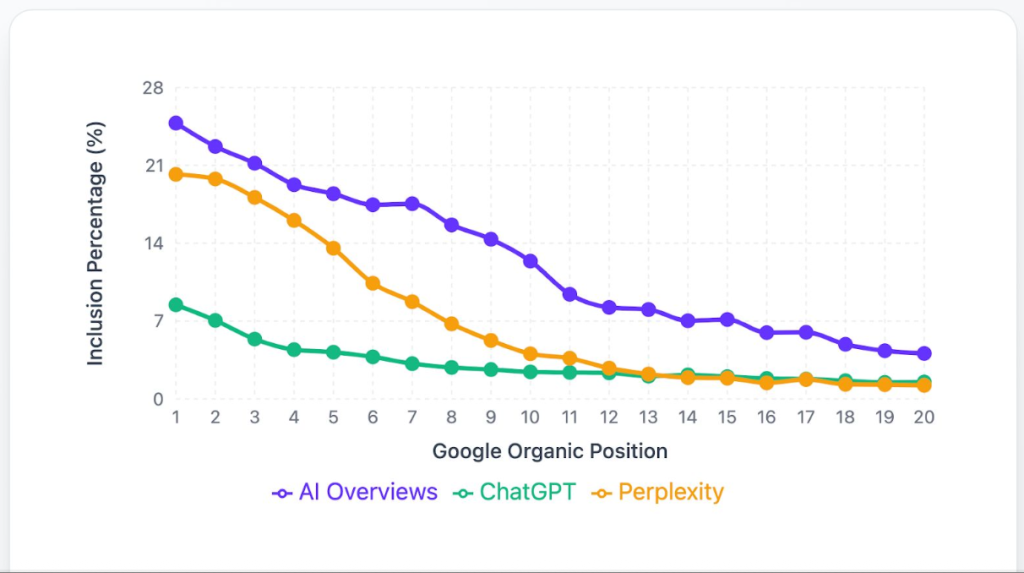
- They’re crawling the top of Google. LLMs are actually kind of “lazy” (get more into this later), and reading the top of Google for a quick synopsis of “quality” sites is a great way for them to capture the best answers, quickly. So, organic Google SEO and ranking in the top ten is a good prerequisite for AI Search. If you don’t currently rank in Google’s top ten, complete that first. Even with this accomplishment, we only have a one in four chance, 25%, to get listed. So that’s not enough, but it’s a start.
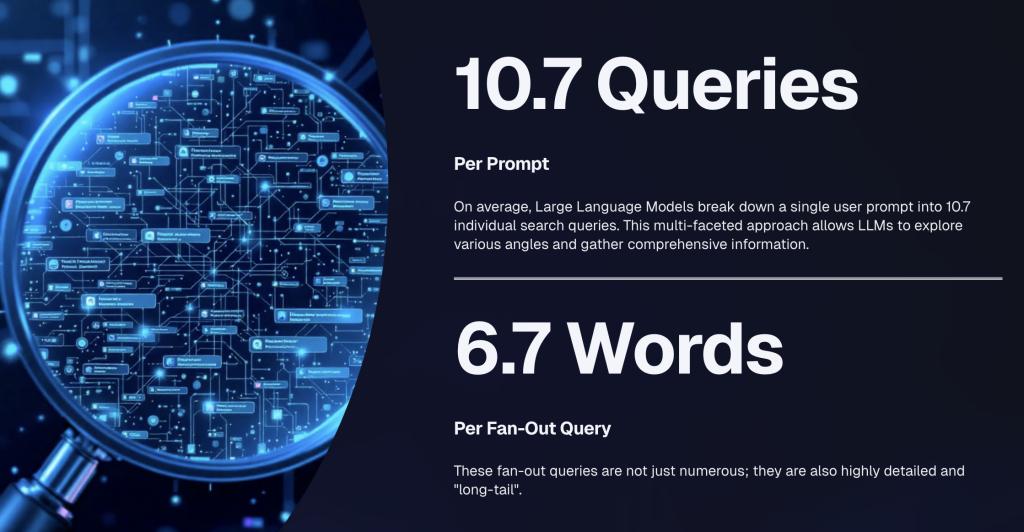
- After you enter a prompt, such as “what is the best water damage company in [city],” the LLMs begin something called “Query Fanning.” This is where the AI will break your prompt into several different queries to find the best possible answer.
2026 Tip: Ask your digital marketing agency, “What is Query Fanning?” if AI is on your radar for 2026.
For example: The prompt “what is the best water damage company in [city]” could be broken down into:
- Best water damage company
- Water damage companies in [city]
- Reviews of restoration companies in [city]
- Fastest response times for water damage companies
- Average cost of water damage cleanup
- What is the water damage cleanup process
- Etc.
Statistics show that Google Gemini breaks out prompts into an average of 10.7 queries. Think about that: you ask it one question, and it’s researching 10-11 different questions to provide an answer. This is also why our search behavior is different, and AI is a recommendation system. More on this later.
Back to our different queries. If you look at each of these different queries, they are each going to provide different SERPs, and different types of content that ultimately need to be created, in order to be referenced.
- Best water damage company – commercial intent, service pages
- Water damage companies in [city] – commercial intent, service pages
Reviewsofrestorationcompaniesin[city]-reviewsfromthird-partyplatforms, forums/threads, etc
- Top water damage company – Listicle, rankings site/page
- Fastest response times for water damage companies – user-generated comments, threads, reviews
- Average cost of water damage cleanup – informational, blogs, forums, reviews
- What is the water damage cleanup process – informational, blogs, YouTube
Now, when you start breaking down where we started, “what is the best water damage company in [city]”, the LLM is researching far beyond our original intent.
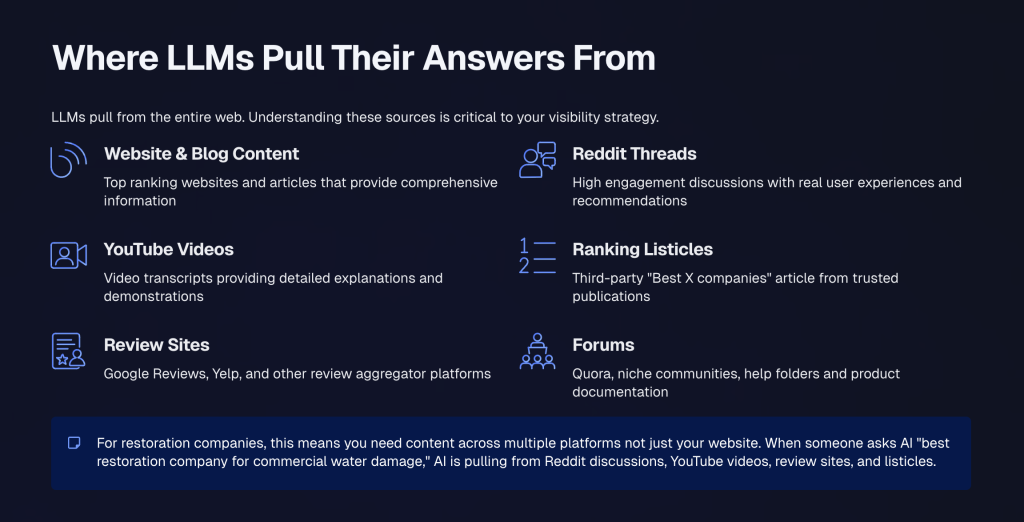
So what does this mean for us in AI search? For starters, we need to be in more places (off-page), and we need more “complementary content.” When an LLM searches all of these different queries, we now need to be cited or a source in as many of those results as possible. More raffle tickets in the drawing, per se. If there are on average 10.7 queries per prompt and we only show up in the answer pool for one of those queries, our odds of being in the answer generation is very low. We need to be shooting for a minimum 50% of query results.
Quote from Microsoft: “If you’re not found at this stage, you won’t be in the answer generation.”
3. Brand Mentions/Citations
The previous section outlining the type of content we need to create and be found in is listed above. This is where we need our brand mentions. But let me make this crystal clear: the LLMs are sourcing more high-profile websites (ranking in Google top ten often) to collect evidence for their answer. So, in order to be in the answer generation for whichever AI a homeowner is using, we also need to be mentioned in these high-profile domains. This requires a higher sophistication of off-page strategy that just wasn’t always necessary for Google’s organic searches. This is one of the major differences from Google’s organic SEO. I used to buy high-authority backlinks that Google deemed “quality,” but the AI is just not seeing these domains. Google has approximately 3-5x more websites crawled in its index than these LLMs. Google cares about an “anchor text” to a link, and then follows that link. AI isn’t doing this.
This is also where a lot of restorers got burned, off-page authority. I would speak to many owners frustrated and annoyed that SEO didn’t work, but they weren’t able to see if their domain authority increased. Which is a key component for traditional Google SEO. If this wasn’t done, it created a poor experience for restorers with digital marketing agencies.
Now, this just got a whole lot harder to execute, and will separate the people who really understand SEO/GEO/AEO, or whatever you want to call it these days.
4. Evidence Synthesis
After the LLM has compiled the results, it will deduplicate, eliminate, personalize, and check security protocols to provide an answer to the user. Then you have to consider the model impact – each model and LLM will have its own unique preferences, guardrails, etc. Creating content, having it placed in high-authority sites, and getting cited by AI is a lot more unique and difficult in this day of organic search.
While this is an overall simplified explanation of what’s happening after we enter a prompt into an LLM (specific to our use case for restorers), hopefully this illustrates how we need to begin approaching our organic search differently.
What can we do?
I’m going to break this topic into a few notable sections that you can take back to your team:
- On-page structure
UGC/Forums
- PR/Brand Mentions
- Server Logs
On-page structure
I think this is really where understanding “Query Fan-Out” and how to set up content that provides results. Let’s talk about what LLMs prefer. Remember earlier when I said LLMs can be lazy? You were probably thinking, “What does that even mean? They just do the job they are told.” Well, LLMs are also trying to be efficient, and if they can’t find the information they are looking for or need to visit multiple pages (they don’t love that), they may stop crawling your site and not reference it. We have to make it easy for them to navigate, understand, and be able to get the information quickly. We can accomplish this by:
- Using Schema
- Less navigation: content depth
- Chunking: synopsis blocks, TLDRs, etc
- Specificity: use detailed information and stats the AI can cite
- Speed: Check for 499 errors in your logs (this means the LLM’s bot gave up, and you don’t want that)
I could go further into detail here, but the technical level of information would simply make this article even less readable.
UGC/Forums
This is pretty straightforward, but again, not something traditional SEO cared a lot about. The plan here is we need to be able to find, source, and engage where the current conversations are when it comes to our search terms. So think of engaging with homeowners as they’re asking the general audience for water damage, restoration, home tips, roofing, carpet, smoke, fire, etc., you get the point. We need to inject your company and brand in front of them, and ultimately have AI scrape that as a “mention.”
In order to do this, you’ll need to set up the infrastructure, strategy, and accounts to be able to execute it. That being said, this is a new must-have. These two platforms (Reddit/Quora), specifically Reddit, have become some of the most trusted and cited sources in the answer generation from AI. We all NEED to be there, it’s that simple.
What’s nice with AI and LLMs is that they’re showing you (in their citations) where they are pulling the sources from and ultimately compiling their answers. Google never gave this to us. Let’s take advantage.
No one is using this strategy right now, so it is the early days and the easy low-hanging fruit.
PR/Brand Mentions
This is similar to the last section (UGC/Forums), but far more difficult to execute and more about getting placed in other high authority sites. As I described earlier, just buying links to what Google deemed as quality domains isn’t going to be enough for LLMs. They aren’t crawling those websites the same way Google did. AI wants to see you cited in the websites that they are picking up, that are ranking, and that are high-influence. Think: Yahoo, News, Media/Industry Publications, Forbes, Listicle/Ranking Sites, and more.
The strategy here is more focused and requires a lot more work. To get listed here you need to:
- Write exceptional data-driven content
- Do PR targeted outreach
- Track and execute submissions
Server Logs
I realize the title of this section is very skip-worthy, but don’t fall asleep on me just yet! As I already noted above in the on-page structure section, we have to make sure our content is quickly accessible. If you see an error log of 499, the AI agent gave up and left your site. When you enter your prompt into the LLM, it will break the prompt into several different queries (Query Fan-Out) and then perform research on all of those. So while it’s compiling all of this information, the AI needs to get you an answer quickly. It knows none of us like waiting. So, if the AI agent bot feels like it is taking too long to get the information from your site, it will leave. Not good.
Not only that, the server logs will show you how often an AI agent bot is visiting your site, and which pages it’s visiting. You want to cross-reference this information to see if:
- Are they visiting and how often?
- Are they not going from one page to the next? (Remember, they can be lazy)
a. Do I need better content depth? - Are they visiting particular pages often, but I’m also not getting cited by them for a specific prompt?
Where is this all going? Why should we care?
Recently ChatGPT has been on record saying they now have 900 million weekly users. Nearly a billion users a week. That’s approximately already ⅓ of the monthly reported numbers for Instagram. One of the most important factors that is becoming very clear from AI search is that it is used as a recommendation platform. Not a research platform like Google. Let’s talk about the difference.
Traditional Google/Research
- You do a search for “best water damage company [city]”
- You get a list of sites you browse and read through
- You check reviews
- You call maybe 2-3 for detailed information (response info, pricing, etc.)
- Non-emergency, of course. But even so, more and more homeowners are shopping for restoration work.
- You make a decision
AI LLM Assisted Search
- You do a search for “what is the best water damage company in [city]”
- AI recommends 2-3 specific companies with reasoning
- You read the explanation and reasoning from the AI and choose one
- You call that one company
The difference here in behavior is monumental. Especially for local service companies. Consumer behavior is going from a research mindset to “I trust the AI’s research.” We’ve probably been there too, where we rely on AI to “give us the answer.” Same here for looking up local service companies.
What does this mean?
Increased conversions! Right now, traffic is still low, albeit difficult to monitor. But when someone does visit your site from an AI Search, their likelihood of converting into a call and a customer is dramatically higher (5-20x). Just imagine when traffic dramatically increases, as it inevitably will.
It’s never going to be easier to position yourself in AI. You could wait until there is more meaningful traffic, or be there ready for when it happens.
Also, they’ve already announced ads for ChatGPT (live).
Takeaways
The Fundamental Shift: AI search isn’t just SEO with a new name. While Google cared about what you said about yourself and followed backlinks, AI LLMs prioritize what others say about you on high-authority platforms they actually crawl. Those expensive backlinks you bought? Largely invisible to AI.
Query Fan-Out Changes Everything: When someone asks, “what’s the best water damage company in [city],” AI breaks this into 10+ sub-queries. Such as, service pages, reviews, process explanations, pricing info, and response times. You need to show up in at least 50% of these query results to have a real chance at being cited. One raffle ticket isn’t enough anymore.
The Citation Game: Reddit threads, news mentions, industry publications, and review aggregators now matter more than your domain authority score. AI trusts brand mentions on platforms that it recognizes over traditional SEO signals. Microsoft put it bluntly: “If you’re not found at this stage, you won’t be in the answer generation.”
Behavior is Changing: AI search is a recommendation system, not a research platform. Instead of calling 2-3 companies after browsing options, homeowners now get AI’s vetted recommendation and call that one company. This is why AI search traffic converts 5-20x higher. Visitors arrive with intent and trust already established.
The Early Adopter Advantage: Traffic is still low but growing very fast year-over-year. Companies optimizing now build compound advantages as AI search visitors are projected to surpass traditional search by late 2027. It’s never going to be easier than right now to establish your position.
Jeff Carrier
 Coming from a restoration marketing background, Jeff Carrier and his team at FRS launched Restoration Digital Marketing in 2017, to serve and help fellow restoration companies with driving sales from online and other online marketing needs. Carrier is also the co-founder of online ERP platform Restoration ERP, a tool designed to assist restoration companies generate sales from commercial clients.
Related Posts