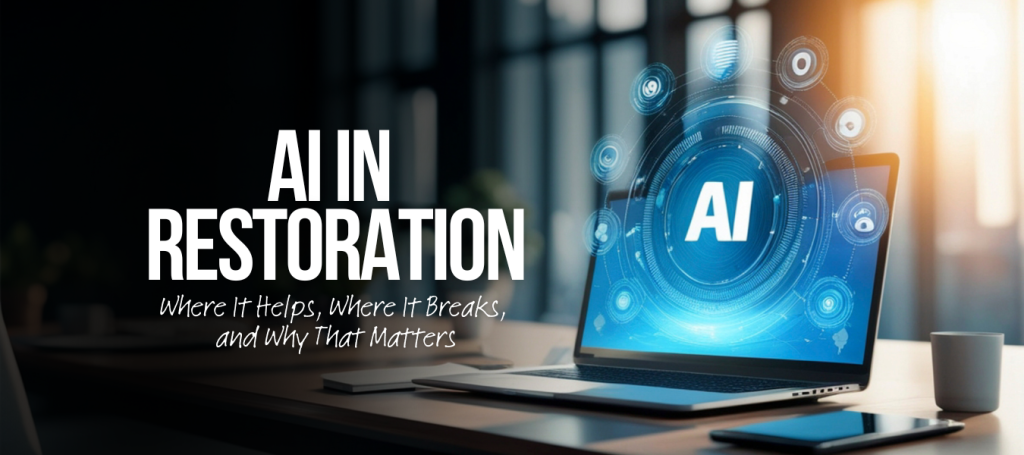
AI has started showing up everywhere in restoration. Not just in marketing talk, but inside CRMs, reporting tools, intake systems, and internal workflows. Some of it is genuinely useful. While others are creating confusion because everything now gets labeled as “AI,” even when the tools behave very differently.
That matters because the restoration industry is not forgiving when things go wrong. Small documentation mistakes turn into claim delays. Vague notes turn into adjuster pushback. Poor communication turns into callbacks, complaints, or lost referrals.
AI can help in this industry. But only when it is used in the right places and kept out of the wrong ones.
What AI Is Actually Doing in Restoration Tools
Most AI used in restoration today is not making decisions. It is doing cleanup work.
- It drafts notes from existing information.
- It summarizes calls, emails, or job updates.
- It organizes photos, messages, or intake details.
In other words, it speeds up the parts of the job that normally happen after the work is already done. That is why it feels helpful. It reduces time spent typing, formatting, and organizing information.
What it does not do is understand what makes a job defensible, compliant, or clean from an insurance perspective. It does not know why one moisture reading matters more than another or why certain language raises red flags with carriers. AI works with patterns, not judgment.
Where AI Starts to Break Down
Problems start when AI output is treated as finished work. In restoration, documentation is not just paperwork. It is evidence. It is reviewed by people who look for inconsistencies, missing details, or vague explanations. AI does not understand that pressure.
A summary that sounds confident but skips context can create more questions than answers. A generated explanation that does not align with the actual scope can slow approval. A report that looks polished but lacks specificity can invite scrutiny. None of this happens because AI is broken. It happens because it is being used the wrong way.
Why This Matters More in Restoration Than Other Industries
In many industries, AI mistakes are annoying. In restoration, they are costly. When something is unclear, the burden usually falls back on the contractor. Which is why treating AI output as final instead of draft level support introduces risks. It saves time upfront but can cost time later when files need to be corrected or defended. The issue here is not speed. It is accountability.
Where Companies Usually Mess Up
Most misuse is unintentional. It usually shows up in a few predictable ways.
- AI drafted notes get uploaded without review.
- Summaries are trusted even when they miss job specific nuance.
- Generated content is assumed to align with insurance expectations.
- Automation outputs are treated as approved language.
Each of these feels efficient in the moment. But over time, they only create friction with adjusters, confusion, or re-work that eats up even more time.
Where AI Actually Adds Real Value
Used correctly, AI can help restoration companies.
It reduces time spent on repetitive admin work.
It helps organize intake information faster.
It assists with first drafts, not final decisions.
When AI is treated like an assistant that prepares information for review, it works well. When it is treated like an authority, it does not. The companies getting value are the ones keeping humans responsible for what gets sent, submitted, or signed off.
Going Forward
AI is not going away from restoration. It will continue to show up inside tools owners already use. The difference between companies that benefit and companies that struggle will come down to expectations. AI should support documentation, not replace judgment. It should speed up prep work, not eliminate review. It should assist teams, not remove accountability.
When those lines are clear, AI becomes useful. When they are blurred, it quietly creates risk in an industry that already operates under enough pressure.
Anish Pal
 Anish Pal is the founder of Compound Labs Systems, helping restoration businesses integrate AI powered solutions to increase conversions. His focus is on performance, clarity, and building systems that support real world operations while helping them keep their human touch. He can be reached at [email protected]
Related Posts