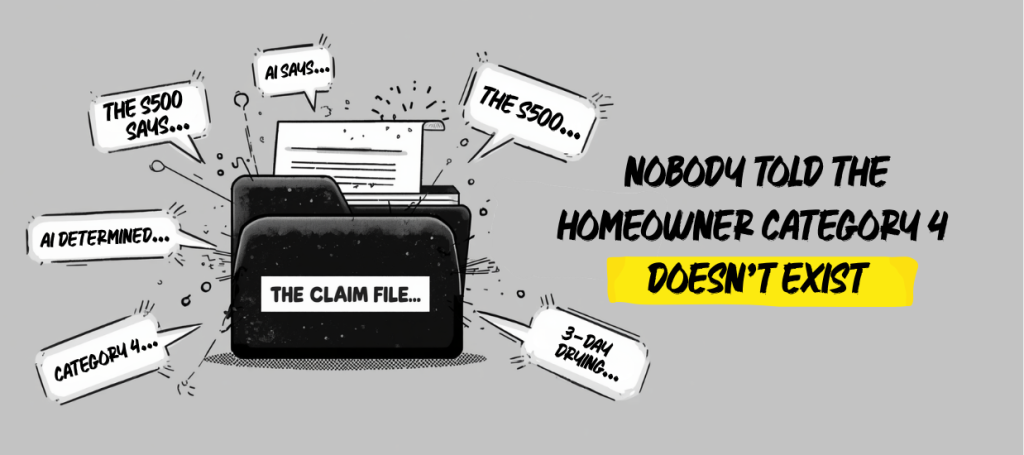
AI is everywhere on a claim now. The homeowner owns the loss. You own the credibility.
Earlier this summer we were involved in a discussion between an adjuster and a mitigation contractor. The usual dispute: water category, equipment run time, antimicrobial application. Nothing unusual until the homeowner, cc’d on every email, decided to insert himself. He was confident, prepared, and armed with notes from an AI tool. His email had the telltale signs — overly verbose, overly confident, formatted to look like an expert. What pushed things sideways was his insistence that the restorer justify Category 4 charges that don’t exist, and his certainty that Class 2 and Class 4 drying cannot coexist on the same loss. The moment that email landed, the resolution process got harder. And I don’t think this is even the most dangerous version of the problem.
Everyone came to the table with a new tool
Nobody coordinated this. The homeowner Googled and prompted his way into the file, eager to advocate for his family. TPAs were drafting responses in seconds. Estimators, tired of being told to use more AI, were prompting ChatGPT with barely a proofread. The allure is real. Most of us have gone through some version of the curiosity phase.
What has changed is that everyone using an AI tool now sounds like an expert. The homeowner in this situation wasn’t being malicious. He was exhausted, financially exposed, and over the process. AI gave him a framework and the confidence he’d been missing. The trouble is that just enough information in a claim’s environment doesn’t split the difference between right and wrong. It just makes wrong look more convincing.
The authoritative email that looks right, but isn’t
In my opinion, the most dangerous AI output isn’t the one that’s obviously wrong. It’s the one that appears expertly formatted, cites real IICRC standards, uses professional language, and arrives on the adjuster’s desk looking authoritative. Unfortunately, AI tools are sycophants by design. They’re built to be agreeable and produce output that feels right. There’s a never-ending stream of information going in and outputs are infrequently checked.
In our real example, this homeowner cited the S500 by name, built a classification table, and argued that Class 2 and Class 4 cannot coexist on the same loss. The logic sounded airtight. But the conclusion was wrong. Class 4 conditions — specialty drying of low-permeance materials like hardwood, concrete, or plaster — can absolutely exist within a broader Class 2 loss depending on the materials affected. The homeowner’s own table supported the restorer’s position if read correctly. They just didn’t know that and nothing about the email signaled the error because AI made it look like expertise.
What I’m watching inside real files
At Elkmont Estimates we’re inside thousands of claims per year. The back-and-forth between our Claims Closure Specialists, adjusters, and TPAs. What we’re seeing is an increase in AI-generated responses citing incorrect or outright fabricated information. There’s no standardization. At the same insurance company, Adjuster A is prompting their tool differently than Adjuster B. Since water losses follow the same principles repeatedly, the responses shouldn’t look this different.
What’s also common is the adjuster abdicating drying decisions entirely to a TPA. However, on more than one occasion we’ve caught a TPA using citations that are obviously AI-generated and factually wrong. We brought it to the adjuster. Their response: we’ll note the file, but we must follow the TPA because they’re certified. It’s the fox guarding the henhouse. When the restorer follows the standard of care and documents fully– but the system shrugs anyway — that’s not a technology failure. That’s an accountability failure.
A two-way credibility tax
The homeowner’s well-intentioned email muddied their file. The restorer who knows the S500 must now correct the record without appearing adversarial to a family living in disarray. If he concedes, he loses revenue he’s rightfully earned. That position costs payroll, focus, and relationship capital that should have gone toward closing the claim.
Your reputation in this industry is earned capital. You may have a dozen claims with the same adjuster. It doesn’t matter whose AI caused the problem if your name is on the truck. It’s yours to fix.
The free tool wasn’t free
Untracked labor hours chasing bad outputs. Supplements that don’t hold up. Your team using tools the owner never vetted because someone said we must use AI. In the end, the owner is still responsible for everything that leaves the building. The AI tool doesn’t sign the email. You do. Most owners in the DIY phase didn’t know they were taking out a loan. The payment terms show up on the file.
Not anti-AI. Anti-unaccountable.
Good tools exist. Purpose-built, trained on real claims data, calibrated to what adjusters actually approve and what TPAs actually push back on. Tools built on industry knowledge that know Class 4 conditions can coexist with lower classifications on the same loss. That know Category 4 doesn’t exist. General AI doesn’t know that, and it doesn’t know what it doesn’t know. That’s why I’ve built tools specifically for restorers. Not because AI is a good business idea, but because I was watching this happen on real files every day to contractors who kept absorbing the damage.
If you’ve gone DIY AI and come back, you’re not alone
Many restorers lured by the ease and low cost of DIY AI were the early adopters. Forward thinkers. They’ve paid attention and some have already found the DIY route didn’t get them where they needed to go. They’re still interested in AI, but ones focused on restoration, not the general kind.
The question worth asking is not whether you should use AI. It’s whose AI will you trust when the homeowner sends an email citing the S500, or the TPA declares materials must be dried in three days because a tool told them so. These emails look authoritative. But they get the standard wrong in ways that make your legitimate scope harder to defend.
In that moment, the only thing standing between a well-executed project and a poor outcome is you. Same as it has always been.
Jeff Diem
 Jeff Diem is the founder of LEVLR, a claims intelligence platform built for restoration contractors, and Elkmont Estimates, a scope writing and defense service with 250+ clients across 43 states. A former Paul Davis franchise owner based in Lakewood, CO, Jeff has spent over a decade in restoration focused on helping owners get paid what they've earned for work they've rightfully performed. When he's not buried in Xactimate line items, you'll find him camping with his family, on a dirt bike, or hunting the best snow for a day of snowmobiling.
Related Posts