Publisher’s Note: This podcast and article are part of an ongoing conversation with leadership at Verisk. Check out our previous conversation with Aaron and David here, and be on the lookout for future dialogue on industry data, trends, etc. Have a question you would like asked in a future podcast? Email [email protected]
The first half of 2024 has brought significant shifts in severe weather patterns compared to the same period in 2023. Public reports, while sometimes inconsistent due to reliance on voluntary reporting, indicate that severe hail activity has decreased by 4-8%, whereas severe wind activity has risen by 18-19%. However, deeper analysis using public reports alongside our proprietary Respond data reveals a more complex picture.
Hailstorm Activity: According to Respond data, the area impacted by severe hail (1″ or larger) has increased by 16% year-over-year. This uptick suggests that while more hail events are occurring, the size of the hailstones—a key determinant of property damage—has decreased. Specifically, the occurrence of hailstones 1.5″ and larger has dropped by 9%, and those 2″ and larger by 18%. As a result, we anticipate a likely 6% year-over-year decrease in hail-related claims. In essence, although 2024 has seen more severe hailstorms, these storms are producing smaller hail, leading to fewer significant damages to roofs and properties.
Wind Impact: On the wind front, our estimates suggest a 6% decrease in wind-related damage impacts. This trend is reflected in a 7% reduction in Verisk’s Property Estimating Solutions Hail and Wind assignments during the first half of 2024. While the frequency of severe wind events may have increased, their impact on insured properties appears less severe, possibly due to regional variations or other mitigating factors.
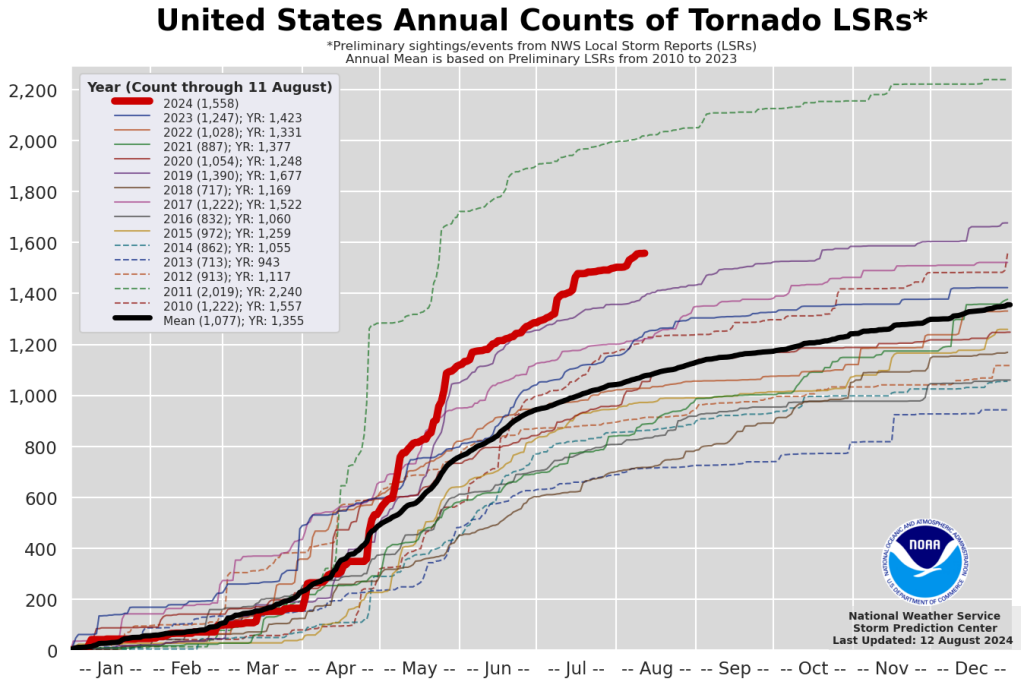
Tornado Activity: Tornadoes have remained a prominent concern in 2024. Preliminary reports place tornado activity at the second-highest level year-to-date over the past 15 years, second only to the historic 2011 season. This heightened tornado activity raises concerns about potential increases in damage and insurance claims.
The Impact of Population Growth and Inflation on Catastrophic Losses
The narrative of record-breaking catastrophe events and escalating insurance losses is often driven by two key factors: population growth and inflation.
Population Growth: Some of the fastest-growing regions in the United States, including Texas and Florida, are also among the most vulnerable to catastrophic weather events. As population density in these areas increases, so does the risk to people and properties during severe weather, leading to higher reported losses.
Inflation: Inflation has significantly contributed to the rise in insured losses in recent years. A comparative analysis of the April 11, 2016 hailstorm in Dallas-Fort Worth illustrates this effect. If the same storm had occurred in 2000 as compared to 2024, the estimated losses would be nearly three times lower, underscoring the profound impact of inflation and exposure growth on insurance claims during severe weather events.
Hurricane Beryl and the 2024 Hurricane Season Outlook
Hurricane Beryl: Hurricane Beryl made history as the earliest Category 5 hurricane ever recorded in the Atlantic, reaching this intensity on July 1, 2024. When it made landfall as a Category 1 storm south of Houston, Beryl brought widespread destruction, with wind gusts reaching 60-80 mph, and locally higher. The storm caused nearly 3 million power outages, surpassing the impact of Hurricane Ian, with approximately 200,000 of these outages lasting more than a week. Additionally, Beryl produced 67 confirmed tornadoes, the second-highest number ever recorded for a tropical cyclone, trailing only Hurricane Rita in 2005.

2024 Hurricane Season Predictions: Looking ahead, the 2024 hurricane season is projected to be exceptionally active, with Colorado State University predicting 25 named storms—well above the 1991-2020 average of 14.4. With only three named storms recorded through the end of July, 88% of the predicted storms are yet to come. Historically, only one season (2005) has recorded 22 named storms from August 1 onward. If 2024 is to reach its predicted storm count, it will need to do so in an unconventional manner, transitioning from an average start to potentially record-level activity.
One significant factor behind the slow start to the hurricane season has been the presence of Saharan dust, which has created unfavorable conditions for storm development. July 2024 was the second dustiest on record, based on 23 years of satellite observations. However, as the dust begins to subside, and with sea surface temperatures in the northern Atlantic hovering around record highs, we anticipate a significant increase in tropical activity. Furthermore, the likely onset of La Niña, typically favorable for Atlantic cyclone development, could amplify this trend.
Conclusion
The first half of 2024 has revealed a complex and evolving landscape of severe weather. While hail and wind activities show diverging trends with varying implications for insurance claims, the approaching hurricane season holds the potential for significant impacts. Population growth and inflation continue to play crucial roles in shaping the narrative of increasing catastrophic losses. As we move deeper into the hurricane season, the combination of subsiding Saharan dust, elevated sea surface temperatures, and favorable La Niña conditions could set the stage for an exceptionally active and potentially record-breaking conclusion to the year.
Aaron Brunko
 Aaron Brunko is the president of property estimating solutions at Verisk, a leading global data analytics provider. Aaron can be reached at [email protected].
Related Posts