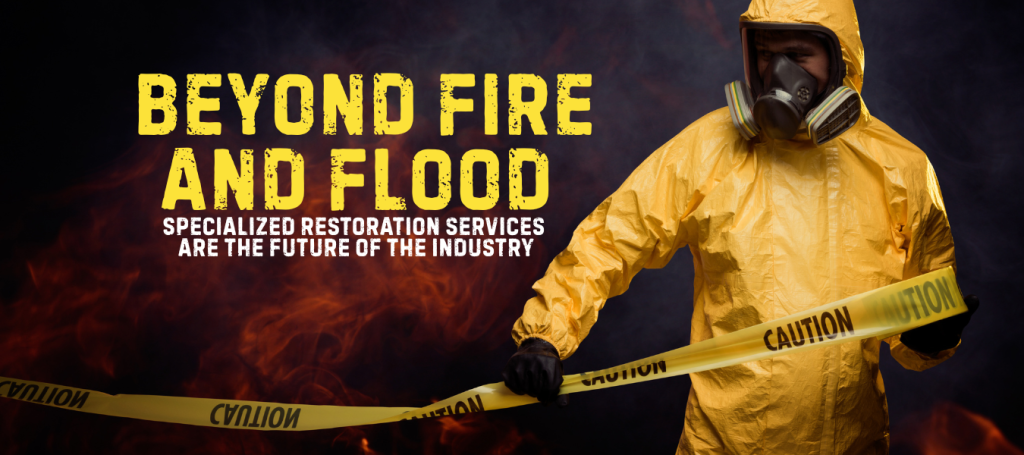
Twenty years ago, the emergency restoration industry was largely defined by water and fire damage. But today, in an increasingly complex world, the demand for specialized services such as biohazard remediation and hazardous materials mitigation has transformed these once “niche” offerings into strategic imperatives. These services are no longer optional add-ons—they are vital tools for ensuring public health, regulatory compliance, and competitive positioning.
The Compliance and Health Stakes are Higher Than Ever
The Occupational Safety and Health Administration (OSHA) defines a hazardous substance as any substance that may result in adverse effects on the health or safety of employees. The consequences of exposure can be severe:
“Any biological agent and other disease-causing agent which after release into the environment and upon exposure… may reasonably be anticipated to cause death, disease, behavioral abnormalities, cancer, genetic mutation, physiological malfunctions… or physical deformations in such persons or their offspring.” — OSHA
Terms like “hazardous waste” and “health hazard” are defined under federal regulations such as 49 CFR 171.8 and 29 CFR 1910.1200, and they aren’t just technical jargon—they define the legal and operational framework within which emergency restoration providers must operate. Employees who respond to these emergencies must be trained under HAZWOPER (Hazardous Waste Operations and Emergency Response) standards.
Yet, too often, restoration professionals accept jobs in hazardous zones without fully understanding or preparing for the risks involved. It’s like catching a hot potato—there’s urgency, but no strategy.
Readiness Drives Opportunity
Training qualified personnel to respond to hazardous situations isn’t cheap—and not everyone is a good fit for this demanding work. However, skimping on training or assuming that “my employees won’t turn me in to OSHA” is a dangerous and costly gamble.
Many business owners don’t even understand the OSHA General Duty Clause, which mandates a workplace must be free of recognized hazards. This obligation can only be met through proper documented training, continued education, and investment in equipment and readiness protocols.
Noncompliance risks fines, reputational damage, and exclusion from high-value vertical industries. And yes, the required equipment can be expensive to maintain and store, especially if it goes unused for periods of time. But when an event does occur, those margins can be significant—if your team is trained and ready to respond.
If the numbers aren’t working, revisit your billing structure to reflect the higher risks and expertise involved in these jobs.
Strategic Investments That Differentiate
Executives that are focused on short-term profits may ask: “Why are we carrying this stuff?” But the real questions should be: “What unique services differentiate us from our competitors? Can this investment qualify us for larger and better opportunities? And, how does our readiness position us in the market?”
Remember: equipment depreciates, but readiness builds credibility. Trained teams and documented compliance signal to potential clients that you’re prepared—not just for routine cleanup, but for high-stakes, high-value projects.
When in Doubt, Sub it Out—But Do It Right
Subcontracting niche services is sometimes necessary. But doing it right requires more than a handshake. Here are some questions to ask yourself and the subcontractor:
- Has the subcontractor invested in training?
- Are they vetted by a third-party credentialing body?
- Do they carry appropriate insurance?
- Are they compliant with local subcontracting laws?
- Have they had OSHA fines or Notices of Violation?
Subcontractors are extensions of your brand. If something goes wrong, you are still liable. Educate your business development teams so they understand not just the sales cycle, but the compliance implications of who gets the job done—and how.
Compliance Sets Leaders Apart
The restoration industry is increasingly seen as the “easy button” for facilities managers and property owners. But true readiness means knowing your capabilities—and your limitations. Investing in certifications like HAZWOPER and Bloodborne Pathogens is no longer optional. It’s a step toward professionalizing and safeguarding our industry.
Add these qualifications to your job ads. Integrate them into onboarding. Educate your teams not just on how to work—but how to work safely and legally.
Moving Forward: Elevating the Industry
The restoration industry is poised to be an essential part of the public safety and environmental health infrastructure. But to truly earn that role, we must raise our standards.
The goal isn’t just to respond to emergencies; it’s to redefine what it means to be prepared.
This moment calls for leadership—not shortcuts. Let’s move the industry forward together.
Thomas Licker CEICR, CBRM
 Thomas Licker CEICR, CBRM has over 20 years of professional experience that includes managing the investigation and remediation of Industrial, Commercial and Residential properties. In addition, he has been involved with the risk mitigation of infectious and hazardous materials in relation to the food, transportation, pharmaceutical and healthcare industries. He has been responsible for overseeing the clean-up of sites under the guidance of the CDC, FDA, USDA, EPA, DOD and DOE. Thomas worked as a contractor for the United States EPA Site Assessment and Technical Assistance Team as an oversight consultant for CERCLA and RCRA Corrective Actions. His company was selected as one of the contractors for the response to the Ebola Crisis by the state of New Jersey in 2014. He is the current Sr. Vice President of Regulatory Business Practice for First Onsite Property Restoration and the Current President of the American Bio Recovery Association (ABRA) In 2011, Mr. Licker earned certification as a Certified Environmental Infection Control Remediator (CEICR) from the American Council for Accredited Certification and in 2016 he earned the ABRA Certified Bio Recovery Master (CBRM) designation.
Contributing Authors
Related Posts