It is not just asbestos and leads that contractors need to handle properly.
From all indications, it looks like fires and floods will continue to plague built environments into the foreseeable future. The recent combination of wildfires in the West, hurricanes in the Southeast, and spring flooding in the Midwest remind us that restoration contractors have to be prepared to deal with a wide range of perils at a moment’s notice. Although such work is a blessing to the clients served, it is incumbent upon both the industry as a whole and individual contractors to make sure that restoration work is not putting people or the environment at additional risk.
The issue of hazardous materials in connection with restoration work is very serious. It goes beyond the “hot button” items that have received significant attention in the press recently: asbestos, lead paint, and silica. Although those materials deserve the attention of estimators and project managers as they scope and complete flood and fire damage projects, the “big three” represent only a slice of the environmental hazards that are common in most commercial structures. Interestingly, the advent of a growing class of professionals who work from home means that some of the environmental hazards typically associated with an office or business are now common in residential structures, as well.
DEFINING HAZARDS
For the purpose of this article, a broad definition of the terms “building hazards” and “hazardous materials” will be used. Anything that could be a danger to individuals working on the site, occupants, or the environment is included in the definition regardless of whether it is specifically regulated or not. This expansive definition goes so far as to include some of the conditions in the building being restored that do not typically get considered. These additional situations involve animal infestations, pits in floors that are covered with water so that the potential drowning hazard is hidden, and muck on floors that are often left after pump-out that can pose a serious threat of slipping.
While few restoration contractors actually conduct and document such activities, the Occupational Safety and Health Administration (OSHA) requires employers to conduct a hazard assessment for each job task as part of their regulations related to the provision of personal protective equipment (PPE). In the case of fires and floods, each work environment is different, which magnifies the importance of having a site-specific hazard assessment. The trick is having enough knowledge to develop an efficient system. As such, restoration contractors should consider taking the information from this article to develop a checklist format for hazard assessments that can be done as part of the initial response. Such an approach can significantly reduce the risk for fines and penalties, as well as improve the health and safety of the workers on-site.
STARTING WITH THE FAMILIAR CONCERNS
Given the publicity that asbestos, lead paint, and silica have received in both the popular press and industry publications, restoration contractors should be well versed in recognizing some of those dangers. Restoration contractors are not exempt from the certification requirements of the Environmental Protection Agency’s
(EPA’s) Lead Renovation, Repair, and Painting Rule (RRP). RRP supervisors who have successfully completed a one-day training class are in a position to use field swabs to check for lead-based paint prior to conducting flood cuts or other demolition activities. Asbestos is often found in fireproofing, pipe insulation, floor/ceiling tiles, and drywall or plaster. Typically, these require sampling by state-certified asbestos inspectors. However, visual clues, like metal bands on pipe insulation, as seen in Figure 1, can be a tipoff that the material does contain asbestos.
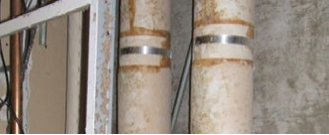
Figure 1: Metal bands on pipe insulation typically indicate that it is an asbestos-containing material.
The silica rules require appropriate PPE and engineering controls for activities that are expected to create airborne dust levels above the permissible exposure limit. Generally, sawing or grinding of concrete or masonry products is going to require sampling or protection for the workers.
OBVIOUS, BUT OFTEN IGNORED, HAZARDS
Whether commercial or residential, chemicals are utilized as a part of cleaning and maintaining buildings. While these consumer products are generally considered to be safe (when used according to the manufacturer’s directions), what happens to them when they are subjected to the heat of fire or being tumbled around in
a flood situation?
Figure 2 shows a typical situation in the sink cabinet of a flooded building. What products are actually present when the labels are smoke-damaged, partially burned, covered in mud, or missing? Has any leaking occurred? Did chemicals from one or more containers mix together to form something completely different? With all these questions, why would the restoration contractor think it was OK to sort and move such products without the protection of chemical-resistant gloves? Given that many chemicals have specific waste disposal requirements, experienced restoration contractors typically have separate waste receptacles designated for such materials.
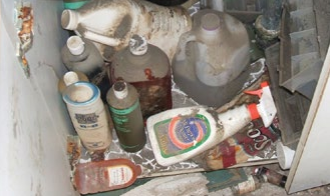
Figure 2: Chemicals present in the sink cabinet after a flood pose a variety of questions — and potential hazards.
Of course, there is a lot more to chemical concerns than household cleaning and maintenance products. Depending on the facility that has been impacted, there can be hazardous chemicals on-site and/or hazardous chemical waste. Figures 3 and 4 are pictures of a 55-gallon drum in a loading dock area of a building that had been flooded during a recent hurricane. In this situation, the label was still affixed to the drum and recognizable. That is not always going to be the case. That is why all bulk storage containers should be treated with caution during the initial assessment of restoration efforts.
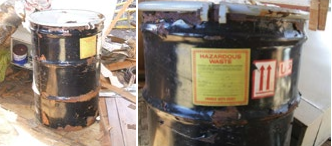
Figure 3 & 4: Some chemical hazards can be more obvious and more serious.
In addition to the chemicals, the packaging also has to be evaluated as a potential concern. Pressurized containers come in all shapes and sizes with myriad products inside. Regardless of the contents, the pressurization presents its own risks for restoration site workers. Compressed gases (from large welding tanks to individual spray paint cans) should be treated as hazardous and segregated from the site. Figures 5 and 6 provide some interesting examples of pressurized containers present at the site of a commercial building that had suffered a groundwater flood following a levee breach. Notice the variety of containers ranging in size from a lighter to acetylene torch tanks and everything in between.
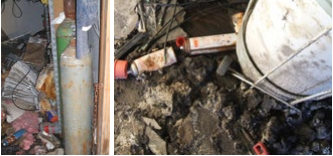
Figure 5 & 6: Compressed gases come in a variety of forms including a lighter, spray teams, a small bottle for a propane torch, and full-size compressed gas tanks. Notice the safety chain for the compressed gas tanks has been damaged by the flooding and is no longer securing the two tanks upright.
A special form of compressed gas tank is a fire extinguisher. Although these are typically considered to be a safety item, following a flood or fire, they should be considered to be potentially hazardous materials until they are evaluated by a trained service professional. As such, all fire extinguishers should be moved from the facility after a fire or flood for transport to the service provider listed on the label, as seen in Figures 7 and 8.
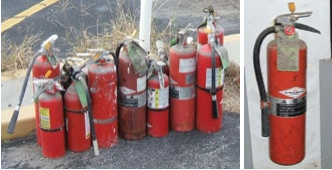
Figure 7 & 8: Fire extinguishers are another common form of a compressed gas cylinder. Their value and ability to be checked and serviced means that they should be segregated for evaluation by a professional.
Sometimes chemicals are hidden inside nondescript items. Many old-style thermostats, and even electrical switches, have mercury in them and need to be handled carefully if they are going to be removed during the renovation process. Mercury can also be present in fluorescent bulbs; whether they are the standard tube style bulbs or the more recent compact fluorescent bulbs. Figures 9, 10, and 11 show a warning poster about hazardous bulbs from the Burlington County hazardous waste facility in New Jersey, as well as photos of a fluorescent light fixture that had dropped out of the ceiling. This happened when a long-term water intrusion event eventually led to the gypsum board giving way and replacement bulbs were scattered by a flood.
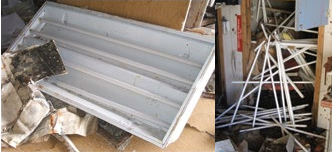
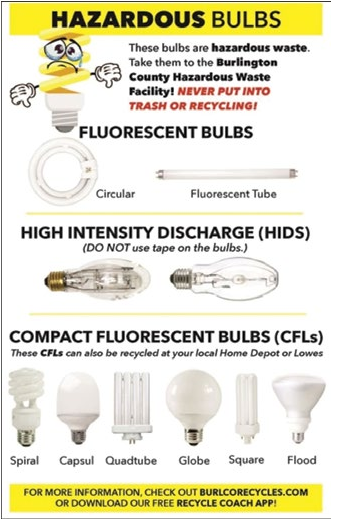
Figures 9, 10 & 11: Many different types of bulbs are considered to be hazardous and need to be treated as hazardous waste, not just the standard fluorescent tube bulbs.
MORE THAN JUST CHEMICALS
One of the reasons that a hazard assessment for each restoration project is so important is that hazardous materials can be tucked into a lot of everyday items. Refrigerators, office equipment (including copy and fax machines, scanners, computer hard drives, keyboards, printers, and other items), microwave ovens, and televisions can all have hazardous components. They should be kept out of the standard waste stream. Figure 12 shows a variety of such components segregated in the parking lot of a flooded building awaiting proper recycling or disposal.
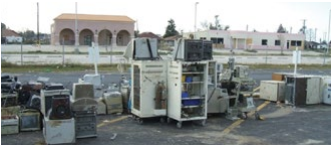
Figure 12: Most appliances should be considered to contain potentially hazardous components because of the refrigerator gases and/or heavy metals that are included in the electronic components.
Sharps containers (used for disposal of medical items such as needles, scalpels, etc.) are no longer relegated just to medical facilities. Most commercial and public spaces have safe disposal receptacles in the restrooms. Following a fire or flood, those waste receptacles are considered to be potential sources of injuries (due to sharp objects) as well as bloodborne pathogens. Therefore, they must be packaged, labeled, and disposed of properly. Figure 13 shows sharps containers (ready for pickup after proper handling by the restoration contractor) from a large medical facility that was flooded during a hurricane.
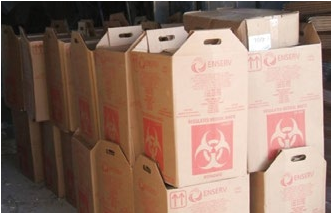
Figure 13: Sharps containers need to be treated as biological waste given the potential bloodborne pathogens.
Of course, medical facilities will have many other materials (more than just sharps containers) that qualify for biological waste handling. It is quite common to see staging areas with a large number of specially marked 65-gallon trash containers for materials that contain bloodborne pathogens, as seen in Figure 14. Handling such waste often is as simple as contacting the waste hauler listed on the container. Still, many unusual situations do develop that require the restoration contractor to intervene carefully. Such was the case with the waste container shown in Figure 15. A weather event caused water intrusion into the medical facility where waste receptacles were filled with water, resulting in the waste hauler refusing to take the container until the liquids had been removed and containerized separately.
Another class of equipment that needs to be considered as potentially hazardous materials following a flood or fire is anything that is battery-operated. Heat or water can compromise the shell of the battery, exposing heavy metals and other hazardous components. The larger the battery (such as those used to power floor cleaning equipment), the bigger the risk.
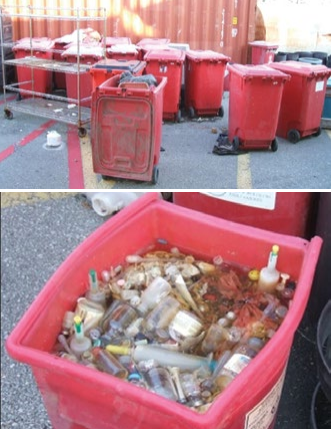
Figure 14 & 15: Restoration contractors should be prepared to deal with waste contaminated with bloodborne pathogens if they accept the work at any type of medical facility. Waste haulers typically will not take any bins that have standing water in them as a result of rain or other water intrusion events.
CHARRED AND FLOODED SOFT GOODS
A class of hazards frequently overlooked are the soft goods that are subjected to a fire/smoke or flooding event. The National Fire Protection Association (NFPA) has produced numerous documents detailing the types of hazardous compounds produced during a building fire. They specifically point out the connection between soot and various types of cancer. It is the basis for the NFPA’s recommendation that PPE (including gloves, eye protection, and respiratory protection) be utilized by all individuals coming in contact with fire-damaged surfaces.
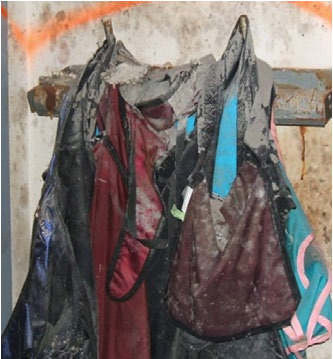
Figure 16: Porous contents and building materials impacted by floods or fire should be considered potentially hazardous because of the dangers from the soot or floodwaters.
Flooded soft goods also carry significant risks. Since Hurricane Katrina in 2005, the Federal Emergency Management Administration (FEMA) has been warning about the dangers of handling porous building materials and contents that have been saturated by floodwaters. In a number of their reports, FEMA has documented that in addition to harboring fungal contamination, porous materials acted as a filter to trap oils, bacteria, pesticides, and heavy metals including lead, arsenic, and mercury. Astonishingly, the levels of contaminants found in many porous building materials were high enough that if the same levels were present in soils, they would have to be treated as hazardous waste.
Handling such waste often is as simple as contacting the waste hauler listed on the container. Still, many unusual situations do develop that require the restoration contractor to intervene carefully.
Figure 16 shows personal goods that were saturated during a flood. These items should be handled by restoration workers protected with PPE.
A CHECKLIST MAKES SENSE
As suggested at the start of this article, a large variety of materials in any restoration project need to be evaluated for the potential hazards that they pose to the workers on the worksite. The most reasonable way to deal with these concerns on a consistent basis is to develop a company-specific checklist of potential hazards for the estimators and project managers to utilize. While the information in this article can be useful in that endeavor, the RIA Environmental Council is in the process of developing a model checklist for the industry. RIA

Michael Pinto is the CEO of Wonder Makers Environmental, a multifaceted organization that assists individuals dealing with indoor environmental concerns. Wonder Makers specializes in resolving problems related to asbestos, lead, mold, micro-organisms, chemicals, and mysterious IAQ situations. Pinto has earned a number of professional titles beyond his doctoral-level education in environmental engineering, including Certified Safety Professional, Safety Management Specialist, Certified Mold Professional, and Certified Forensic Operator. He has authored six books and more than 230 published articles. During his 39 years in the industry, Pinto has supported the industry by volunteering and developing guidance documents with EIA, ECA, NSC, ASTM, IICRC, RIA, CIRI, and others. He can be reached at 888-382- 4154 or at [email protected].
Related Posts