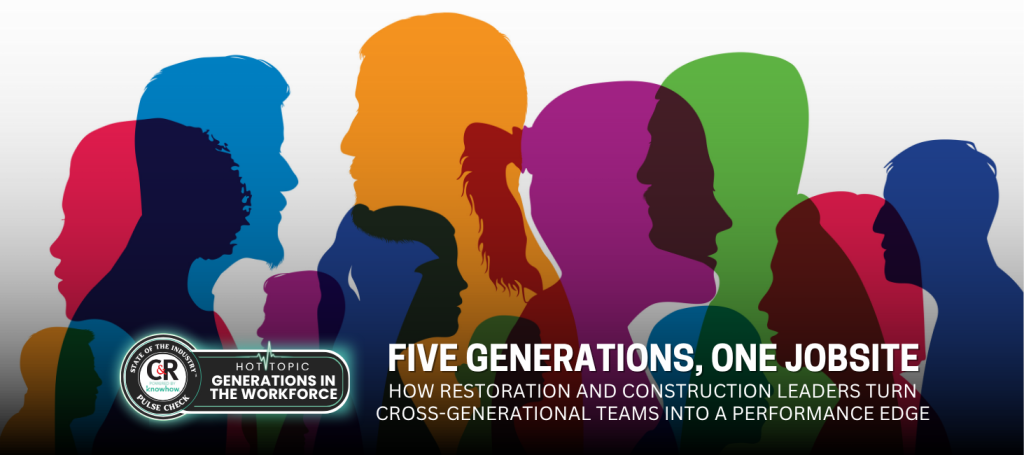
Walk any active restoration site and you’ll see it: a Baby Boomer superintendent coordinating with a Gen X estimator, a Millennial project manager running a punch list from a tablet, and a Gen Z tech documenting moisture readings on video. Multi-generational crews are today’s reality and with tight timelines, safety-critical tasks, and rising client expectations, the way leaders harness those differences can make or break a project. The winning formula is simple but powerful: pair generational awareness with behavioral insight. When leaders understand both the era people grew up in and the way they naturally work, communication gets cleaner, safety improves, closeouts happen faster, and retention rises. That’s the performance edge of cross generational teams.
Jobsites, by their nature, amplify communication gaps. Noise and motion make it harder to process instructions. Pace and hierarchy can suppress the very questions that would catch errors early on. Even toolsets, from paper logs to estimating and project-management apps, create friction when team members prefer different methods. In that environment, assumptions multiply and minor misunderstandings become costly rework. Generational awareness helps leaders anticipate preferences and blind spots before they slow the work. The real unlock, however, is using that awareness to translate across styles and experiences. Great leaders use generational group trends as clues and then lead people as individuals. That’s how cross generational teams shift from a management challenge to a genuine asset.
Look closely at who’s on today’s jobsites.
Baby Boomers
Baby Boomers bring deep experience, loyalty, and a preference for face-to-face problem solving; many serve as the institutional memory of how and why the company does what it does.
Gen X
Gen X tends to be independent and pragmatic, bridging the analog and digital worlds and often acting as the informal fixer who simply says, “Give it to me, I’ll figure it out.”
Millennials
Millennials are team-oriented and feedback-seeking; they’re fluent with technology and strong at collaboration, documentation, and keeping clients informed.
Gen Z
Gen Z, our digital natives, learn fast, value inclusion, and are comfortable with video, chat, and real-time data capture. And while
Gen Alpha
Gen Alpha isn’t on your payroll yet, they’re already in CTE programs and apprenticeships; smart contractors are building pipelines now. Remember, stereotypes are not people. Use generation group patterns to start a conversation, not to limit it. The moment you meet the individual, manage them and not the stereotype.
Age is only part of the story. Behavior is the part that shows up every day on site. A practical language for behavior uses four cornerstone tendencies. Dominance describes decisive tasking – the ability to set direction, clear blockers, and keep momentum. Extroversion is the communication glue that builds buy-in, coordinates trades, and shines in client moments, translating scope into action and aligning stakeholders. Pace, sometimes called Patience, is the steady execution that protects schedule through cadence, routines, and smooth handoffs. Conformity represents quality and safety systems – the love of standards, checklists, and documentation that catches risks before they become rework. Coach to behavior, not birth year, and you’ll see cross generational teams click into place where it matters most: in day-to-day execution.
Communication is where these insights become results. On a restoration job, clarity is critical, so match the message to the medium that serves the work. Daily huddles provide alignment for priorities, safety notes, and role assignments; quick texts or PM-app pings confirm specifics like room numbers, arrival times, and material drops; emails preserve the trail for change orders, approvals, and insurance documentation; and whiteboards or other visuals cut across preferences with a universal language that everyone can follow. Frequency and format matter as much as the channel. Brief, repeatable, visual summaries beat long speeches. Consistency narrows the gap between “I thought” and “I know” and creates a culture of accountability.
Even with strong communication, friction points are inevitable, yet fixable. Technology adoption is a common one. After 10 hours on site, another app can feel like another burden. Pairing a Gen Z “app captain” with a Boomer craft mentor creates a two-way exchange: the captain streamlines the workflow and shortens clicks; the mentor pressure-tests whether the workflow genuinely helps production. Feedback cadence is another. Millennials and Gen Z tend to expect iterative coaching, while Boomers and Gen X often prefer milestone debriefs. Blending quick-course corrections during the week with structured-reviews at phase gates satisfies both and keeps learning continuous without becoming noise. Speed versus precision is the classic tug-of-war. But speed without standards yields rework, and standards without speed misses deadlines. Balance the momentum of Dominance and Extroversion with the controls of Pace and Conformity through pre-task plans, checklists, and hold points.
Finally, role clarity underpins everything. Ambiguity breeds conflict, so assign tasks through a behavioral lens: who will set direction, who will coordinate the handoffs, who will maintain cadence, and who will verify quality? When everyone understands not only what they own, but why they own it, ownership sticks.
Hiring and succession planning benefit just as directly from this approach. Before you post a job or promote a high performer, model the role’s behavioral demands. A foreman often succeeds with a blend of decisiveness and steadiness – calling sequence while keeping crew rhythm. Superintendents thrive with a mix of direction-setting, stakeholder management, and enforcement of spec and safety. Estimators need methodical analysis and clear communication. Project managers win when they can align trades and clients. Align recruiting, promotions, and coaching with these models and you’ll reduce mis-hires, shorten ramp time, and make development plans obvious. Build mentorship ladders that cross generations with explicit goals; mentors pass along hard-won judgment while mentees bring digital fluency and documentation discipline. Everyone moves faster.
Culture turns these practices into habits. A mission statement on the wall won’t move a schedule, but a mission woven into daily behavior will. Tie tasks to purpose: zero-injury sites come from opening huddles with a safety moment and closing with a near-miss share; quality workmanship grows when you celebrate precision catches as loudly as big production days; schedule reliability improves when you recognize crews that hit dates and reduce rework; community impact becomes real when teams connect restoration milestones to what matters most to the client, whether that’s reopening a business or getting a family back home. Operationalize values with small rituals: end-of-week shout-outs for knowledge transfer across cross generational teams; spotlights on crews that used a checklist to prevent a change order; rotating huddles to build confidence and voice.
The payoff is straightforward. Cross generational, behavioral-savvy crews execute faster, safer, and with fewer surprises. They navigate change orders with less drama, keep insurers and owners informed without endless meetings, and finish strong because they communicate on purpose.
Kristy Bach

Kristy Bach serves as the President at Know Your Talents. KYT is a workforce consulting firm working with leaders to enhance culture and optimize performance at every level. Our expertise is centered around four key principles: helping businesses know, grow, include and inspire their employees. We’ve served over 300 restoration and construction companies helping them get to the root of what makes their employees tick, provide them a roadmap for growth, give them a voice in their organization and cultivate strategic alignment.
Related Posts