Every rug has a story.
It may be a piece purchased during world travels. It may be the family rug in the center of childhood memories. Or it may be the rug that really tied the whole room together.
In the midst of an emergency response, the rugs may not be high on the team action list. A technician without any rug education may not know if the wet rug is a $100 machine woven art silk, or a hand-knotted $100,000 silk. The technician may not know if the rug is easily replaced, or impossible to replace.
The technician often does not discover the value, or the emotional attachment to this rug, until after the pack-out. Often when it is too late to do anything to save it.
How a company does one thing reflects to their customer how they do everything else. If a restaurant’s bathroom is a neglected mess, that communicates something important about the kitchen. Similarly, how the cherished contents from a flood are handled, or mishandled, projects something to the homeowner about their entire flood job.
 Textile Triage
Asking the homeowner which rugs are the most prized in their flooded rooms can help to prioritize the work. If there is not someone to ask, then you may be on your own.
Many higher quality, valuable rugs can survive a flood with a quick and proper pack-out. However, the extraction and dry-out to halt the damage, with the subsequent sanitizing soak and full wash, requires time and labor that may be in short supply.
Some rugs will be worth the effort, and some will not. In the middle of a flood, there is no time to waste. Here are three quick textile triage steps to determine which rugs to focus on first, and which ones to set aside.
1. Identify: Woven or Tufted?
Most restoration companies do not have a rug expert on staff. For the purpose of textile triage, that level of expertise is nice but not necessary. What is needed is someone trained in the basics of rug construction. Someone who can identify the difference between a woven rug and a tufted rug, the two broadest categories.
 With woven rugs, when you flip over the corner of the rug, you can see the same design and color on the back side of the rug as on the front. This might be hand woven, or it might be machine woven. You do not need to know which one yet, you just need to know if you can clearly see the design. If you can, then it is one to focus on first.
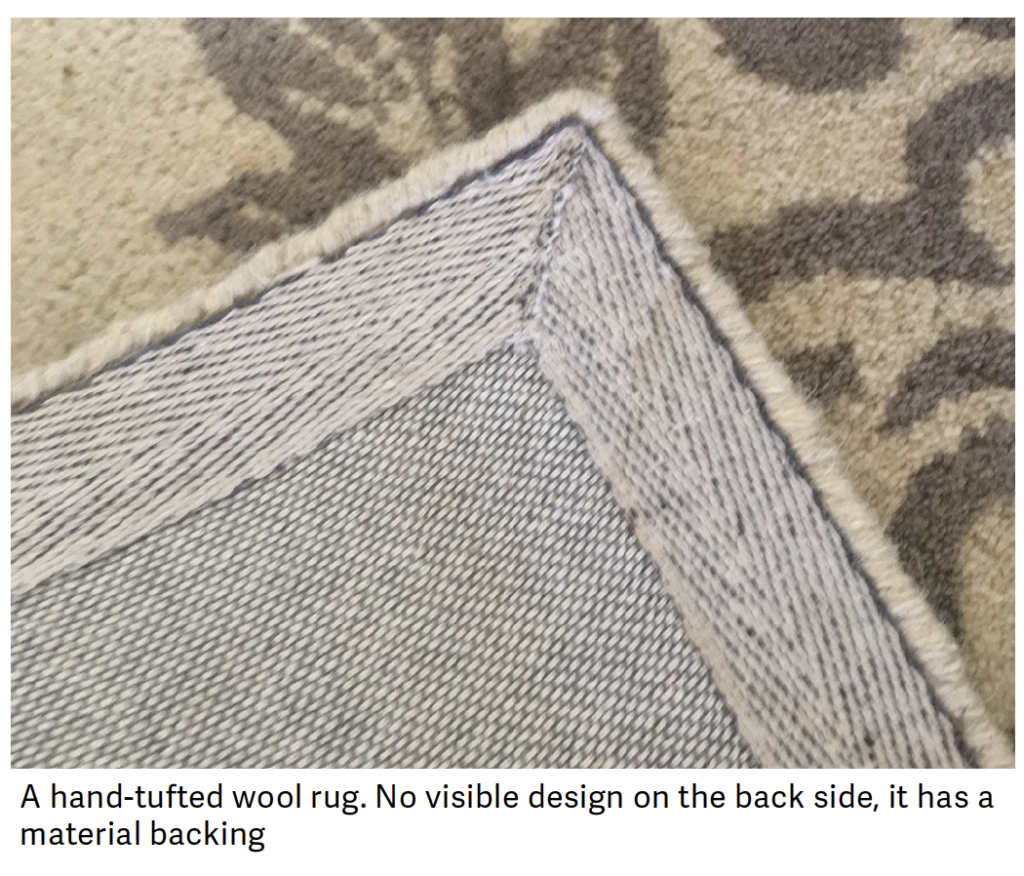
With tufted rugs, when you flip over the corner of the rug you do NOT see the design on the back. Instead, you see a material backing, or perhaps a glue/rubber backing. This might be hand tufted, or it might be machine tufted.
Today’s hand-tufted rugs are a quicker way to create a rug than traditional weaving. They are rugs that are held together with a latex adhesive. A traditionally hand-knotted 8×10 wool rug may take five months to weave and require two to three weavers. A tufted wool Pottery Barn rug that size can be made in a week by one rug maker. The cost and labor savings are huge, which is why it is much easier to replace today’s tufted rugs when involved in a flood. Often a flood will cause commodity tufted rugs to delaminate and fall apart. The work to clean and repair these flood-damaged tufted rugs to make them safe to return to the home often far exceeds the cost to replace.
By identifying the woven rugs from the tufted rugs, you can focus your efforts on the rugs with a much higher likelihood of being the ones “worth” saving.
 2. Identify: Natural or Synthetic Fiber?
The next step is to determine the fiber type. Having team members who are familiar with the differences in natural and synthetic fibers will assist in triage. Natural fibers require quicker care in floods to halt the damage, while synthetic fibers can wait. Natural fiber colorful rugs have a risk of dye migration. Quick extraction and packing with absorbent towels/mats will limit this damage and improve the odds of returning these rugs to pre-loss condition.
Wool and silk are predominantly the face fibers used in the higher quality antique and contemporary handwoven rugs. These protein fibers respond well to proper washing. However, when sitting wet for extended periods in a flood, there are risks to the fibers and dyes, and if woven on a cotton foundation, they will develop fungal issues as well without proper handling. These will be the rugs to focus on first to get them dry as quickly as possible, and to pack them out in a manner to limit the damage during transport.
It can be quite difficult to identify real silk from artificial silk when in the field on a loss site. Both fibers are in danger from a flood.
 Real silk is often not colorfast, so the dyes can bleed rather rapidly. Pulling an extractor across the face can pull dark dyes into other areas and worsen the flood-related damage.
Fake silk, such as viscose, can lose up to 50% of its strength when wet, so pulling an extractor across the face can cause fiber damage and tearing that can also worsen the flood damage.
Often the owners of artificial silk rugs believe their rugs to be real silk. This is because many fake silk rugs are sold at real silk prices. The safest action will be to cover the rug in absorbent mats/pads or cloth tarps and roll it up to deliver to a rug facility for rapid washing and drying.
Synthetic fibers can wait. Prioritize the natural fiber woven rugs first.
3) Inspect: Does it have a Label?
Most contemporary rugs will have a label on the back of one corner with the company brand and often the specifications of the rug. Commodity rugs from stores such as Pottery Barn, Crate & Barrel, West Elm, Pier One, Dash & Albert – these are all mass market suppliers of decorative, low-price, shorter-life rugs. The pressure to make these rugs affordable means shortcuts in production quality, so these rugs are often easier (and much less costly) to replace than to try to “save.”
Having a label also gives you the power to search the style and store online and get an immediate replacement cost.
With a textile triage process of focusing dry out efforts first on woven natural fiber rugs, you will increase the chances of having saved the most valuable rugs in that flooded home even if you do not know anything about investment rugs. It will also set the stage with the homeowner that you are taking the steps necessary to help protect and care for the higher quality textiles in the home.
 FLOODED RUG FIRST RESPONSE:
- Client communication. Determine which rugs mean the most. If communication is not possible or unclear, focus on the wool/silk woven rugs first.
- Photo-document. Flip over one corner of the rug so that you can capture the weave so you can prove if a rug is handwoven or a commodity production if the rug is lost.
- Extract carefully. Extraction tools can be too aggressive on softer wools and silks. If your extractor has rough edges, extract the back side of the rug instead.
- Protect damp rugs in transport. Sandwich the rug in water absorbent pads/mats, blankets, or towels, and roll it up. This will remove moisture and pull released dye away from the rug fibers during transport.
- Dry out as soon as possible. If you do not have a rug washing division to immediately wash these contents, then drying out the rugs is paramount to halting the damage and slowing down the mildew issues. Storing textiles damp and dirty can shift the blame for ruined rugs away from the flood and instead place it on the flood response.
- Store rugs clean, dry, and protected. Improper pack-out procedures can lead to mold issues, odor issues, and insect issues.
Lisa Wagner
 Lisa Wagner is a rug care instructor and an owner of Blatchford’s Rug Cleaning & Repair in San Diego. Her RugChick.com blog is the #1 consumer rug care resource on the web. She has been the featured rug expert for articles in Real Simple Magazine, HGTV Magazine, Family Circle Magazine, Wirecutter, Consumer Reports, and the New York Times. She can be reached at [email protected] or through her industry training site at www.textilepronetwork.com.
Related Posts