Let me get something out of the way before anyone reads further.
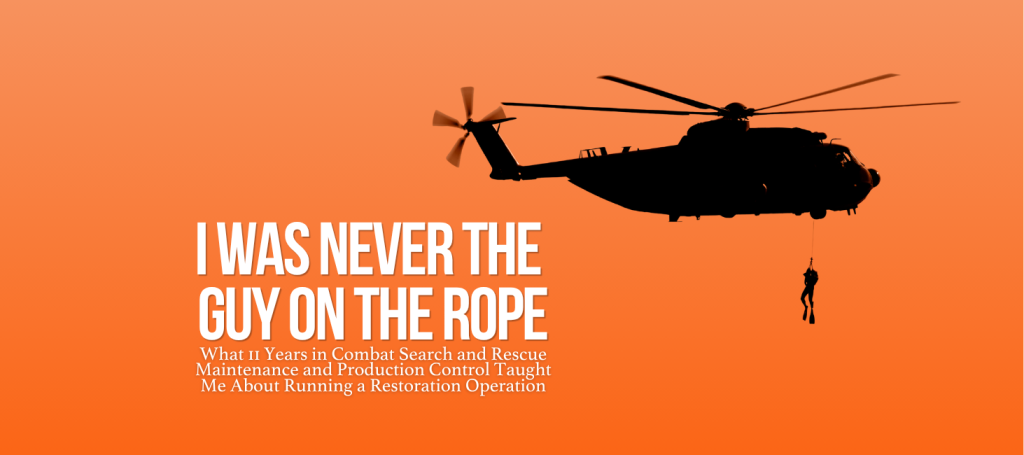
I spent eleven years in United States Air Force Combat Search and Rescue. I was not a Pararescueman. I was not a pilot. I was a helicopter crew chief and, later, production control. My job was the airframes — the HH-60s that carried the rescue teams — and the maintenance Airmen who kept them flying. The heroes in my story are the PJs who went down the rope, the pilots who flew into places most people can’t find on a map, and the maintainers who worked sixteen-hour shifts, so the next bird was on alert before the last one was cold.
I say that up front because plenty of leadership articles borrow other people’s valor to make a point, but this industry deserves better than that. What I can tell you about, honestly and from the inside, is what it takes to keep a high-tempo, high-consequence operation ready for when a call comes in. That isn’t rescue work. It’s operations work. And that’s the work I do now.
Today I’m Director of Operations for a restoration company covering four counties in Central Pennsylvania. Different uniform. Same principle: the people on the frontline win because of the people behind them. Here are five things from CSAR maintenance and production control that translate one-for-one in running a restoration team.
1. Commander’s Intent Beats the Perfect Plan
Every military operation starts with a commander’s intent — one sentence that answers a single question: if everything else falls apart, what does success still look like?
In a CSAR squadron, the commander’s intent is some version of “Have enough combat-ready aircraft and crews available to respond to a downed personnel call within the required alert window.” The specific plan — which aircraft, which crew, which parts, which maintenance cycles — flexes every single day. Birds go Code 3. Parts don’t show up. A crew times out on rest. The plan dies constantly. The intent is what survives.
There’s a line I tell my restoration crews every week, and it started in a military maintenance ops center where the plan on the whiteboard at 0600 was already wrong by 0700:
Plans aren’t written in concrete. They’re written in Jello. We have to be flexible, not rigid, to be successful.
In production control, my entire job was translating intent into a daily schedule that didn’t fall apart when the Jello started moving. You can’t panic at 0200 because an HH-60 went down for a hydraulic leak — you have to already know which backup bird has been worked on, where the parts are, and whether you can still meet the alert requirement. The plan is a living document. The intent is the compass.
Restoration is the same shape. Every job starts with a sentence: “Protect the structure from secondary damage and preserve the evidence chain for subrogation.” The adjuster said 1,200 sq ft of Cat 2 water. You arrive to 2,400 sq ft, Cat 3, with the homeowner in a medical event and a tenant who won’t let you next door. Your plan is a piece of paper. What survives? Intent does. So, if the crew has to choose between saving a ceiling or saving the photo log, they save the photo log. If they have to choose between running one more air mover or starting containment, they start containment.
Write your intent. Put it on the dispatch ticket. Read it out loud at the huddle. And when a tech asks at 0400 why the plan from 0300 already looks different — tell them about the Jello. A crew that expects the plan to move, handles the moving plan. A crew that expects concrete, freezes when the concrete cracks.
2. Readiness is the Quiet Work
A helicopter doesn’t go on alert because a pilot showed up. It goes on alert because forty people spent the last seventy-two hours making sure it would. Inspections. Time-change components. Fluids. Fuel. Avionics. Tool control. Paperwork. The crew chief whose name is stenciled on the nose of the aircraft signs off that the bird is ready to fly. That signature is not ceremonial.
In CSAR production control, I stopped turning wrenches and started coordinating the people and parts, so the wrenches could turn. It’s scheduling, prioritization, logistics, and a lot of phone calls. Knowing which aircraft is the swing, which maintainer is strongest on which system, which part is on back order and which vendor can ship it overnight if you ask the right way. It’s the unglamorous-grinding foundation underneath every alert-ready aircraft.
Restoration runs on the same foundation, but most shops skip it. Here’s what I’ve pulled from the maintenance side and built into our operations: every truck is loaded to the same manifest, so a tech swapping trucks doesn’t change anything. Every kit is inventoried at shift end, not shift start — you want to discover a missing infrared thermometer at 1700, not 0300. Instruments are calibrated on a published schedule with a sticker on the unit. Consumables are re-stocked to par, not to empty, because a crew that runs out of poly at midnight is a crew cutting corners by 0100.
This is not interesting work. But it’s the difference between a team that deploys in 45 minutes, to a team that deploys in two hours.
3. Brief, Execute, Debrief — and Nobody has Rank in the Debrief
Every sortie in CSAR was bookended by two conversations. The pre-flight brief was short and structured: intent, threat, comm plan, go/no-go criteria, abort criteria, maintenance status. Fifteen minutes at the outside. Then the bird launched.
Then there was a debrief. The aircrew walked through what happened, what broke, what they wanted looked at. My maintainers took it in, asked clarifying questions, and went to work. If the bird was coming back dirty for a reason nobody could explain, we grounded it and investigated until we could.
The organizational version of that conversation is the after-action review, and it’s the single highest-leverage habit I brought into the restoration business. In a proper AAR, rank doesn’t exist. The most junior person on the crew says what went wrong first. Then up the chain. You don’t interrupt. You don’t defend. You note. The AAR asks four questions, in order:
- What were we supposed to do?
- What actually happened?
- Why was there a difference?
- What do we do differently next time?
I run a 15-minute huddle before every dispatch and a 15-minute AAR after every demobilization. The notes go into the job file and get reviewed at the end of the week. Every recurring pattern — a particular insurer pushing back on the same line item, a specific building type chewing up more labor hours than scoped, a technician consistently catching what others miss — shows up in the AAR record before it ever shows up in the P&L.
If you do nothing else from this piece, start running AARs. They cost you nothing, but will change your operation inside of 60 days.
4. Redundancy and the Clock
Two old maintainer sayings apply directly to restoration operations. The first: two is one, one is none. Redundancy isn’t waste — it’s the price of admission for operating where failure is unacceptable. Most restoration companies are one-deep on every critical role: one on-call PM, one person who knows the Xactimate login, one generator, one backup dispatcher or none. Pick the five positions and five pieces of equipment your operation can’t function without for 12 hours and build redundancy for each. It costs less than one lost large-loss job.
The second: the clock is always running, in two directions. In CSAR maintenance we tracked the mission clock — how long until the next alert window — and the aircraft clock, which is how long a bird had been down. You didn’t get sentimental about either one. Restoration has the same two clocks: the IICRC S500 clock (24 hours before extraction should be well underway, 48 to 72 before mold colonization becomes a serious liability) and the operational clock, which most operators don’t track correctly. The number that matters, isn’t dispatch-to-arrival. It’s phone-ring to extraction-started. Every minute the crew is still staging, or still calling the property manager for the gate code, is a minute of uncompensated damage accumulation. Put it on the whiteboard. Run AARs against it. Watch what happens.
What a Production Controller Knows that a Technician Doesn’t
The heroes in a CSAR squadron are the PJs and the aircrew. They go into the worst situations a human being can encounter, and they bring people out. Nothing about what I did for eleven years compared to that. What I can tell you though, because I was in the operations center and on the flight line and in the production control office for all of it — is that none of those rescues could have happened if the maintenance side had failed. So, the aircraft had to be ready. The crew had to be rested. The parts had to be stocked. The schedule had to be honest. The commander’s intent had to be translated all the way down to the Airman turning the wrench at 0200 on a Tuesday. And when the plan for that Tuesday fell apart, the Airman had to already know that plans move — and that their job was to stay useful while the plan was moving.
That is the work of operations. And that’s the work I do now.
The heroes in restoration are the techs in the Tyvek at 3 AM, the PMs walking through a fire loss with a homeowner who just lost everything, the estimators at a kitchen table writing a scope against a claims adjuster who’s going to push back on every line. My job — our job, if you run operations in this industry — is to make sure those people have the truck, the kit, the crew, the plan (written in Jello), and the trust underneath them to do their work without fighting their own organization at the same time.
I never went down a rope. But I made sure the helicopter was ready so the people who did, could come home. Now I make sure the truck is ready, and the crew is trained, so the techs can walk into someone’s worst day and walk out having made it better.
What would your operation look like if every crew debriefed every job, every truck was loaded to the same manifest, and every plan was written in Jello – on purpose?
Shawn Hester
 Shawn Hester is a USAF veteran who served eleven years as a helicopter crew chief and in production control supporting Combat Search and Rescue operations. He is currently Director of Operations at Disaster Restoration Systems LLC, operating as 1-800 Water Damage of Harrisburg, serving York, Lancaster, Dauphin, and Cumberland Counties in Central Pennsylvania. He writes about restoration operations, AI tooling, and the work behind the front line of the industry.
Related Posts