2025’s 2nd Quarter, a Busy One for IICRC Advocacy
Much of IICRC’s Advocacy work naturally takes place at the state level, simply because that is where the majority of relevant legislation is introduced. However, we are also actively engaged in several important federal initiatives. As a result, the first quarter of the year is typically our busiest, with activity slowing in the second quarter as fewer state legislatures remain in session. Despite this trend, this quarter has remained an active one for the ICRC Government Relations team and our dedicated Advocacy volunteers. We are excited to provide you with these updates, which will help to keep you informed about legislative and regulatory developments that impact the recognition and adoption of IICRC standards and certifications. By staying engaged, we can ensure that policymakers understand the value of industry-driven expertise.
But First, Are You Attending the IICRC’s 3rd Annual Educating the Advocates Symposium?
This year, on Wednesday, October 1, 2025, the IICRC will host its 3rd Annual Educating the Advocates Symposium at the Palms Resort & Casino in Las Vegas from 8 am to 3 pm (PST). This is an in-person event that you will not want to miss! Join us for a day of networking and the chance to learn how to advocate alongside the ICRC and other leading voices in the industry.
https://iicrcmarketing.typeform.com/to/yHwfdY0D
Key Policy Activity:
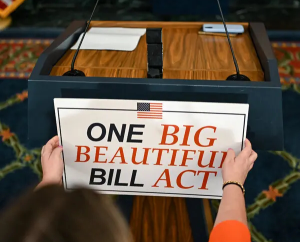
The President of the United States has officially signed into law the “One Big, Beautiful Bill,” a comprehensive budget reconciliation package that combines tax and spending provisions. One section of the bill, which the IICRC has been advocating over the last few years for, expands the allowable use of 529 Education Savings Plans to cover expenses related to workforce training, including industry-recognized certification programs. This change will enable individuals to use these tax-advantaged savings to pay for certification courses and exams, such as those provided by the IICRC.
https://leginfo.legislature.ca.gov/faces/billNavClient.xhtml?bill_id=202520260AB338
This bill, if passed, would task the California Workforce Development Board with allocating funds to support workforce strategies in Los Angeles and Ventura Counties, which were severely impacted by wildfires in 2025. The funding will focus on education, job training programs, stipends, and supportive services for low- to moderate- income individuals who are underemployed or unemployed. Key industries targeted for employment include construction, firefighting, health care, utilities, social services, education, childcare, and housing assistance.
https://www.mainelegislature.org/legis/bills/getPDF.asp?paper=HP1288&item=2&snum=132
The bill as originally drafted would have required landlords to address mold issues by taking prompt action when notified of a leaking event or mold presence, including inspecting and restoring affected areas and creating a remediation plan. It would have mandated professional assessment and remediation for mold over 10 square feet and required all mold-related activities to follow best practices.
The definition of mold remediation professional would have included someone with the ICRC’s Mold Remediation Specialist (MRS) Certification. Unfortunately, the definition of “best practices” only included the EPA’s 2008 Guidelines on Mold Remediation in School and Commercial Buildings.
The IICRC’s Director of Government Relations, Robbie Bradshaw, testified in front of the committee emphasizing the importance of requiring adherence to the ANSI/IICRC S520, the industry standard of care.
The bill has since been amended to simply add mold to the warranty of habitability and does not include any of the provisions previously discussed. The amended version is the one that has passed the legislature.
https://malegislature.gov/Bills/194/HD2787
The bill outlines the formation of a task force dedicated to improving indoor air quality across various settings, including schools, long-term care facilities, and public housing. This task force will create a framework to identify, monitor, and remediate indoor air pollution and mold contamination, involving representatives from public health, environmental protection, and housing sectors.
IICRC Advocacy Volunteer, Cole Stanton, and IICRC’s Director of Government Relations, Robbie Bradshaw, both testified in front of the Massachusetts Joint Committee on Public Health about the importance of amending the bill to include task force members with experience in assessing and remediating indoor air pollutants and mold.
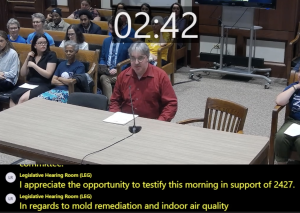
IICRC Advocacy Volunteer, Cole Stanton, testifying in front of the Massachusetts Joint Committee of Public Health
https://legislature.mi.gov/Bills/Bill?ObjectName=2025-SB-0019
The bill, in relevant part, would require mold remediation to be initiated within 72 hours of notification by the tenant. The mold must be remediated in accordance with the ANSI/IICRC S520 Standard for Professional Mold Remediation.
IICRC’s Director of Government Relations, Robbie Bradshaw, has been working on this legislation for over a year now and testified in support of this bill in front of the Senate Housing and Human Services Committee on June 3, 2025.
https://mgaleg.maryland.gov/2025RS/bills/hb/hb1348T.pdf
This legislation expands the definition of “home improvement” to include disaster mitigating services, introducing new regulations for home improvement contractors providing these services. It allows homeowners to rescind a contract for disaster mitigation within five days without paying more than a stipulated penalty. The bill also prohibits contractors from soliciting disaster victims within 48 hours of a disaster and permits counties to set rules on in-person solicitation limitations following a disaster. Violations are deemed unfair or deceptive trade practices, subject to enforcement and penalties under existing consumer protection laws.
https://capitol.texas.gov/tlodocs/89R/billtext/pdf/HB04169I.pdf#navpanes=0
This legislation establishes guidelines for fire remediation contracts, requiring that they be in writing and include specific information about insurance coverage and estimated costs to property owners. It differentiates between contracts made before and after insurance assessments, with only the latter being initially binding except under specific conditions. Contractors must file these contracts electronically with the Secretary of State’s office. Violations of these requirements are considered deceptive trade practices and attempts to waive these requirements are prohibited and deemed void.
To view more legislation that the IICRC is tracking, CLICK HERE.
Virginia Mold Committee
As part of Virginia Bill HB 2195, which passed earlier this year, the Department of Professional and Occupational Regulation (DPOR), in consultation with the Department of Public Health and mold industry professionals, must study the current state of the mold inspection and mold remediation workforce in the state of Virginia. Robbie Bradshaw, the IICRC’s Director of Government Relations, along with Matt Duffy, an IICRC- certified professional based in Richmond, Virginia, were both appointed to the committee. The committee initially met on May 14th and will meet again in July and then a final time in September.
How You Can Support Industry Advocacy
Advocacy is a collective effort, and your engagement helps drive meaningful change. Here’s how you can support these efforts:
- Stay Informed: Follow these updates to understand the latest legislative and regulatory developments.
- Support IICRC Standards in Policy Discussions: If you engage with policymakers or industry stakeholders, emphasize the importance of IICRC standards in ensuring quality, safety, and best practices.
- Get Engaged: The IICRC Government Relations & Advocacy team is small; help from volunteers is always needed.
For more information or to get involved, contact: [email protected].
Thank you for supporting the future of our industry
A Note to Our International Registrants and Certified Firms
While much of the ICRC’s current Advocacy work is focused within the United States, this is not by design. We recognize that the cleaning, restoration, and inspection industries face important regulatory and legislative challenges worldwide. We are committed to growing our global advocacy efforts and better understanding the issues impacting our international stakeholders.
If you are aware of regulatory developments, industry challenges, or opportunities for engagement in your country or region, we encourage you to share them with us. Your insights are invaluable in helping the ICRC expand its advocacy footprint and ensure that our standards and certifications continue to serve and protect professionals and consumers around the world.
Advocating for Industry Standards & Certifications
In 2021, the IICRC created a department within the organization to solely focus on government relations and advocacy issues. Voluntary, consensus- based standards are critical to the cleaning and restoration industry. The ICRC develops ANSI-accredited standards and certifications that serve as the foundation for professional excellence. However, without advocacy, these standards risk being overlooked or replaced by impractical regulations that do not reflect real-world industry practices.
Through these updates, we’ll keep you informed about legislative and regulatory developments that impact the recognition and adoption of |ICRC standards and certifications. By staying engaged, we can ensure that policymakers understand the value of industry-driven expertise.
Robbie Bradshaw
 Robbie Bradshaw is the Director of Government Relations for the IICRC.
In this role, he leads the organization's advocacy efforts at the local, state, federal, and international levels, promoting policies that support IICRC's standards and certifications. Robbie is an attorney, earning his Juris Doctor degree from Regent University School of Law and holds a bachelor's degree in political science from Old Dominion University. Prior to joining the IICRC, he served as a Legislative Aide to Delegate Stephen E. Heretick in the Virginia House of Delegates, where he developed a strong foundation in legislative affairs and public policy. In addition to his professional work, Robbie is an accomplished singer- songwriter and enjoys spending time on the golf course with friends and family.
Related Posts