RESTORATION ADVOCACY REPORT #1 – JUNE 20, 2019
An infusion of fresh thinking and younger leadership at the Restoration Industry Association (RIA) has led to the conclusion that to give members a good return on their investment of dues, RIA must advocate for the legal and financial interests of restorers. Accordingly, I am excited to report that RIA has formed the industry’s first unified advocacy team, the Advocacy and Government Affairs (AGA) Committee. Its sole purpose is to advocate for the property restoration industry. What’s more, RIA and the Institute of Inspection Cleaning and Restoration Certification (IICRC) have executed a “Mutual Benefits Agreement” whereby the two industry giants will work together to establish areas of mutual interest that will include advocacy for restorers. RIA is the grandfather of the restoration industry, and the IICRC is the preeminent source of publications on restoration industry standards of care. They are in full agreement about the dire need for a unified voice of advocacy on behalf of the restoration industry and are ready to level the playing field. This will be a shining example of strength in numbers. The powerful alliance will lead to several transformative changes in the industry that we will report on in months to come.
With sufficient support from you, the AGA will provide advocacy for restoration professionals across the country and seek to influence legislation and/or reform as needed, on a priority basis. I was honored to be chosen as chairman of this important group, and I extend my sincere thanks to the RIA Board of Directors for this challenging but rewarding opportunity.
With growing frequency, restorers report frustration and exasperation with price-slashing, administrative burdens, and Monday-morning quarterbacking by third-party administrators (TPAs), insurance adjusters, and third-party claims consultants. Restorers suffer from stagnant or declining prices in standardized pricing/scoping platforms that do not reflect real-world increases in labor and operating costs. They also struggle to comply with laws that fail to take into account the unique challenges faced by emergency service contractors. For example, time and materials pricing models are illegal for residential work in many states, like California, and many contractors don’t know it. Many, if not most, of those states require a written lump sum (fixed price) contract signed by the residential customer before any work begins. Most emergency service contractors find it extremely difficult or impossible to render a meaningful price in the short time they have to commence emergency service. If the restorer guesses too high, he may lose the job. If he guesses too low, it could bankrupt him. The problem is that generic construction laws apply equally to emergency service contractors, apparently because no one has notified state legislators of the special challenges encountered by emergency mitigation contractors. Requiring an emergency service contractor to have a fully executed fixed-price contract before any work begins is like requiring an emergency room physician to commit to a written cost for saving a patient’s life immediately upon the arrival of the ambulance to the hospital — before the physician has had time to initiate emergency life-saving measures for the patient.
The net effect of these problems is far-reaching. Some of the best and the brightest contractors are withdrawing from insurance company preferred vendor programs, or greatly limiting the geographic areas they will serve, to minimize travel expenses. Others are getting out of the business altogether. This attrition gradually forces insurers to assign work to contractors with less training, efficiency, and expertise, which lowers the quality of service received by insureds. When lower-quality service is provided, the insurance companies’ liability exposure increases, because when customers take legal action for substandard work performed by a preferred vendor, they usually sue the insurance company as well. When insurance companies are sued, they raise premiums to offset the loss — and the insured suffers again. Obviously, when jobs are assigned to less efficient contractors, it delays the resolution of claims, which increases the insurance companies’ expenditures for additional living expenses. This tarnishes the reputation of the restoration industry and decreases the confidence of the public and the insurance companies in the restoration industry. That becomes another potential motivation to raise premiums.
Ladies and gentlemen, this is not sustainable. For the well-being of consumers and all industry stakeholders, something significant has to change to avoid continued and irreparable harm to restorers, their customers, and even insurers. I was delighted to hear that RIA has stepped up and assumed the mantle as the industry’s voice on the front lines. The blueprint for the AGA was laid out in the brilliant article “Our Greatest Need” by RIA Vice President Mark Springer. It appeared in C&R magazine. RIA is the oldest and largest restoration industry trade association. At the ripe old age of 74, it has proven its resilience, and now, it has been revitalized with fresh new ideas from progressive and enthusiastic leaders. I submit that it is clearly the best-suited association to represent the industry on critical issues. RIA is now actively seeking a pathway to becoming involved in lobbying activities to help the restorer, something it never did before the AGA was born. RIA,
through the AGA, will thoughtfully evaluate issues and publish and disseminate white papers taking definitive positions intended to ensure that restorers are treated fairly, stop the downward spiral, and help restorers sustain long-term financial and operational health. Restorers, large and small, will be able to hang their hats on those positions and will know they are in good company sticking to their guns on those issues, instead of feeling like they are alone on an island being chased by a wild beast that refuses to negotiate. Our hope is that the industry will finally band together through this effort. segmented snake. It vividly represented the disconnection among the eight American colonies. Franklin wrote that mere prayer is not enough to stop the invasions of property by privateers. Sarah Duke, a curator at the Library of Congress, was quoted by the Washington Post as saying that “The image proved so evocative that colonists used it to defeat the British during the American Revolution.” Franklin showed that the whole was greater than the sum of its parts. Fortunately, the colonies united — and formed the greatest nation in the history of the planet.
For the well-being of consumers and all industry stakeholders, something significant has to change to avoid continued and irreparable harm to restorers, their customers and even insurers.
The message from TPAs continues: They want more and more documentation and administrative hoop-jumping, and faster work at even lower prices. When will it end? Who has the robust financial and human resources and is properly equipped to stand for the restoration industry as a whole? Only RIA. Like most 74-year-olds, RIA has had its share of ups and downs, but this is not the time to debate past grievances. That accomplishes nothing. The industry needs to shift its focus to action-oriented solutions that will allow restorers to be treated fairly in the future. RIA has a fresh new spirit. It needs your support, and I respectfully submit that you need to support it.
In fairness, insurers and their allies are not the only ones to blame for the current state of the industry. Inexperienced and misguided contractors created the need for third-party claims consultants in the first place. Those contractors need education on restoration methodology, pricing, and ethics from RIA. And many others simply do not have the right information to defend themselves. The information exists; we just need to get organized and deliver it where it is needed. If you support the AGA, this can be accomplished. Otherwise, the decay will continue.
In 1754, Benjamin Franklin created the historic “Join or Die” cartoon that shows an institutional body as a The AGA will unite the restoration industry and become the leading voice advocating for the best interests of restoration contractors nationwide. It will develop and implement strategies to help create and maintain equity between restorers and insurers and their partners. The AGA will advocate for the financial and legal interests of restoration contractors while working collaboratively and fairly with insurers and the other stakeholders involved in the restoration process.
This can only be accomplished with a large unified body of restorers who are ready to commit time and treasure to protect the industry that has provided them with such rewarding careers. The automobile repair industry banded together to oppose lowball insurance repair programs and pricing and it prevailed — because it was united.
It is important to state that the AGA does not exist to wage war against TPAs or anyone else. This is not a contest to see who can shout the loudest. The goal of the AGA is to work tactfully with industry stakeholders, intelligently citing applicable coverage language in insurance policies, as well as labor statistics, the law, and the facts. This is the only way to sustainably reverse the trend of decreasing profit margins in the restoration industry.
It is time for restorers to unite before irreversible damage is done. Taking on these challenges will not be easy or pretty, but the benefits justify the costs. It may create some discomfort, but please ask yourself: “What is the worst-case scenario if restorers protest the fact that many standardized prices have not risen in over 25 years despite reports from the United States Bureau of Labor and Statistics that show that labor costs have increased?” Will the pricing platforms retaliate by lowering prices even further? That would only support our argument. Well-qualified contractors that perform high-quality work deserve to earn a good profit. The AGA does not advocate for contractors getting paid whatever they want; we just want prices to reflect the actual labor market, and, right now, in many cases, they do not. Insurers and those who work for them are organized. They share well-crafted positions to argue for lower prices, but most restorers do not sing from the same sheet of music. But now, by supporting the AGA, financially and otherwise, you have the ability to acquire standardized messaging so your profession can deliver consistent messages with a unified voice. RIA believes this needs to start now, without the delay of waiting for a perfect plan. General George S. Patton Jr. changed the world in World War II with swift and decisive action. He famously said: “A good plan, violently executed now, is better than a perfect plan executed next week.”
I wish to extend my sincere appreciation to the talented restoration professionals who have invested their time as committee members and have conveyed so much commitment and enthusiasm to pursue a mission for transformative action, and to many of my fellow committee members who reviewed and contributed to this report. Many hands make light work, and, pulling together, we will make a difference.
RESTORATION ADVOCACY REPORT #2 – JULY 15, 2019
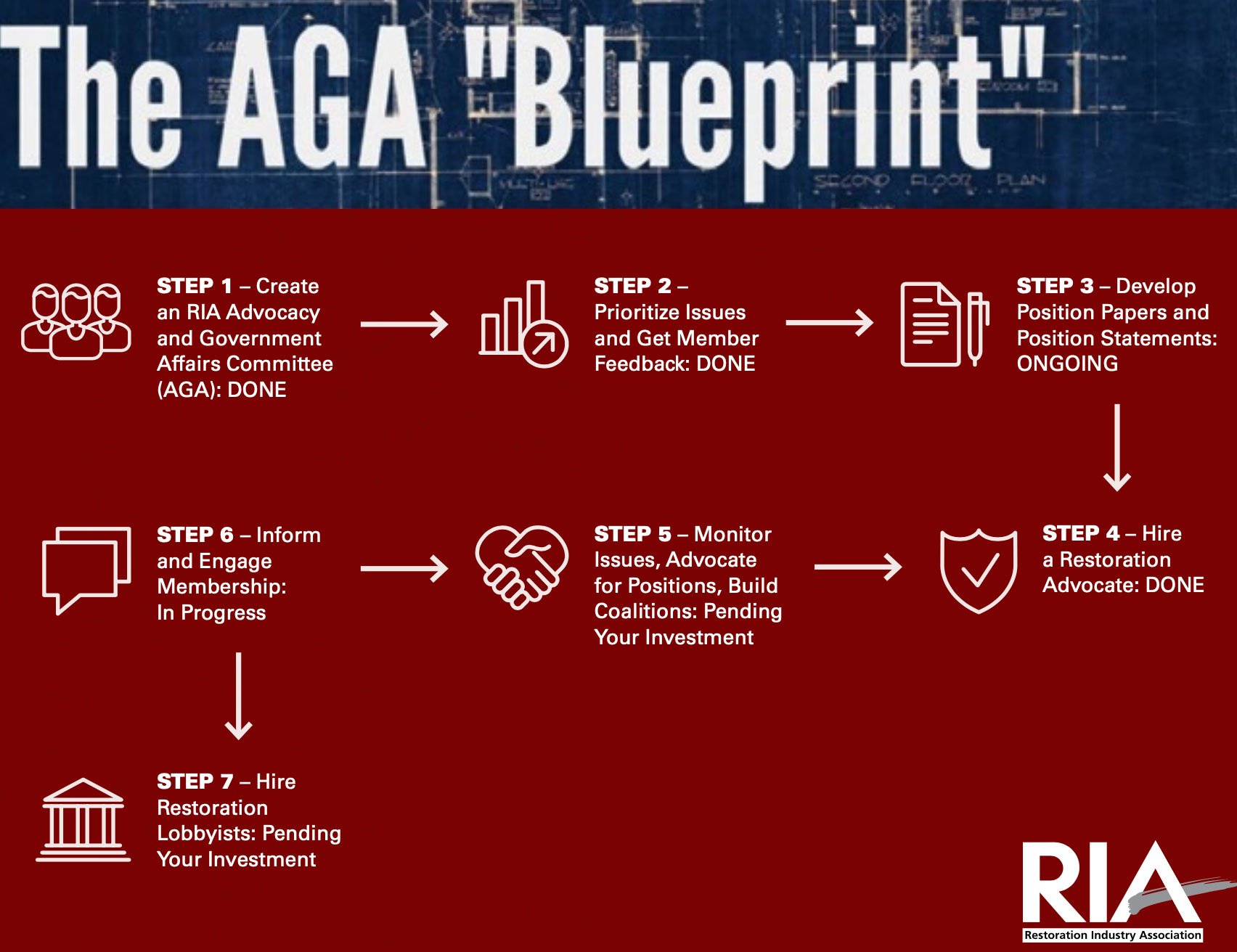
The leadership of RIA is not satisfied with the status quo. It is hungry for change, and it is acting on that hunger. Stimulated by youthful governance and fresh ideas, RIA has made a bold public commitment to effecting real change that will positively impact restorers’ businesses in a measurable way. In his article, “Our Greatest Need,” RIA President-Elect Mark Springer, CR, of Dayspring Restoration in Montana, made the case for and outlined a path to advocacy for the restoration industry. He wrote of many problems very familiar to restorers, including issues with standardized pricing platforms, TPAs, claims consultants, and government regulation. The article garnered widespread attention and support because it included a specific, action-oriented, seven-step blueprint to address the problems:
• Step 1: Create an Advocacy and Government Affairs (AGA) Committee
• Step 2: Prioritize Issues and Get-Member Feedback
• Step 3: Develop Position Papers and Position Statements
• Step 4: Hire a Restoration Advocate
• Step 5: Monitor Issues, Advocate for Positions and Build Coalitions
• Step 6: Inform and Engage Membership
• Step 7: Hire One or More Restoration Lobbyists
STEP 1: CREATE AN ADVOCACY COMMITTEE – STATUS: DONE
On May 1, 2019, RIA rolled out its Advocacy and Government Affairs (AGA) Committee at the Town Hall meeting during its annual convention in Phoenix. I have been honored with the position of chairman of the committee, which consists of an array of talented and extremely successful restoration practitioners with diverse skill sets: Todd Benson of Oakwood Construction & Restoration Services Inc. (a BELFOR company); Steven Anderson of Anderson Group International; Will Akin of McKenzie/Taylor Construction; Dave Robbins of SRP Contractors LLC; Tom Peter of Insurance Restoration Specialists; Jeff Gross of Maxons Restoration Inc.; Charles Cassani of Restoration Management Company; and Katie Smith of PHC Restoration. Each of them has very strong business acumen, runs a successful business, and contributes fresh ideas, not only to tackle the problems of today but to anticipate the problems of tomorrow.
RIA is in growth mode and is adapting to changing conditions in the marketplace to better serve its members. RIA has rebranded its annual convention as the International Restoration Industry Expo, which everyone should attend in New Orleans from April 14-16, 2020. RIA thought long and hard about the fact that the biggest event in this industry is a TPA conference. RIA’s 2020 convention will be co-located with DKI for the mutual benefit of the two organizations and the industry as a whole. This is part of the coalition-building, discussed under Step 5.
The AGA effort cannot succeed without significant financial investments for experts, research, and other expenses, so the AGA formed a Fundraising Subcommittee. We are blessed to have industry sage Warner Cruz of J.C. Restoration in Bensenville, Illinois, as chairman of that subcommittee. The goal of the AGA is to raise $100,000 in its first 90 days and, as of July 18, 2019, $89,235 has been pledged and $64,510 has been collected. Cruz has vowed to support the effort in any way he can to bring unity to restoration contractors, noting that his father had always told him this was something that needed to be done in the industry. He is excited that the industry has finally coalesced in a way that will allow the voices of restorers large and small to finally be heard. Cruz’s success story and his passion for AGA are featured on the C&R content hub.
STEP 2: PRIORITIZE ISSUES AND GET MEMBER FEEDBACK – STATUS: DONE
RIA polled members at its annual convention and received a lot of member feedback, explained in more detail under Step 6. Many attendees submitted Commitment Cards and made important comments about our direction. The AGA has now received and sorted feedback from hundreds of restorers about the issues that plague their businesses. The committee and subcommittees give us a close feel for the heartbeat of our members. After careful review, it became clear that the two biggest priorities are pricing and interference from third parties, such as TPAs and independent building consultants. The AGA hears you and is taking action. See Steps 3 and 5.
STEP 3: DEVELOP POSITION PAPERS AND POSITION STATEMENTS – STATUS: IN PROGRESS
The AGA will thoughtfully evaluate issues and publish and disseminate white papers taking definitive positions intended to ensure that restorers are treated fairly, stop the downward spiral, and help restorers sustain long-term financial and operational health. Restorers, large and small, will be able to hang their hats on those positions and will know they are in good company sticking to their guns on those issues. Our hope is that the industry will finally band together through this effort.
On the TPA front, the AGA is working actively with RIA’s TPA Task Force, chaired by Ben Looper of Southeast Restoration. Among other things, his team is drafting a position paper about TPA requests for changes in scope that are not outlined in program agreements. Great care will be used in the creation of all RIA position papers, and they will be vetted and scrutinized before they are published. This is a time-consuming process but will be worth the wait.
STEP 4: HIRE A RESTORATION ADVOCATE – STATUS: PENDING YOUR INVESTMENT
Once the industry has made the requisite financial commitment in this movement, the AGA will hire a
We will partner with any entity that agrees with our vision, vows to pursue our mission and would like to unite with us.
restoration advocate. Rather than a volunteer speaking for RIA in their spare time, the restoration advocate will be a paid professional with a detailed scope of work and specific goals. To avoid conflicts of interest and fears of retaliation, the right candidate for this position will not be currently engaged in the business of restoring property but will have a deep understanding of the industry and its history, a strong reputation and credibility, and the ability to communicate effectively with myriad stakeholders who affect the outcome of a restoration project. As Mark Springer stated so deftly in “Our Greatest Need ̧” the advocate must be a tough-as-nails diplomat, not an administrative wallflower or policy wonk. The advocate will report to me and the RIA executive director. We stand ready to vet candidates for this position. This unique individual may not be easy to find, so please put the word out and send confidential nominations for this position to [email protected]. Once the funds are available and the Executive Committee and the AGA approve the nomination, you will see results from Step 4.
STEP 5: MONITOR ISSUES, ADVOCATE FOR POSITIONS AND BUILD COALITIONS – STATUS: PENDING YOUR INVESTMENT
Large volumes of information are now flowing rapidly to the AGA headquarters through dozens of industry conduits (and to [email protected]), and we are very grateful to everyone who helps keep us informed in real-time of the real challenges happening in the field. As the AGA grows, more subcommittees will be formed, and they will provide the ammunition necessary for the advocate to be effective.
Xactware presented at the annual convention and some of what I heard varied greatly from what my restoration contractor clients have been telling me over the years. However, in my experience as a litigator and mediator, I often find that truth is somewhere in the middle between what the two sides are saying, so I sent a letter to Greg Pyne, vice president of pricing at Xactware, requesting a meeting with me to get to the bottom of these problems. He cordially agreed, and although we have not raised the funds necessary to engage the advocate, we are in the process of preparing for that meeting. To make sure I am properly prepared for that meeting and to pursue one of the main goals of the AGA, which is fairness in pricing, we formed a Pricing Subcommittee. I am delighted to report that the phenomenal Dave Robbins is the chairman of that subcommittee.
The highly energetic Robbins immediately took the proverbial ball and ran with it, forming a very powerful subcommittee of some of the best and brightest restoration pricing experts in the country. His phenomenal group is conducting in-depth research and gathering data for my upcoming meeting with Pyne. We don’t have all the solutions yet, but one thing is clear: Things have to change. We hope that the meeting will not be a singular event but rather the commencement of ongoing dialogue between the two organizations that will lead to some reasonable solutions. Please watch for future Advocacy Reports for updates.
RIA and the AGA have already made great strides at building coalitions and alliances, and this work will continue. We will partner with any entity that agrees with our vision, vows to pursue our mission, and would like to unite with us. In addition to rolling out the AGA at the annual convention, RIA and the Institute of Inspection Cleaning and Restoration Certification (IICRC) executed a “Mutual Benefits Agreement” in a live signing ceremony. The agreement memorializes a strong alliance whereby the two industry giants will work together to establish areas of mutual interest that will include advocacy for restorers. This is one of many coalitions that will expand the reach of RIA, making it more powerful, more efficient, and more effective. We are also seeking to collaborate with other associations where we have mutual benefits, such as the Indoor Air Quality Association and its Government Affairs Committee. More important alliances are in the works and will be announced in the coming weeks and months.
STEP 6: INFORM AND ENGAGE MEMBERSHIP – STATUS: IN PROGRESS’
This step is a process — not an event — and, therefore, it will never be “done.”
In the days before the annual convention, RIA made the shrewd decision to move the Town Hall meeting from its traditional place at the end of the convention to the No. 1 position at the very beginning of the convention. This was a strong public statement that RIA sees advocacy as its No. 1 task.
What followed was a big, bold information and engagement campaign, in every conceivable medium. The outreach is too vast to fully describe here, and this report only includes a few representative highlights. The AGA distributed Commitment Cards at the Town Hall, which secured investments of time and/or money from a large group of enthusiastic restorers. Immediately after the convention, a social media frenzy began with restorers large and small, everywhere from rural areas to major metropolitan markets, distributing Commitment Cards and directing the attention of their peers to the RIA as the entity best suited and best equipped to advocate for the business interests of restoration contractors. Many of the recipients of this message had never heard of RIA before the AGA was formed and might never have heard of it had it never been formed. Investments continue to flow in from restorers who want to fuel this movement.
RIA implemented cutting-edge technology at the Town Hall, which allowed attendees to ask questions through their smart devices. The level of interest was beyond what we had anticipated, and the number of questions was too large to answer in the time allotted for the Town Hall, so RIA promised to address those questions in a follow-up webinar. It fulfilled that promise on June 27, 2019, in a webinar hosted by Mark Springer and sponsored by IICRC and Sunbelt.
Everyone who invested $150 or more in the AGA received a free pass to a Pricing Feedback Webinar by restoration
Many of the recipients of this message had never heard of RIA before the AGA was formed and might never have heard of it had it never been formed.Many of the recipients of this message had never heard of RIA before the AGA was formed and might never have heard of it had it never been formed.
pricing expert Ben Justesen of JRCC and Enlightened Restoration Solutions. The webinar covers methods a contractor can use to determine his or her own pricing, make price lists, and how to submit pricing feedback to Xactware. Justesen has successfully increased his retail labor rates using the XactAnalysis feedback tool and shares that process in his webinars. Once you effectively change the retail labor rates, Xactimate automatically increases local unit pricing. Justesen has successfully increased his retail labor rates using the XactAnalysis feedback tool. He also created the Labor Calculator, which is available for free on the RIA website.
RIA Executive Committee and AGA Committee member Katie Smith wrote an outstanding story about the Town Hall meeting, which can be seen on the C&R content hub. She also gave a compelling and very well-received presentation about the need for the advocacy and the vision of the AGA at the Violand Executive Summit in Canton, Ohio, in June 2019.
With the birth of the AGA, RIA has a new, bigger social media presence, with intensive coverage on Facebook, Linked In, the RIA website, C&R magazine, Restoration & Remediation magazine, and Cleanfax. The AGA is collaborating with many major entities in the restoration sphere to build a broad coalition in the industry. The committee is keeping the industry abreast of its activities and all major developments. Accordingly, these Advocacy Reports will be consistently published in several leading restoration trade publications. Between reports, there will be updates on the C&R content hub, which is a treasure trove of valuable research and writing on issues of great importance to restorers. The AGA extends its special thanks to the multitude of media outlets and supporters who have helped to spread the word and allowed the AGA to gain rapid momentum in a short period of time.
STEP 7: HIRE RESTORATION LOBBYISTS – STATUS: PENDING YOUR INVESTMENT
The AGA is actively carving a pathway to become involved in lobbying activities to help the restorer, something it never did before the AGA was born. With enough support from you, the AGA will provide advocacy for restoration professionals across the country and seek to influence legislation and/or reform as needed, on a priority basis.
RESTORATION ADVOCACY REPORT #3 – AUG. 20, 2019
The AGA presently has four subcommittees: the Pricing Subcommittee, chaired by Dave Robbins; the TPA Subcommittee, chaired by Ben Looper; the Investment Subcommittee, chaired by Warner Cruz; and, most recently, it has formed the TPC (Third Party Consultant) Subcommittee.
PRICING SUBCOMMITTEE REPORT
The AGA Pricing Subcommittee,
It is important that users on the insurance side of the industry understand that one size does not fit all.
under the soaring leadership of Dave Robbins, aims to focus the industry’s attention on the inequity of universal pricing models, more specifically challenging Xactware to vigorously promote contractor survey participation through awareness, education, and safety from retaliation. While we on the professional restorer side of the industry must understand that it is our responsibility to provide accurate pricing and survey feedback, there must be a greater awareness in the industry that these options are freely available to us. It is also important that users on the insurance side of the industry understand that one size does not fit all. Greater awareness must be the goal if we are to achieve harmony among all materially interested parties (insurers and contractors alike).
Based on conclusions from the Pricing Subcommittee, as well as the hundreds of years of combined experience of the members of the AGA Committee, AGA’s official position is that 10% for overhead is unrealistic and outdated. In response to an inquiry about why 10% was chosen for overhead and why it has not changed over the years, Greg Pyne, vice president of pricing for Xactware, has stated in writing: “The overhead and profit percentages used at the end of an estimate are not something Xactware sets. It is something that needs to be determined by the estimator and/or parties involved.” The AGA recognizes the limitations contractors face when they voluntarily agree to participate in vendor programs but wants to banish the notion that 10% is a fair or appropriate percentage for overhead.
The problem is exacerbated because the hourly rates for many trades are not even close to what the marketplace is dictating. The Executive Summary of Xactware’s pricing research methodology paper asserts that its costs data is used more than all of its competitors’ data combined and that its data is the industry standard. It says its Pricing Data Services Team follows a multitiered approach by performing industry surveys on both time and material (“bottom-up”) and unit costs (“top-down”) with more than 50,000 suppliers, contractors, and services across the continent. In addition, Xactware reviews recent transactions in the form of completed repair and remodeling estimate that has been submitted from live jobs in each market.
Xactware’s Feb. 6, 2018, Pricing Research Methodology report states: “Xactware employs a proprietary cluster analysis algorithm designed by doctorate-level professors with wide experience in the fields of economics and statistical analysis. The cluster analysis algorithm analyzes all submissions, identifies the cluster(s) into which prices are grouped to minimize the impact of outliers, and selects a representative price from the largest cluster. This process is run independently of all other information received.”
Xactware has multiple methods of collecting price data. One of the most prominent methods is Xactware’s reporting tool, XactAnalysis. Xactware’s 2018 Property Report reveals that roughly 90% of the estimates uploaded to XactAnalysis come from adjusters and not from entities that actually perform work in the real-world marketplace. The AGA is searching for statistics about Xactware’s other data collection methods but so far has found none.
Furthermore, the majority of all contractor transaction reviews are program-related uploads through XactAnalysis, most of which are governed, policed, and highly scrutinized by the TPAs. In other words, most completed, uploaded estimates have been modified (reduced) before being accepted by the TPAs and/or carriers. Therefore, these estimates are not (necessarily) representative of accurate (or sustainable) pricing models.
Also, based on our review and comparison with the Bureau of Labor Statistics pricing models, Xactimate utilizes the lowest costs available to measure hourly trade rates. Trade rates for restoration workers should rank among the highest-paid due to the physical work environment (unstable building conditions, hazards, environmental issues), the time-sensitive nature of the work, the investments employers must make in certifications insurers require for technicians, the unique risk exposure entailed with this type of work and many other factors.
Additionally, there are a number of default settings within Xactimate (such as demolition labor) that should be changed to support the actual trade being performed. This should be changed at the design/platform level, not the user level.
While each of these items is critically important, this is only the beginning. Our overarching goal is to create greater awareness and harmony for everyone, on all sides, while working to ensure that prices are reported accurately.
TPA SUBCOMMITTEE REPORT
The TPA Subcommittee, chaired by Ben Looper, is concerned, among other things, about the TPA file review process. Conflicts arise when contractors receive requests for reductions in price or scope when they believe the requests are not supported by the terms of the program agreement or by insurance repair standards of care. In an effort to reduce these conflicts and improve communications between contractors and TPAs, the TPA Subcommittee has worked hard to develop a position paper to address this predicament. The goal is to educate all parties involved in an effort to create a smoother claims resolution process. Once approved by RIA’s Board of Directors, it will be RIA’s first-ever position paper. Now that a process is in place, position papers will be easier to produce for RIA and its committees.
The TPA Subcommittee has invested significant energy in formulating a scoring system for TPAs that will allow contractors to make well-informed decisions before agreeing to participate in a program. Doing this properly and fairly is a major undertaking, and the AGA is dedicated to taking the time to do it correctly so that it yields high-quality data.
TPC (THIRD PARTY CONSULTANT) SUBCOMMITTEE
The new TPC Subcommittee will address issues with certain third parties that interfere with contractors’ businesses. For purposes of this subcommittee, a “TPC” is a third party who has no contractual relationship with the contractor but evaluates contractors’ billing and work and/or provides consultation or adjusting services to insurance companies regarding restoration projects. TPCs include independent adjusters, third-party building consultants, commercial loss consultants, and construction “experts” who critique restoration invoices. TPAs are not
All restorers, large and small, conveyed passion and pain from the bullying they experience from TPAs and TPCs who change the rules after work has been completed.
TPCs. Contractors agree to work with TPAs, such as Contractor Connection, by signing up for their programs. TPCs, on the other hand, is imposed upon contractors without their consent. Therefore, they can –– and should –– be handled differently.
The TPC Subcommittee will confront the “Monday morning quarterbacking” by certain TPCs who attempt to change the rules of the game after it has already been played. Some TPCs make arbitrary allegations about billing norms for items such as weekly rates, overtime hours, and consumables. The subcommittee will conduct research, formulate winning strategies and eventually publish position papers restorers can use to overcome the most bothersome problems with TPCs.
The founding members of the TPC Subcommittee are Jeff Gross and Tom Peter. The subcommittee is still in the early formation phase. This is a call for biographies from experienced contractors who are interested in joining this subcommittee to effect real change across the industry. Please send an email to [email protected] to submit ideas for names or to volunteer.
INVESTMENT SUBCOMMITTEE REPORT
On May 1, 2019, the day the AGA was unveiled, RIA President-Elect and Investment Subcommittee member Mark Springer issued a public challenge to the industry to raise $100,000 for AGA in its first 100 days. We are proud to report that under the fine leadership of Investment Subcommittee Chairman Warner Cruz, this goal was not only met but shattered — in only 75 days. In fact, as of Aug. 20, 2019, an impressive $127,300 has been pledged to the AGA movement by members of our industry, and the number is increasing weekly.
Cruz is very proud of his entire team for the spirit they showed working the phones in the month of July. He and the AGA extend special thanks and hearty congratulations to Investment Subcommittee member and superstar fundraiser Josh Hobbs of Dalworth Restoration, who was the member who raised the most money in July.
The members of the Investment Subcommittee shared a common experience as they called potential investors: All restorers, large and small, conveyed passion and pain from the bullying they experience from TPAs and TPCs who change the rules after work has been completed. Standardized pricing programs are a source of great anxiety. But all restorers get excited about uniting their voices and creating a vehicle where these complaints can be heard and something constructive and sustainable can be done for the sake of the industry. “It is about time someone did something about it” is a common sentiment from the restorers, particularly since the AGA intends to take the proverbial “high road.” This movement is being well received by our industry.
Motivated by its surge of success in July, the Investment Subcommittee has now set its next goal, which is to reach $250,000 by the end of 2019. We wish them the best of luck in this effort. Contractors have suggested a minimum investment of 1/100th of one percent of each restoration company’s annual gross revenue (i.e., $100 per one million in gross revenue), which is very modest. However, most restorers across the country are investing at least $1,000. Please consider investing at least $1,000 as a burst of fuel to help meet our goal by the end of this year.
RESTORATION ADVOCACY REPORT #4 – SEPT. 20, 2019
JOIN OR DIE
If restoration companies are unwilling to unite, advocate for sustainable claims practices and take a proactive approach with insurance carrier claims policies, then the restoration industry, at least as we know it, could cease to exist within a decade. The AGA Committee has made major strides to build unity within the industry and is moving aggressively to level the playing field for restorers, both legally and financially. We extend our heartfelt appreciation to the hundreds of restorers who have invested, time, ideas, and money in this growing movement.
THE ROAD TO VICTORY
In prior reports, we have outlined the steps in the plan to achieve our goals and the completed tasks. The AGA presently has four subcommittees: the Pricing Subcommittee, chaired by Dave Robbins; the Third Party Administrator (TPA) Subcommittee, chaired by Ben Looper; the Investment Subcommittee, chaired by Warner Cruz; and the Third Party Consultant (TPC) Subcommittee. Every member of the team is deeply devoted to the success of this effort and to reverse the trends that threaten the industry.
DEALING WITH THIRD-PARTY ADMINISTRATORS
Restorers, especially with smaller companies, are often the victims of unequal bargaining power in the settlement of restoration claims. RIA stands ready to help give restorers the tools they need to neutralize these challenges. The RIA Board of Directors recently approved the association’s first-ever position paper. This milestone is the product of the hard work of the AGA’s Third Party Administrator (TPA) Subcommittee. It addresses best practices for restorers confronted with requests from TPAs for changes in scope and/
Our reports and position papers will give restorers the ammunition they need to defend themselves to achieve fair results.
or price. Confusion arises when TPA staff allege that these requests are based on program agreements. In that case, the TPA should specifically cite the contract provision that justifies the request. Contractors should be wary of arbitrary and capricious requests for price reductions, and, when they are not required by the program agreement, they should request a review by the carrier adjuster. On Nov. 1, 2019, the full TPA position paper will be on the AGA “Resources” page, under the “Advocacy” menu of the RIA website.
TOOLS FOR SUCCESS IN PRICE NEGOTIATIONS
The AGA Pricing Subcommittee, led by industry icon Robbins, has amassed voluminous market data and is preparing an organized and focused challenge to certain aspects of standardized pricing platforms and the data collection methodologies behind them.
Many restorers are defeated in price negotiations with carriers because they do not have the information they need to counter common attacks on price and scope. Our reports and position papers will give restorers the ammunition they need to defend themselves to achieve fair results.
We reiterate that trade rates for restoration workers should rank among the highest in all construction-related trades, due to unstable building conditions, hazards, environmental issues, the time-sensitive nature of the work, and many other challenges. The AGA is concerned that prices reported in standardized pricing platforms are given far more weight than they deserve. The AGA wants to dispel the myth that Xactware “sets” prices. It does not. In the Frequently Asked Questions section of its eService Center, Xactware states: “How does Xactware set prices? While it may seem a trivial distinction, it is important to know that Xactware does not ‘set’ prices, but rather acts as a reporter of market price information. Xactware does not tell individuals what they should charge (or pay) for work, but rather provides information that is intended to be helpful in the estimating process.” (Answer ID 2963)
Xactware collects price data through multiple channels, one of which is XactAnalysis. As explained in our last report, restorers must keep in mind that roughly 90% of the estimates uploaded to XactAnalysis are not from entities who perform actual work in the real-world marketplace. Nonetheless, Xactware asserts that it goes to “great lengths to ensure that no one party or industry segment has any undue influence on the pricing data that we research and report on.” The AGA will address this imbalance, and the apparent disconnect, head-on. Many restorers wonder why any price should be considered in a market analysis if it does not come from a practitioner currently in the trade. Unbeknownst to many, Xactware states: “In the end, the correct price for any job is based upon an agreement between the purchaser and the provider: the price which the purchaser is willing to pay and the provider is willing to work.” (Xactware Pricing Research Methodology report, Feb. 6, 2018)
Restoration project conditions are varied and diverse and do not lend themselves well to a one-size-fits-all approach for pricing. Reports on market prices may or may not be relevant to a given job. Standardized prices are generic, nonspecific, and inapplicable to many different scenarios. Open-mindedness and common sense should prevail in all instances. That’s why in order to obtain a Xactimate user’s license, insurers, TPAs and contractors alike must agree in writing that they will not prohibit or preclude deviations from Xactimate prices when market conditions or other factors warrant a deviation. The AGA urges restorers to look at the last sentence of the second paragraph of Section 9 of their Xactimate License Agreement and employ it when someone insists on Xactimate prices. This point is seemingly unknown in many corners of the insurance industry.
“You agree not to prohibit or preclude deviations from the Price Data where contractor requirements, market conditions, demand or any other factor warrants the use of a different line item price in the specific situation.” — Xactimate License Agreement, Section 9
LEVELING THE PLAYING FIELD WITH THIRD-PARTY CONSULTANTS (TPCS)
TPCs include independent adjusters, third-party building consultants, commercial loss consultants, and construction “experts” who critique restoration methods and invoices. TPAs are not TPCs. Contractors agree to work with TPAs by signing up for their programs. TPCs, on the other hand, is imposed upon contractors without their consent.
Many third-party building consultants and reviewers interfere with contractors’ business operations and systems. This diminishes the level of service provided to policyholders whose homes and businesses have been destroyed in a catastrophe. The AGA urges restorers to
vigorously resist Monday morning quarterbacking from anyone who attempts to change the rules of the game after it is already underway, or when it is already over.
The AGA’s TPC Subcommittee is comprised of experienced and passionate restoration specialists with hundreds of years of combined experience warding off assaults against industry standards of care and the hard-earned compensation of restorers across America. The subcommittee members are dedicated to formulating organized strategies and best practices to overcome the most harmful tactics of TPCs. The subcommittee created a list of dozens of inappropriate, unfair, and, in some cases, illegal practices of TPCs. After careful consideration, the subcommittee elected to focus first on the following three TPC practices:
1. TPC DEMANDS RECEIPTS AND OTHER EVIDENCE OF CONTRACTORS’ COSTS
Restoration contractors do not typically work on a “cost-plus” basis, so their costs are typically irrelevant. In most cases, contractors are under no obligation to provide them. Property insurance companies are generally required to pay the “usual and customary cost of the work.” That means retail price — not wholesale. When a contractor works hard, builds a good reputation, and treats his vendors well, his business grows and he enjoys greater buying power and earns well-deserved discounts. He alone has earned that reward –– not the insurance company or the customer. Think of the shoe on the other foot and ask the adjuster if the insurance company will provide records of its costs when it issues invoices for premiums. Stay abreast of the true market prices for the services you provide and do not be shy about demanding the profit you earn. Seek legal advice from a lawyer licensed in your jurisdiction to learn more about your rights and obligations in this area.
2. TPC DEMANDS CHANGES IN METHODS OR PROTOCOLS
Those who provide professional services must perform at the level of members of the trade-in good standing. “Good standing” means, among other things, that they are recognized in the trade as qualified and competent. Unfortunately, some TPCs are willing to jeopardize
the integrity of a structure and the health and well-being of the occupants in an effort to stay in the good graces of an insurance company. They will do this unabashedly and at the expense of the contractor (and the contractor’s liability insurance carrier). Sometimes there is a benefit from having two sets of eyes review a situation. Nonetheless, contractors must stand together to resist the pressures of outside forces seeking to make the contractor lower his standards, or face legal peril. In many, if not most, cases, contractors should withdraw from a project when they are under unrelenting pressure to perform work in a substandard manner, or they will be left holding the bag.
How did we get here? How did the insurance industry become so powerful that it can force a hardworking contractor who provides good work to accept a payment that includes little or no profit?
3. HOLDING UNDISPUTED AMOUNTS “HOSTAGE” WHILE DEMANDING DEEPER PRICE CONCESSIONS IN ORDER TO RELEASE FUNDS
Contractors perform work in good faith reliance that they will be paid according to their contract. Unfortunately, some TPCs take advantage by causing entire invoices to be withheld when only a small portion is in dispute. The contractor feels forced to make unfair concessions and/or incur attorneys’ fees as if to “buy” his own check. Some states require prompt payment of undisputed sums to contractors. Ask your local lawyer if your jurisdiction has such a statute, and consider adding a provision to your contract requiring prompt payment of undisputed sums. Contractual penalties are often unenforceable, but your jurisdiction may allow you to tack on extra “fees” when undisputed sums remain unpaid.
RESTORATION ADVOCACY REPORT #5 – OCT. 16, 2019
As natural disasters continue to devastate large swaths of landscape across the country, Americans rely more than ever on restorers to help rebuild their lives. Every day of delay is a day of agony for the victims of these catastrophes. But if insurers insist on prices that are based on generic price systems that do not reflect the true current cost of labor, they shortchange their customers in their hour of need and discourage contractors from returning properties to their pre-loss conditions. Xactware has stated that the “correct” price for any job is based upon an “agreement between the purchaser and the provider: the price which the purchaser is willing to pay and the provider is willing to work.” (Xactware Pricing Research Methodology report, February 6, 2018.)
The volunteers who serve on the AGA and its subcommittees are focused on righting these wrongs and creating an environment that is sustainable and fair to all the parties involved in a property insurance claim.
If insurers insist on paying no more than the prices set by Monday morning quarterbacks who are ignorant of the site conditions and obstacles faced by restorers, and the true expense of restoring a building, the insurers breach their quasi fiduciary duties to their policyholders. In the process, they subject themselves to liability for breach of the implied covenant of good faith and fair dealing (“insurance bad faith”) because they interfere with the policyholders’ rights to enjoy the benefits of the insurance contract. Insurers that stand on lowball estimates spend hundreds of millions of dollars defending bad faith claims, which undoubtedly leads to higher premiums, and everyone — including the insurance executives who perpetuate these systems — suffers. The volunteers who serve on the AGA and its subcommittees are focused on righting these wrongs and creating an environment that is sustainable and fair to all the parties involved in a property insurance claim. We are not asking for anything to which we are not entitled; we are only asking for what is fair.
How did we get here? How did the insurance industry become so powerful that it can force a hardworking contractor who provides good work to accept a payment that includes little or no profit? Why do labor rates in standardized pricing platforms remain stagnant for years as the cost of labor and the cost of living continue to rise? And why do standardized labor rates suddenly spike after years without increases, and then a flat line for years to follow? In particular, how can the standardized rate for restoration labor ever increase if it is based on surveys that only parrot back the standardized rate? A survey that just regurgitates the surveyor’s own information is not only ineffective; it is worse than no survey at all because it affirms a falsehood.
Restorers need to know their true costs of rendering services and build in a margin that allows them to earn a living for themselves and their employees. The cost of service includes training, employee benefits, insurance, and legal expenses, just to name a few. Restorers suffer when they yield to the pricing mandates of third parties, particularly when the restorer is not sufficiently capitalized to wait six or more months for payment. The restoration industry is the only segment of the construction industry that is self-funded, and restorers should not be forced to “buy” their checks when a third party interferes with the normal course of business.
The AGA is attacking these problems on multiple levels. Its Pricing Subcommittee is conducting in-depth research to expose the flaws in standardized pricing platforms. It has been declared that 10% is an inaccurate and unfair number for both overhead and profit. We have engaged Xactware in this discussion, and its representatives are listening. The TPA Subcommittee is publishing its first position paper on Nov. 1 and is rating TPAs so contractors can make informed decisions
before they are lured into doing high-volume work for cut-rate prices. The Third-Party Consultant (TPC) Subcommittee is formulating strategies for restorers to combat the most common tactics from independent adjusters, construction “experts” and third-party building consultants who have declared war on restoration profits. (In our last report, we pointed out that the holders of Xactimate license agreements agree in writing in Section 9 of the license agreement not to prohibit deviation from Xactimate prices where contractor requirements, market conditions, demand, or “any other factor” warrants the use of a different price for the specific situation.)
AGA has elected former RIA (ASCR) President Barry Swidler, Esq., as chairman of the TPC Subcommittee. Swidler is a former business partner of John Held and has a wealth of information and experience in this area. He is truly a force to be reckoned with, and his subcommittee promptly reached a consensus on a number of important TPC issues.
WE NEED YOUR SUPPORT
Please support the AGA now. This will be labor-intensive, so we need people, ideas, and money. We need people to perform research, write papers, and serve on subcommittees and task forces. Please volunteer to help on whatever level you can, and please submit ideas for issues that warrant examination by the committee, by emailing me at [email protected] or calling the AGA Headquarters at (760) 773-4002. Please write “AGA” in the subject line of your emails. We will carefully consider all ideas submitted, using a triage system.
Each member of the AGA Committee has pledged to make an investment of at least 1/100th of 1% because they know the investment will pay off if the industry
The Pricing Subcommittee has declared that 10% is an inaccurate and unfair number for both overhead and profit.
unites, and they believe RIA is in the best position to effect this change.RIA
Related Posts