It is no secret that the restoration industry is riddled with uncertainty when it comes to the demand for services. Seasonal weather patterns give contractors an indication of what the cyclical nature of the business looks like from year to year. Most will use these observations to staff production and allocate resources conservatively to line up somewhere in the middle across the peaks and valleys. This is not a bad strategy, but it leaves a lot of money on the table when demand surges with natural disasters or large loss projects, which can often come in waves.
While I’ve always said that the restoration industry is neither predictable nor convenient, I do believe the use of predictive management, powered by data, can help restorers plan for these unpredictable spikes more effectively.
In the first part of this article, we will explore what predictive management looks like and the benefits of using data to forecast demand in the restoration industry. The following installment will then focus on the strategies along with the associated tools and technologies to maximize your company’s bottom-line return during times of peak demand.
What is Predictive Management
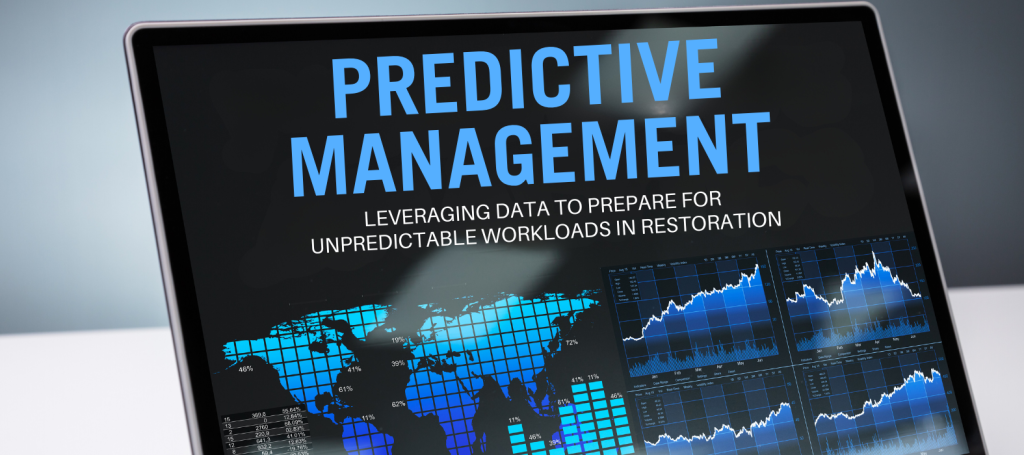
Predictive management is the use of data and analytics to anticipate future events (opportunities and threats) and adjust operations accordingly. The ability to use historic information to forecast future workloads can improve resource allocation and response times, reduce downtime, and maximize productivity while maintaining service quality.
Earlier this year, I wrote an article on CAT response planning. In doing the research for that piece, I looked at 50 years of data that revealed some very interesting and somewhat predictable information. These numbers led me to conclude that we had a 94% chance of seeing a landfalling hurricane in the United States in 2024. At the time of this writing, we have experienced five: Beryl, Debby, Francine, Helene, and Milton.
How Predictive Management Can Benefit Your Business
Knowing this information, managers of companies in coastal states—especially the Gulf Coast—can use this type of analysis to plan for staffing, material and equipment inventory needs, vendor contracts, and strategic partnerships with other restorers, all of which are focused on the singular goal of capitalizing on predictable demands for service.
This type of initiative is not limited to just natural disasters. The restoration business is littered with data points that give us insight into the predictability of service demand. Looking at lead sources, loss types, volume, size, and quality by date and geographic location can reveal trends and patterns that are repeatable.
Other examples of this can include surges in mold remediation opportunities that relate to the real estate market, fires and puffbacks to the heating season, and large water loss opportunities on Sundays during the summer months as people find unpleasant surprises upon returning from week-long vacations.
Some might consider this a microscopic method of fine-tuning an operation that already has a large volume of projects. I would contest that it can apply to even the smallest of companies and put them in the best possible position to succeed at various levels. As more traditional approaches rely on an “event” to trigger a response as it occurs, predictive management sets the stage for a much more effective response by having the right resources in the right places at the right times.
Of course, the holy grail of profitability occurs when the demand for services and resource supply are in balance. This rarely occurs in service businesses, so the next best thing is getting them as close as possible. Proactively allocating resources such as crews, equipment, and materials when the data tells us we should position the company to improve profitability by increasing the capacity to perform more work with faster response times, reduced labor and rental equipment costs, and waste reduction.
Managers in the food services industry are very familiar with predictive management strategies. Typical mealtimes are akin to seasonal and routine property claims patterns, and large dining groups and banquets represent large losses and catastrophic events to restorers. While pipe breaks and fires may not be as predictable as when people eat, there are enough similarities to see that being prepared can make the difference between mediocrity and success.
Looking ahead, we will dive into five specific strategies prevalent in the food services and other industries that restorers can use to maximize their bottom line. All of these require very little investment other than time, and they utilize data and information that is readily available. In the meantime, I would encourage you to think about the last surge in business that you had. Whether it was event-driven or not, consider your organization’s performance relative to its potential. If these two things were not in harmony, predictive management can be used to bring them closer to that space. If they were in harmony, then we raise the bar on the potential side of the equation. Either way, it’s a win-win scenario for everyone.
Timothy E. Hull, CR
 Timothy E. Hull, CR, is President of Violand Management Associates. He has a vast knowledge of all facets of business, enhanced by strong analytical and negotiating abilities, and extensive experience in the disaster restoration industry. Early in his career, Tim spent time in the building trades before working in top positions for two well-respected, high-performing restoration companies. He joined Violand in 2008 as a business development advisor and purchased the company in January 2025. To reach him, visit violand.com or call (330) 966-0700.
Related Posts