Is your business model primed for disruption? More and more, companies of all sizes across every industry are coming to the reality that they will come under some level of threat in the next five years due to disruption.
In fact, it’s a certain type of disruption that they are facing: digital disruption. Defined as technology developments that challenge traditional business models and foster quicker and more direct engagement with customers, digital disruption has become the common reality facing businesses large and small across every market today. And businesses that are not prepared to handle disruption, both from a tactical and strategic perspective, run the risk of becoming vulnerable to losing customers, market share — or worse.
Some characterize digital disruption as being the flipside to digital transformation — the journey that businesses take toward innovation. That being the case, things like artificial intelligence (AI) and smart devices present equal parts opportunity and challenges.
No matter what size company or what industry, there is some form of disruption waiting at the doorstep — and that means business leaders must prepare to shift organizational structures and remove the barriers that are keeping them from maximizing the potential impact of new digital technologies.
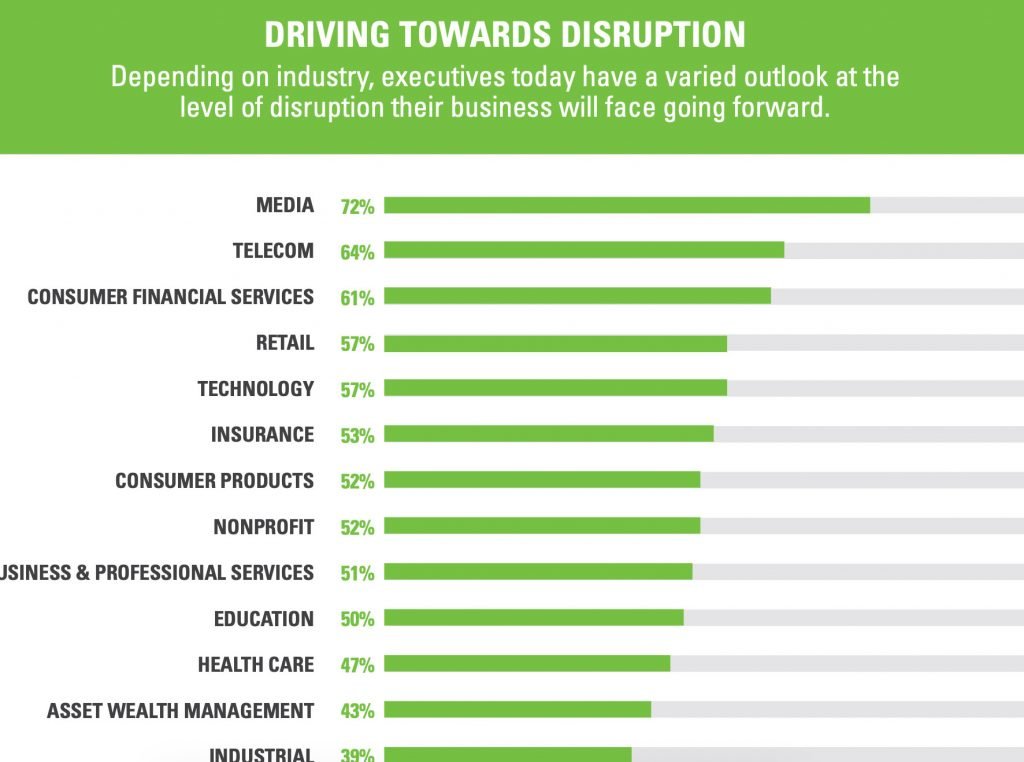
In an article written for Harvard Business Review (HBR), Rhys Grossman, who co-leads the Digital Transformation Practice and Consumer Digital and Media Practice with Russell Reynolds Associates, said digital is no longer “the shiny front end of the organization — it’s integrated into every aspect of today’s companies.” Russell Reynolds Associates polls more than 2,000 C-level executives across multiple industries on the impact, structure, barriers, and enablers of digital technologies. The graph on the follow- ing page shows the percentage of executives surveyed who said that their business would be moderately or massively disrupted by digital in the next 12 months.
In the article, he says industries that typically become most susceptible to disruption have two common characteristics: One is a low barrier to entry that leads to competitors with greater agility. Second is the fact that these organizations have large legacy business models that often generate the majority of their revenue. As a result, the culture of these organizations can be challenged when it comes to adapting to change at the right place.
On the flipside, industries that are least disrupted — industrial and education, are two examples cited by Russell Reynolds Associates — often have perceived higher barriers to entry, and a smaller part of their business that can be digitized. Although this means the impact of disruption is lessened, it does not mean that they aren’t at risk.
Business leaders who are facing the reality of disruption — whether presently or in the near future — must be actively preparing to combat the impact.
ADAPTING TO DISRUPTION
Business leaders who are facing the reality of disruption — whether presently or in the near future — must be actively preparing to combat the impact. According to Grossman in HBR, these business leaders can focus on three areas in order to keep pace: people, culture, and commitment.
1. People. This is described in the article as the “catalytic” roles and focused highly on new employees who can act as catalysts. These employees come aboard, most often, to disrupt traditional thinking and business models, and thus speed up the pace of transformation. However, in order for these catalysts to be successful, they must be positioned correctly within the firm — at the appropriate level with sufficient scope and influence.
2. Culture. This is associated with a company’s data. There is a shift in how decisions are being made these days where data is taking a stronger hold. In other words, company decisions are less about the insights of employees with experience and more aligned with data that supports what the customer truly wants. Fostering a culture of data-based decision-making means businesses will be in a better position over the long term.
3. Commitment. This involves building digital into the core strategy, systems, and processes of the business.
“Digital Pulse 2015,” by Russell Reynolds Associates | http://www.russellreynolds.com/insights/thought-leadership/digital-pulse-2015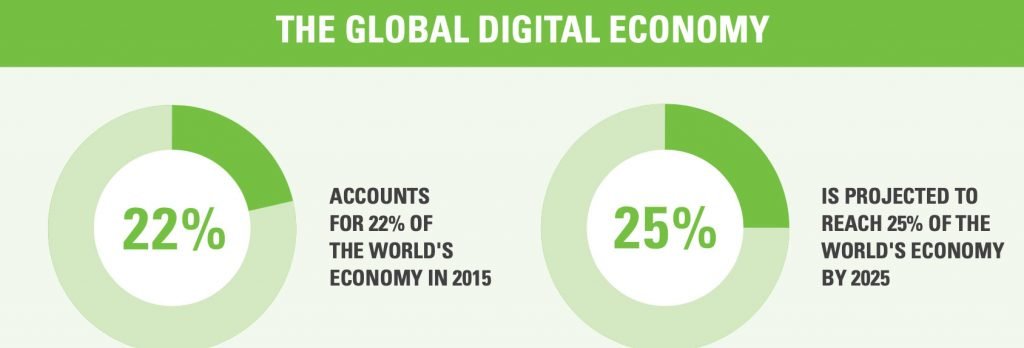
Global consulting firm Accenture publishes its Technology Vision report
In other words, company decisions are less about the insights of employess with experience and more aligned with data that supports what the customer truly wants. Fostering a culture of data- based decision-making means businesses will be in a better position over the long term.
BECOME DATA-DRIVEN
Global consulting firm Accenture publishes its Technology Vision report on an annual basis. The latest report cites that the global digital economy accounted for 22 percent of the world’s economy in 2015, and is projected to reach 25 percent by 2025.
Accenture says companies today are struggling to deal with change. Specifically, they find the impact of technology and the associated tactics to be overwhelming at times. To combat this, these companies face the task of being able to change their business models and all supporting processes, develop new skills, and learn different and more agile ways of working collaboratively with partners.
Helping to address such challenges, Accenture has established four pillars of the corporate cultural shift, one of which is the idea of being a data-driven organization. While it seems that the idea of being a data-driven organization isn’t necessarily new, Accenture believes that far too many companies are still in their infancy when it comes to making this shift to becoming fully data-driven. Being truly data-driven goes beyond just having better tools or skills;
it means changing the basis for making decisions at every level of the company. What is needed is for data to become so pervasive and readily available that it is able to support “insight-driven” decision-making throughout the enterprise. This goes beyond people using data — machines must also be equipped to harvest and act upon intelligence.
Given this idea, in order for organizations to become truly data-driven, they must embrace what Accenture calls the Platform Economy. Accenture says that the next wave of disruptive innovation will come from the technology-enabled, platform-driven ecosystems that are beginning to develop across all industries. It states, “Having strategically harnessed technology to produce digital businesses, leaders are now creating the adaptable, scalable and inter-connected platform economy that underpins success in an ecosystem-based digital economy.”
POISED FOR DISRUPTION
Today, the idea of disruption comes in many forms. Whether it involves massive shifts in business models and customer experience, or simply being forced to find a new way to serve customers due to new competition, businesses can no longer ignore the long-term impacts of digital disruption. Business leaders looking to weather the storm and grow their business for the future are becoming increasingly agile — readying their business to ride the wave of disruption. RIA
Related Posts