The restoration industry has reached an inflection point.
Industry estimates suggest there are roughly 20,000 restoration contractors operating in the United States, responding to fires, floods, storms, and environmental losses every day.
For decades, restoration operated as a fast-moving, entrepreneurial trade defined by urgency, relationships, and field expertise. Today, it operates inside a far more complex environment – one shaped by data platforms, insurance program structures, regulatory attention, and increasing financial scrutiny.
It’s not the work that changed. What changed is the system surrounding it.
Restoration professionals still respond to fires, floods, and disasters. They stabilize damage, protect property, and help families and businesses recover during disruptions. The urgency and responsibility of that work have not changed, but the frameworks used to evaluate that work have.
Contractors today face rising operating costs, tighter audits, expanded documentation requirements, payment delays, and growing administrative oversight. Each of these pressures developed gradually. Taken together, they have reshaped the environment in which restoration companies operate.
And that shift is forcing the industry to confront a question it has long avoided: what, exactly, is restoration as a profession?
The Industry’s Identity Problem
 Restoration professionals are expected to perform emergency, safety-driven services while navigating increasingly complex administrative, legal, and financial requirements. At the same time, they are asked to absorb rising costs, compressed margins, delayed payments, and heightened scrutiny – often without a shared framework for fairness or accountability.
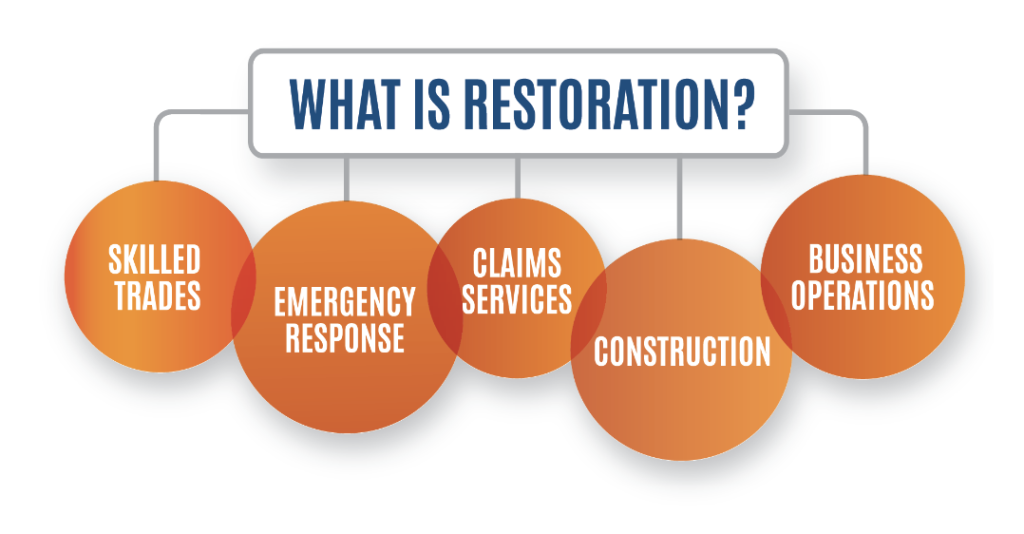
Part of the challenge is that the industry has never fully defined its professional identity. Restoration companies don’t just provide a wide range of services – water, fire, mold, and reconstruction – they also operate across multiple roles at once.
Are restorers tradespeople?
Emergency responders?
Construction professionals?
Claims vendors?
Business operators?
In practice, restoration companies often function as all these things at once. But when a profession lacks a clear definition of its role, expectations are often shaped externally – by systems, policies, and assumptions that may not fully reflect how the work actually occurs day-to-day.
This ambiguity has consequences. When emergency services are evaluated using frameworks designed for predictable construction projects or standardized service work, important elements of restoration – judgment, speed, urgency, and uncertainty – can be misunderstood or undervalued.
Complexity has also shaped the system around restoration. As the industry grew, different parts of the ecosystem evolved to support different aspects of the work.
How the Industry Became Fragmented
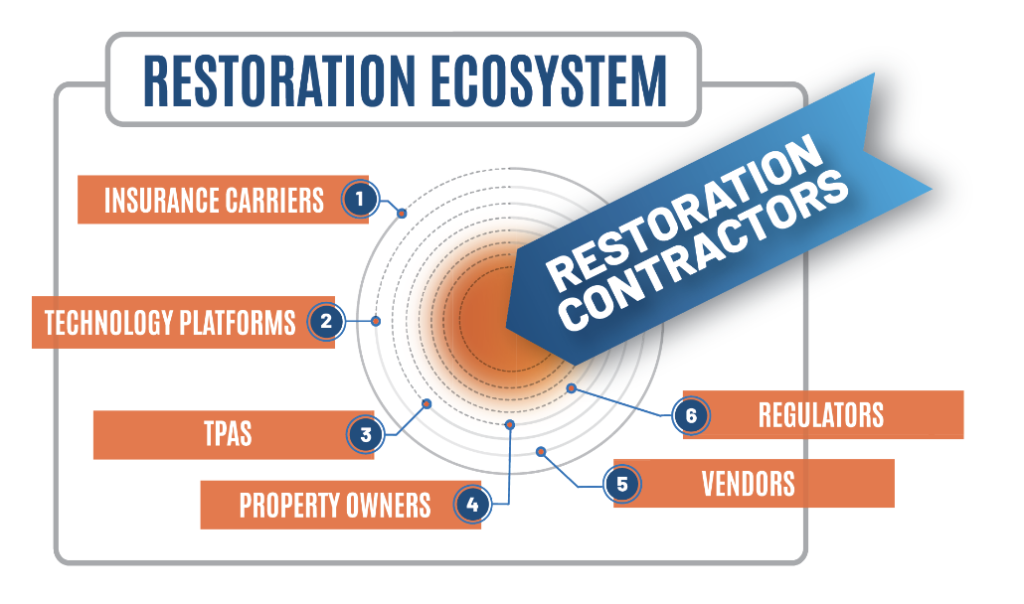 The restoration industry did not become complex overnight. As it grew, specialized roles emerged to solve real operational needs:
- Insurance carriers sought greater consistency and scale in claims handling.
- Third-party administrators (TPAs) developed systems to manage program networks and workflows.
- Vendors introduced technology platforms and products designed to improve efficiency and documentation.
- Contractors expanded geographically and operationally to meet growing demand.
Each of these developments made sense on its own, but collectively, they created silos. No single group designed this system – it evolved as different parts of the industry scaled in different ways. As a result, contractors now report increasing pressure from preferred-vendor networks and private-equity-backed national firms expanding into local markets.
Today, contractors are measured on performance metrics they do not fully control. Carriers are responsible for managing loss ratios and claim severity across massive portfolios. TPAs are tasked with enforcing consistency while balancing expectations from multiple stakeholders. Vendors serve all sides simultaneously, developing tools and services meant to support speed, compliance, and operational visibility.
None of these participants created the system alone, and none of them can fully control how it operates. The problem is not bad actors – it’s a system where everyone is solving a different problem.
When Narratives Replace Facts
Fragmentation has another consequence: it creates space for narratives to replace shared understanding.
- One group’s operational necessity becomes another group’s perceived excess.
- One party’s risk mitigation becomes another party’s administrative burden.
- One definition of efficiency becomes another definition of undervaluation.
When stakeholders operate from different assumptions about what restoration work entails, disagreements are almost inevitable. Scope decisions, pricing discussions, documentation requirements, and ethical expectations can all become sources of tension. In many water loss cases, mitigation must begin before a complete scope or estimate even exists, because delays can allow moisture and microbial growth to spread rapidly.
Without a common framework, disagreements are often resolved through leverage rather than principle. Over time, this dynamic erodes trust – not just between contractors and carriers, but across the entire ecosystem that supports restoration work.
The Pressures Are Real
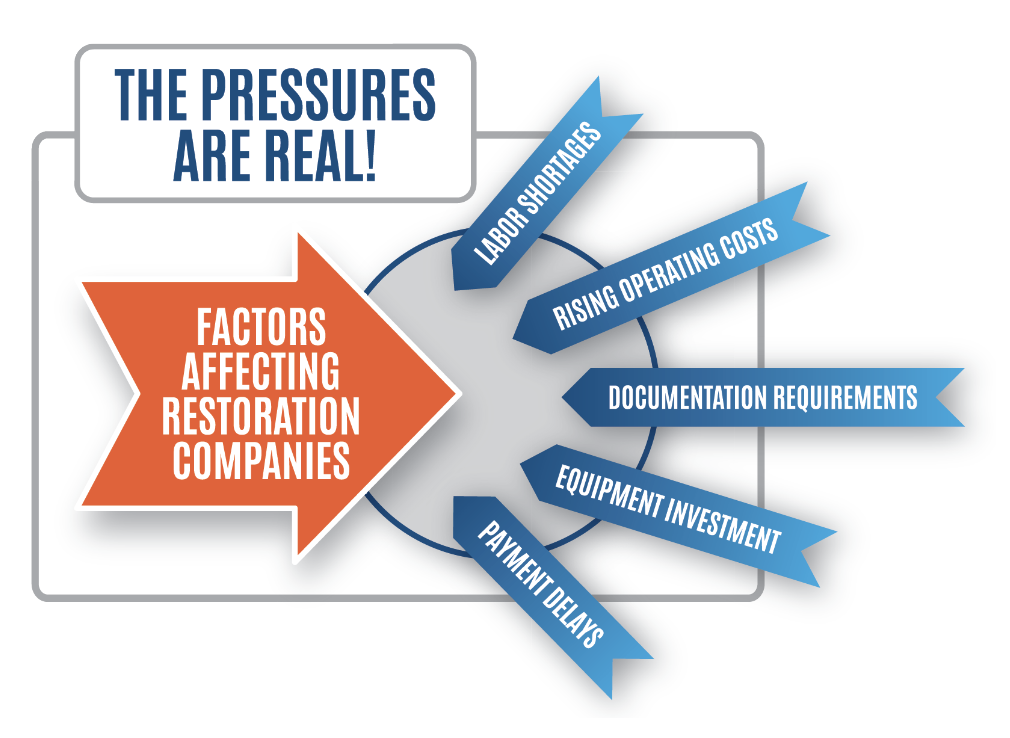 The pressures facing restoration companies are not theoretical. In fact, recent industry benchmarking data shows that restoration contractors across the country are grappling with a similar set of operational challenges:
- Recruiting and retaining skilled employees remains the most widely cited concern in the industry.
- Maintaining margins and managing cash flow continue to create significant strain.
- Payment delays, rising labor costs, equipment investments, and increased administrative requirements all affect financial stability – especially during periods when CAT events place additional demand on response capacity.
- Labor and material costs are rising while pricing platforms lag in showing real operating costs.
- Restoration is still physically demanding work that requires 24/7 availability and a high level of technical knowledge.
These realities shape how companies operate, grow, and invest in the future. Yet discussions about restoration often focus narrowly on pricing or compliance without fully accounting for the economic environment in which companies must function.
The Risk of Misclassification
At the heart of many industry tensions is a simple issue: restoration work is frequently evaluated using frameworks designed for other types of services. But emergency mitigation is not elective construction.
Restoration professionals often make critical decisions in the early hours of a loss, when conditions are still evolving, and complete information is not yet available. Stabilization efforts must begin quickly to prevent further damage, protect health and safety, and preserve property.
But systems built for predictable project environments often require certainty, documentation, and scope clarity before action can occur.
When emergency services are treated like standardized construction projects, or when professionalism is reduced to compliance checklists rather than judgment and leadership, the industry loses credibility and leverage. These frameworks do not reflect how restoration actually works.
A Structural Challenge, not a Personal One
It is easy to frame many industry tensions as conflicts between groups – contractors versus carriers, programs versus independents, technology providers versus field operators – but the deeper issue is structural.
Different stakeholders solving different problems, inconsistent enforcement, unclear professional standards, and limited industry advocacy have allowed others to define restoration, often without sufficient input from the professionals performing the work.
This does not mean the industry must eliminate competition or standardize every business model. In fact, restoration’s diversity of approaches has long been a key strength – but without alignment, it creates confusion.
A Different Way to Think About the Future
 The restoration industry does not need to become monolithic. It needs to become coherent. This does not mean every contractor operates the same way; it means the industry has a clearer understanding of its professional standards, economic realities, and operational responsibilities. It means defining restoration as the emergency service profession it has become and ensuring the systems surrounding it recognize that reality.
This conversation is already beginning across the industry. The question is not whether restoration will continue to evolve – it is whether the industry will define that evolution or allow others to do so.
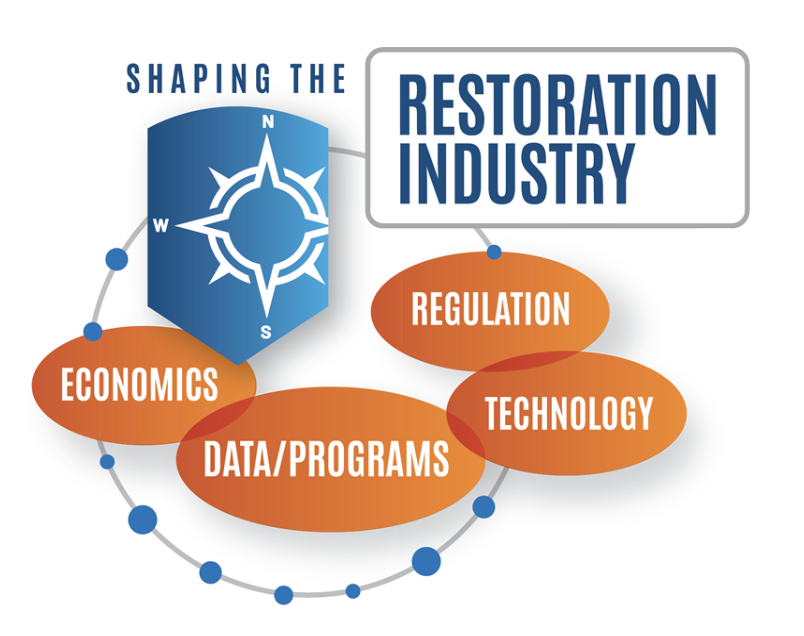
This series will explore that challenge from several angles, including economics, technology, leadership, and professional standards.
The future of restoration will not be determined by how quickly the industry reacts to change. It will be determined by how clearly it defines what restoration is – and what it should become.
Jeff Moore, CR, WLS, CMP, Triple Master (IICRC)

Jeff Moore is a second-generation restorer and the 2025 President of the Restoration Industry Association (RIA) as well as President of ATI Restoration. He started in the family business as a teenager, organizing the warehouse and working his way through nearly every role – from technician and estimator to executive leadership. Licensed in asbestos at 18, Jeff has managed major loss projects from 9/11 to today and brings hands-on insight into mitigation, construction, and large-loss operations. He lives in Phoenix, Arizona, with his wife, Tavia, and their four children – Tyler, London, Savannah, and Phoenix.
Related Posts