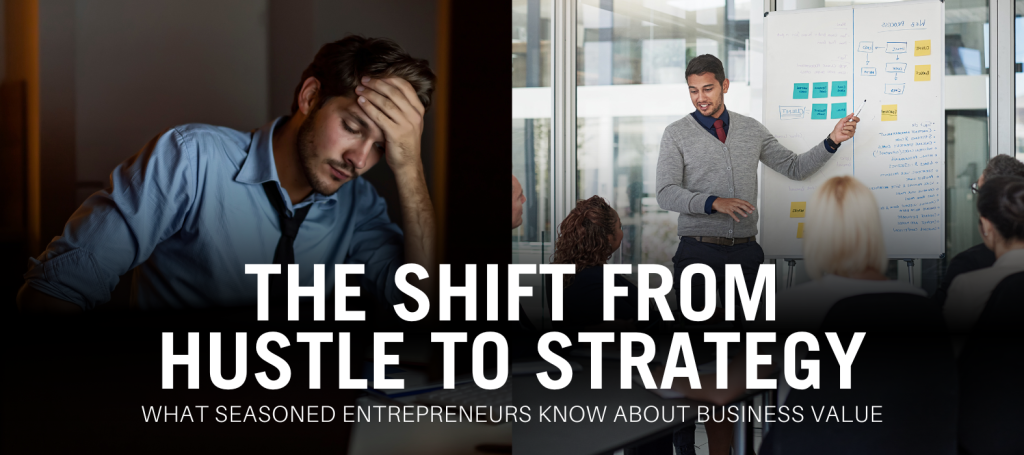
There’s a huge difference between first-generation business owners and those who’ve built, scaled, and exited multiple times. The gap? Mindset.
Most first-time entrepreneurs treat their business like an extension of themselves. Their identity is wrapped up in it, and they run on emotion, hustle, and sheer willpower. They ride the highs and lows, convinced that outworking everyone else is the key to success. But the truth is, while hard work matters, the best business owners don’t rely on grind alone. They play the long game, making strategic, unemotional decisions that drive enterprise value.
Hustle vs. Strategy: The Key Difference
First-gen entrepreneurs often struggle because they’re too emotionally attached to their business. They burn out, make reactive decisions, and get stuck because their self-worth is directly tied to how the business is performing.
Experienced entrepreneurs, on the other hand, treat business like an asset. They see it as a tool, not their identity. They focus on long-term value, make data-driven decisions, and constantly evaluate the strength of their earnings, leadership team, and operations.
Quality of Earnings: The Real Value Driver
Revenue is meaningless if it isn’t predictable and diversified. Buyers don’t just look at top-line numbers—they want to know where that money is coming from and how sustainable it is.
A $10M restoration company that gets $4M from a single job or $8M from just a few referral sources? That’s risky. The minute those relationships disappear, so does the revenue. On the other hand, a company that generates $10M across hundreds of customers, with no single source making up more than 5% of revenue, is far more valuable.
This is where culture and brand come into play. A strong culture leads to lower turnover, higher productivity, and consistency in operations. Companies with great cultures tend to have higher revenue per employee—often as much as $500K or $600K. Struggling businesses? They’re closer to $50K-$100K. Culture isn’t just a buzzword—it shows up in your financials.
Key Man Risk: Why It Can Kill a Deal
A business that’s too dependent on one key person—whether it’s the owner, a top salesperson, or an operations manager—is a ticking time bomb. If that person leaves, what happens?
Smart businesses solve this by spreading out knowledge and decision-making power. A simple test: Write down your 10 most important employees and rank them based on how hard they’d be to replace. If one of them walked tomorrow, how screwed would you be? Now, build a plan to cross-train, create redundancy, or offer equity to your top people to keep them engaged long-term.
The best way to lock in key players? Give them skin in the game. Many owners hesitate to share equity, but those who do it strategically see massive returns. Even a simple plan—giving 10% of the company over five years, with profit-sharing along the way—can make a massive impact. It reduces key man risk, boosts retention, and increases enterprise value. Buyers love businesses with stable, engaged leadership teams.
Balance Sheet vs. P&L Thinking
Most business owners are obsessed with their P&L—revenue, expenses, margins. But if you want to scale and build enterprise value, you need to think in terms of your balance sheet.
A P&L mindset is about keeping the lights on—making payroll, covering expenses, chasing monthly growth targets. A balance sheet mindset is about long-term value—branding, leadership development, diversifying revenue, and reducing dependency on key individuals. Owners who make this shift start asking better questions:
- What’s my business worth today?
- What will make it more valuable in five years?
- How do I remove myself from daily operations?
- Where can I reinvest profits for the highest return?
A lot of owners think real estate is the best investment, but often, it’s a poor use of capital. The best ROI usually comes from investing in talent, marketing, or acquisitions that drive exponential growth.
Scaling Without Working More
Here’s a paradox: The fastest-scaling companies often have owners who work less than those struggling to grow. Why? Because they’ve moved from “How do I do this?” to “Who can do this for me?”
Scaling isn’t about working harder—it’s about building systems and teams that operate without you. If your company can’t function without you, it’s not a business—it’s a high-paying job.
Final Thought: The Test of a Scalable Business
Want to know how scalable and valuable your business is? Ask yourself this: Could you take a three-month sabbatical—zero emails, zero calls—and come back to a business that’s still growing? If the answer is no, you’ve got work to do.
Enterprise value isn’t about revenue, hustle, or even profit—it’s about creating a business that can thrive without you. That’s what buyers want, and that’s what separates grinders from real entrepreneurs.
Hustle is a phase. Strategy is a method. How are you building your business?
If you’re looking to grow and scale your company or prepare for an exit, reach out to Chris and schedule time to talk shop. A Floodlight consultant might be the difference-maker that helps you build what you’re trying to build, faster. https://calendly.com/chrisnordyke/30min
If you’re ready to sell your company and want to maximize the value of what you’ve built, reach out to Gokul for a discovery chat: [email protected]
Chris Nordyke & Gokul Padmanabhan

Chris Nordyke is the co-Founder and President of Floodlight Consulting Group and Floodlight Sales Partners, and CSO at FP Restoration.. Chris speaks throughout the year at industry events, and conducts live workshops focused on commercial sales and ops, customer experience strategy and building enterprise value. He is also the co-Host of the Head Heart & Boots podcast, a popular restoration industry show. For more information on Floodlight’s fractional sales management solution, visit https://www.floodlightgrp.com/
 Gokul Padmanabhan is the owner and CEO of Restoration Brokers of America. With over 15 years specializing in the sale of restoration businesses, RBA builds relationships with straightforward advice and proven practices to maximize the selling price and exposure of a business to qualifed buyers. Gokul and his team leverage their experience to serve the industry by closing more sales than any group in the restoration industry.
Related Posts