Helping Cascadian Fruit Shippers Warehouse recover from smoke damage helps France and Company takes home the Phoenix Award for Innovation in Restoration
On the afternoon of March 28, 2016, France & Company was called in to respond to the Cascadian Fruit Shippers Warehouse in Wenatchee, Washington. The request involved pumping out water from a parking/loading area that was filling with water from the final stages of firefighting activities related to the adjoining building that had caught fire around 11 p.m. the night before. Shortly after arriving, the scene was cleared and the scope of work was expanded to include temporary fencing and ventilation of the remaining warehouse structure, as well as water extraction from the first floor. Over the course of the next two days, the scope of work further expanded to include the cleaning and deodorization of the entire facility, as well as exterior debris removal and temporary repairs.
The Cascadian Fruit Shippers Warehouse is a historic cold storage facility of heavy-timber post and beam construction with a poured concrete exterior shell and central support structure. Built during the 1920s and 1930s, at one time it was the world’s largest apple cold storage facility with a total cold storage area of over 110,000 square feet spread over its three main levels.
Due to the cleaning and deodorization process used, they were able to avoid applying any sealant to all but approximately 100 square feet of the affected exposed lumber in the structure. This not only protected the historical value of the building, but also maintained the salvage value of the lumber should the building eventually become repurposed or demolished.
At the time of the incident, the majority of the facility was leased to Tree Top, a global supplier of top-quality fruit products, who used the space to store their inventory of high-value finished goods, including over one million pounds of assorted dried-apple products. The adjoining 17,000-square-foot structure, which was destroyed by the fire, housed bulk packaging materials for Tree Top.
On the evening of March 27, at 11:04 p.m., a 911 call came in about a fire at the facility. The primary effort of firefighters was to prevent the main facility from catching fire, with firefighting efforts continuing into the afternoon the following day due to a gas line being present that had no shut-off. While the number of penetrations into the primary warehouse was small, the extended timeframe of the fire itself resulted in moderate smoke damage in the interior of the warehouse.
The interior of the warehouse is constructed primarily of lumber, with the majority of walls and ceilings being exposed to unfinished wood. The floor system for the third and fourth floors was constructed with wood floor joists below the original two layers of diagonal slats and a newer layer of three-fourth-inch slip-resistant plywood material as the finished floor. The first and third floors are cooled with a central ammonia-based refrigerant system with an elaborate wooden ducting system, and the fourth floor is cooled with independent cooling units.
SCOPE AND STRATEGY
The entirety of the interior space that was affected by the smoke had damage directly proportional to the proximity of the penetrations near the fire. This led to a varying scope of work on a room-by-room basis.
The directive that France and Co. received for the interior was to clean and deodorize the structure to allow the tenant to reoccupy the space with new products off their production line. This could only begin after the existing product within the facility was addressed, due to both known-damaged and known-good products existing in the building. In order to maintain its high level of quality control, Tree Top undertook an extensive and lengthy sampling/testing operation to determine what product could be re-packaged to continue to meet its clients’ needs for premium fruit products.
This process took approximately six months and led to a situation in which a long-term deodorization strategy was necessary. France and Co.’s strategy needed to ensure not only that any odor attributed to the structures’ contamination would not further contaminate the tenants’ product, but also that the tenants’ contaminated product was not further affecting the structure prior to the product being disposed or repackaged.
The exterior scope of work included removal of the debris pile with subsequent asbestos and lead abatement, cleaning the exterior wall, cleaning a tunnel that connected to the burnt structure and runs the full length of the warehouse, as well as temporary repairs consisting of painting and other weatherproofing measures.
UNCOVERING THE HIDDEN VALUE
This project presented numerous challenges to overcome, including a long list of traditional challenges that would be expected in such a scenario. This list included Co. was restricted from using any chemical products that could affect the product or its packaging in any way. After exhausting all other options the decision was made to utilize hydroxyl generators, and 100 units were installed in conjunction with air scrubbers and additional air movers to aid in circulation. After seven days, the odor was reasonably under control and 80 of the hydroxyl generators were removed; the remainder continued in operation with the air scrubbers and circulation fans for the duration of the project.
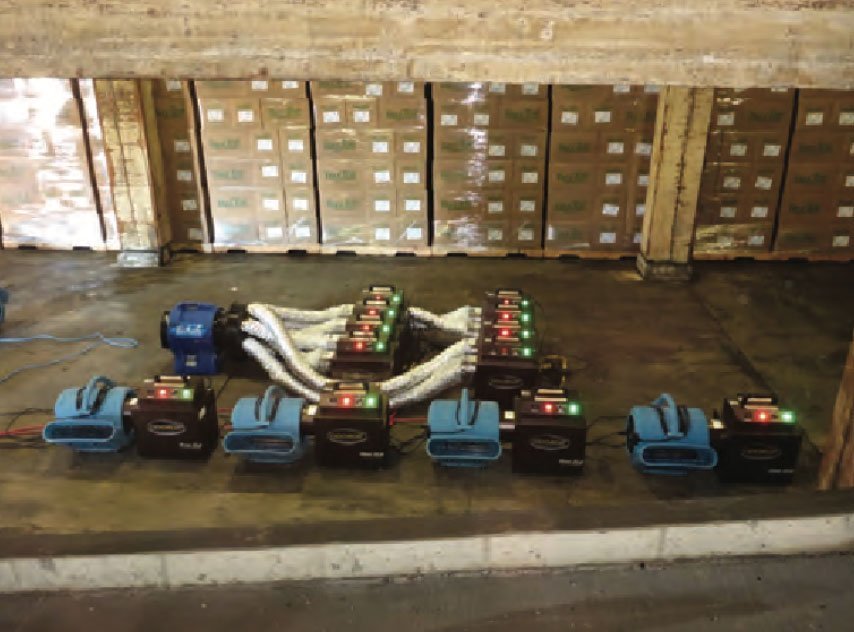
Given the limited power available in the space, the company was unable to wire in as many power distribution boxes as needed. In order to minimize power consumption, they were able to utilize 1HP axial air movers with Injectidry Adaptidry ducting adapters to run eight units with one air mover (Photo 1). This provided a small equipment saving, but more importantly, it minimized the overall power needs by approximately 25 percent and prevented what would have been a costly endeavor to run temporary feedback to the electrical room for what was only a short-term spike in demand.
The largest technical challenge faced was how to completely clean and deodorize more than 75,000 square feet of various plywood products that represented the finished floor on the third and fourth floors. The majority of this being a plywood product in which a trading name has yet to be identified, but has a traditional plywood construction with the finished surface being a one-eighth-inch layer of wood fiber with a binding agent with a textured surface, similar to high-density fiberboard; it appears this product is an early version of anti-slip plywood.
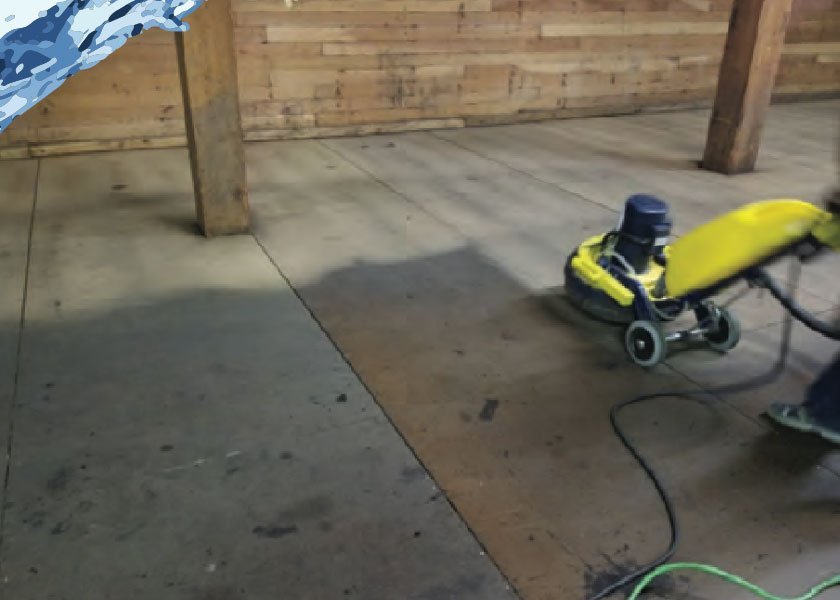
After consulting with numerous industry experts, equipment manufactures and distributors, France and Co. were not able to yield any positive directions, as most recommendations involved either sanding or wet cleaning, neither of which was possible given the overall conditions present. After some primary experimentation with a Cimex machine and grit-impregnated Tynex brushes showed promise, they quickly came to the realization that this product in many ways could be compared to natural fiber carpeting and that low-moisture carpet cleaning principles may work. With that in mind, France and Co. proceeded to “double down” on its testing and were able to determine a four-step cleaning protocol that yielded spectacular results.
The initial step in this process was to accomplish dry soil removal by utilizing a high RPM Cimex “Diamond Finisher” machine with the grit-impregnated brushes. The Cimex machine allows variable weight to be installed, which allowed for the most efficient combination of productivity versus brush wear. Its counter-rotating planetary gear system with the brushes allowed a very thorough scrubbing action to occur with the loosened material captured via a HEPA vacuum. However, even after this cleaning, the visible residue was leftover with most of it being bound to the surface. Upon testing numerous low-moisture carpet cleaning products, the company was able to select a product with a hydrogen peroxide component and was able to boost the peroxide power of the solution in order to provide maximum deodorization value to the process. This type of cleaning product works by suspending soils into solution and then binding them to polymers; when the solution dries, the crystalized structure is then easily removed via agitation and vacuuming. This cleaning solution was applied with a low-pressure sprayer and then agitated with a traditional Cimex Carpet Machine also utilizing the abrasive brushes.
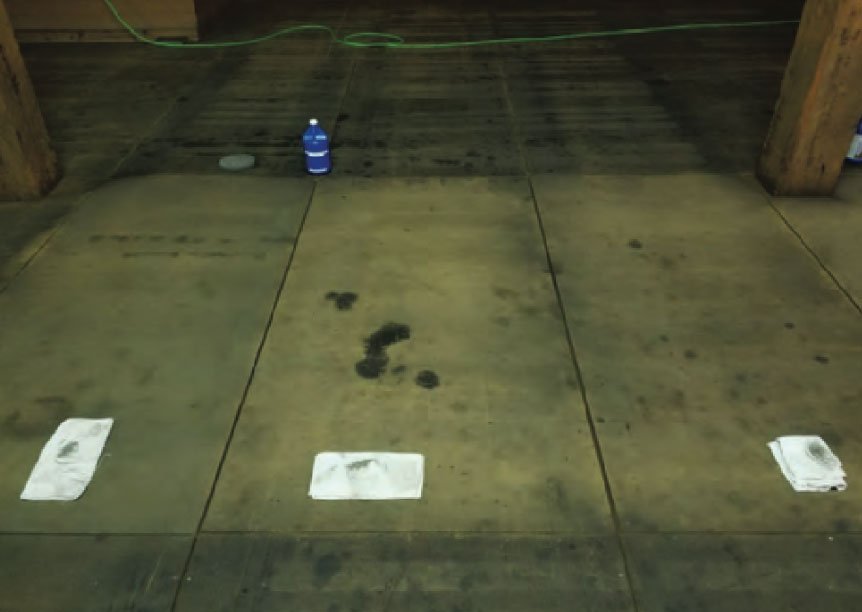
The next step involved another dry pass with the Cimex “Diamond Finisher” machine to scrub off the polymer-bound soils, which resulted in a visually clean surface that had no detectable odor present (Photos 2 and 3). The final step was to manually remove the debris between the variable gaps between all of the sheets as well as a final HEPA vacuuming. This cleaning process enabled the entirety of the plywood floor to be salvaged, resulting in savings in excess of $100,000 compared to the replacement cost with the modern equivalent material. Portions of this cleaning process have also proved highly successful on other projects where the abrasive cleaning of plywood and OSB subfloors is necessary.
The largest technical challenge faced was how to completely clean and deodorize more than 75,000 square feet of various plywood products that represented the finished floor on the third and fourth floors
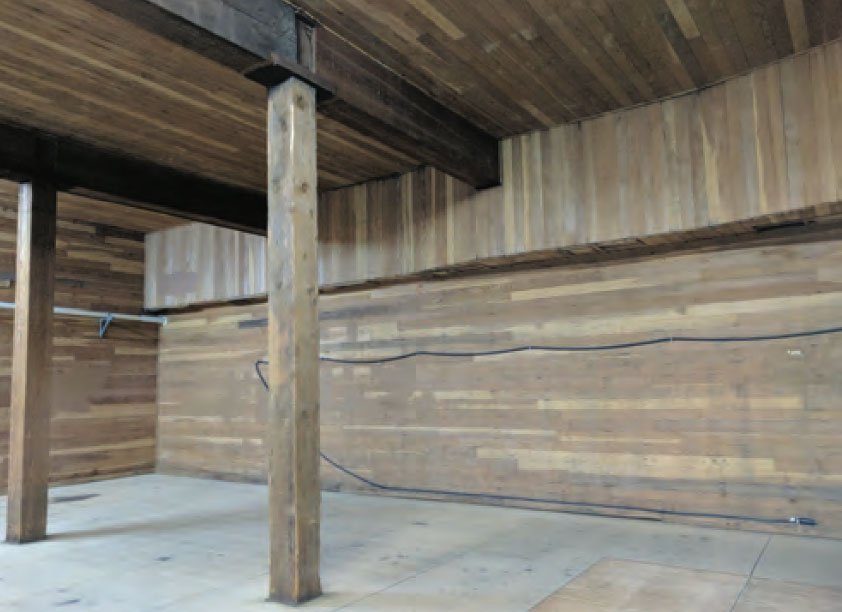
Typical View of Wood Materials Present
For France and Co., perhaps the most valuable result of the process was one that cannot easily be quantified. Due to the cleaning and deodorization processes used, they were able to avoid applying any sealant to all but approximately 100 square feet of the affected exposed lumber in the structure. This not only protected the historical value of the building but also maintained the salvage value of the lumber should the building eventually become repurposed or demolished.
During the duct-cleaning phase, France & Co. was also able to identify hidden damage to the extraordinary wooden ducting system that had prevented adequate cooling to be provided to the third floor. At the time of the loss, the third floor was conditioned by proxy between the first and fourth floors.
With approximately $7,000 in costs outside the insurance claim, France and Co. were able to not only re-establish airflow to the third floor but also optimize the entire system to deliver more conditioned air to the rooms with the most need. The ducting system itself for the first and third floors encompasses over 10,000 square feet of supply and return plenums, and includes thousands of linear feet of supply and return runs throughout the floor joist system between the floors.
After a successful final walkthrough, the facility was turned back over to Tree Top on Jan. 17, 2017.
FRESH FROM AUSTIN:
ACCEPTANCE SPEECH
GIVEN BY ROMAN RENDERFRANCE, CR, WLS, FRANCE & COMPANY WENATCHEE WASH.
“Good evening everyone.
It is a tremendous honor to be able to accept this award on behalf of France & Company.
I’d like to thank the Phoenix Award selection committee and the RIA for offering this award to the restoration industry.
We could not have had this success without our amazing staff that continually produced excellent work through tough working conditions on this project.
This project provided a constant stream of challenges for us to overcome.
Our company problem-solving skills are fundamentally supported by our emphasis on obtaining high-level education from within the industry, such as RIA’s advanced certifications.
Coupled with support from a number of industry experts and specialty suppliers, we were able to overcome all of these challenges.
We would like to express our gratitude to those individuals, many of whom are in the room this evening.
Thanks again to the RIA and everyone responsible for this award!”
“Our staff deserves a lot of credit for making this project a success. Most worked for weeks on end in a cold, poorly lit environment doing fairly monotonous work; being able to keep up our high standards in those conditions cannot be overlooked. Our client and building manager were also a pleasure to work with; both are straight shooters that address questions and concerns as they occur, which limited the potential for larger issues to build up. Keeping communication open was vital for a project as dynamic as this was in the beginning,” says Roman Renderfrance, CR, WLS, Emergency Services Manager, France & Co.RIA
Related Posts